Have Any Question?
 +44 7452 122728




 Back
Back




What is EBITDA: Meaning, Formula, Examples, and Use Cases
EBITDA is a financial metric that measures a company's operating performance by excluding interest, taxes, depreciation and amortisation from earnings. It helps businesses, investors and analysts evaluate operational profitability, compare financial performance and assess a company's ability to generate earnings from business activities.
Table Of Contents


 44 7452 122728
 26-Feb-2026
Author-Veronica Davis
Ever wondered how investors quickly judge whether a business is truly profitable or just looks successful on paper? Financial statements can be complex, but some metrics cut straight to the heart of performance. One of the most widely used measures is EBITDA. It reveals how efficiently a company runs its core operations by removing the effects of financing and accounting adjustments.
That is why understanding EBITDA can change how you evaluate business performance. It helps compare companies, identify growth potential, and make informed decisions. This blog explains what it means, how it is calculated, and why it matters. So read on and boost your organisation’s profitability!
What is EBITDA?
EBITDA stands for Earnings Before Interest, Taxes, Depreciation, and Amortisation. It is a financial measure used to understand how profitable a company is from its core business operations. Focusing on operating performance, it shows how efficiently a business generates earnings from its main activities.
This metric excludes financing costs, tax environments, and non-cash accounting expenses such as depreciation and amortisation. By removing these factors, EBITDA provides a clearer view of operational performance and makes it easier to compare companies across different industries and financial structures.

History of EBITDA
Here's a brief history of EBITDA:
1) In the 1970s, EBITDA was introduced by John Malone, Chairman of Liberty Media, to demonstrate the earning potential of highly leveraged cable businesses.
2) Malone used EBITDA to support a growth strategy based on debt financing and reinvesting profits while reducing tax liabilities.
3) In the 1980s, EBITDA became widely used in Leveraged Buyouts (LBOs) to assess whether acquired companies could generate enough earnings to service acquisition debt.
4) Investors excluded interest and tax expenses because these could change after an acquisition due to a new capital structure and tax obligations.
5) Depreciation and amortisation were also excluded because they are non-cash expenses that do not immediately affect a company's ability to repay debt.
6) LBO investors commonly used the EBITDA-to-interest coverage ratio to measure a company's ability to meet interest payments.
7) During the dot-com bubble in the late 1990s and early 2000s, some companies used EBITDA to present an overly optimistic view of their financial performance.
8) In 2018, EBITDA received renewed criticism when WeWork introduced its "Community Adjusted EBITDA," which excluded additional operating expenses such as general and administrative, sales, and marketing costs, raising concerns about the misuse of the adjusted financial metric.
Formula for EBITDA
The EBITDA formula explains how operating profitability is measured by excluding financing costs, taxes, and non-cash expenses. This gives a clearer view of core business performance. There are two main formulas for EBITDA:
1) Net Income-based Formula (Most Common)

2) Operating Income-based Formula (Simpler Approach)

How to Calculate EBITDA?
Calculating EBITDA is straightforward once you have the required figures from a company's financial statements. You can start with either Net Income or Operating Profit (EBIT) and add back specific expenses that are excluded from the metric.
1) Start with Net Income (profit after all expenses) or Operating Profit (EBIT)
2) Add back Interest Expense to remove the impact of financing decisions
3) Add back Tax Expense to exclude differences in tax obligations
4) Add back Depreciation to remove non-cash charges related to tangible assets
5) Add back Amortisation to exclude non-cash charges related to intangible assets
The resulting figure is the company's EBITDA, which reflects its operating profitability before interest, taxes, depreciation, and amortisation are considered.
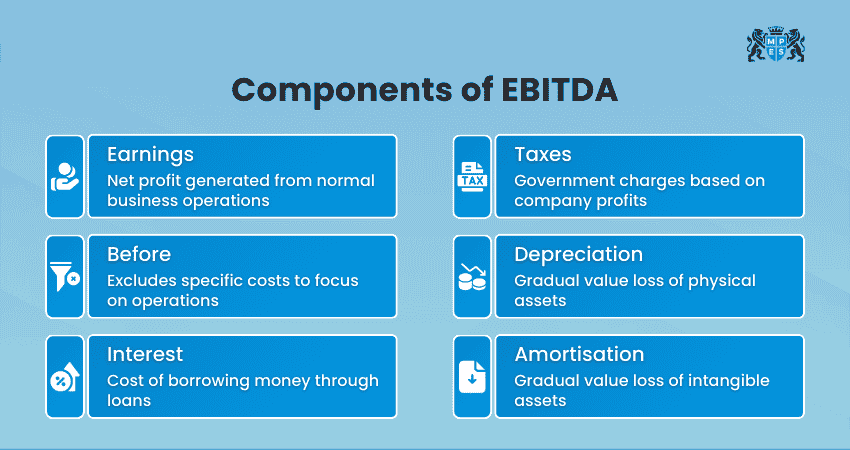
To understand this better, let’s break down each component of EBITDA:
1) Earnings
Earnings usually refer to net profit, which is total revenue minus legitimate business expenses. It reflects the income a company generates from its normal operations before adjustments are made for non-operating or non-cash items.
2) Interest
Interest represents the cost of borrowing money, such as loans or debt repayments. It is added back because financing structures differ between companies, and these costs do not directly reflect operational efficiency or performance.
3) Taxes
Taxes are payments made to governments based on profits. Since tax rates vary by country, regulation, and timing, they are added back to ensure EBITDA reflects operating performance rather than tax policies or obligations.
4) Depreciation
Depreciation is the gradual decline in the value of physical assets such as machinery, buildings, or vehicles over time. It is a non-cash accounting expense, so it is added back to show true operating earnings.
5) Amortisation
Amortisation is the gradual reduction in value of intangible assets such as patents, licences, or copyrights. Like depreciation, it is a non-cash expense, so it is added back to reflect actual operating performance more clearly.
Formula for EBITDA Margin
EBITDA margin measures how much of a company's revenue is converted into operating earnings before interest, taxes, depreciation, and amortisation are deducted. It is expressed as a percentage and helps assess how efficiently a business generates profit from its core operations.

Where:
1) EBITDA: Earnings Before Interest, Taxes, Depreciation, and Amortisation
2) Revenue: Total income generated from the sale of goods or services
A higher EBITDA margin generally indicates stronger operational efficiency and better profitability from core business activities. Conversely, a lower EBITDA margin may suggest higher operating costs or lower profit generation relative to revenue.
Who Uses EBITDA?
EBITDA is prominently used by investors, Financial Analysts, business owners, entrepreneurs, Investment Bankers and Mergers and Acquisitions (M&A) Advisors:
1) Investors and Financial Analysts
Investors and Financial Analysts use EBITDA to evaluate a company's core operating performance without the impact of financing decisions, taxes, or non-cash expenses. It helps compare businesses across the same industry and assess profitability.
2) Business Owners and Entrepreneurs
Business owners and entrepreneurs use EBITDA to measure operational performance, monitor profitability, and identify opportunities to improve efficiency. It also helps determine business value, prepare for fundraising or a sale, and make informed strategic and financial decisions.
3) Investment Bankers and M&A Advisors
Investment Bankers and M&A Advisors rely on EBITDA to value businesses, compare acquisition targets, and structure Merger and Acquisition (M&A) deals. It provides a standardised measure of operating earnings, thus making it easier to estimate enterprise value and negotiate transaction prices.
4) Lenders and Credit Analysts
Lenders and Credit Analysts use EBITDA to assess whether a company generates sufficient operating earnings to repay loans and meet interest obligations. They often analyse EBITDA alongside debt ratios, such as the EBITDA-to-interest coverage ratio, when evaluating creditworthiness and lending risk.
Learn how effective tax planning can strengthen business performance and maximise opportunities in our Business Planning Tax (BPT) Course - Sign up now!

EBITDA Use Cases
EBITDA helps analyse business performance, attract investors, and support strategic decisions by showing how efficiently core activities generate earnings. Once calculated, it can be used in several key ways, including the following:
1) Build More Reliable Financial Models:
It provides a solid base and starting point for cash flow forecasts, helping businesses create more accurate financial projections and performance models.
2) Assess Business Value for Sale:
EBITDA helps clearly present profitability and financial strength to potential buyers during mergers, acquisitions, or business sales.
3) Attract and Inform Investors:
Investors rely on EBITDA to compare companies within the same industry using a consistent measure of performance.
4) Measure Operational Efficiency:
By isolating core activities, EBITDA helps evaluate how effectively the business operates without external financial influences.
5) Benchmark Against Competitors:
Companies use EBITDA to compare performance with industry standards and assess their competitive position.
6) Support Strategic Decision-making:
Understanding operating performance helps guide expansion plans, budgeting, cost management, and long-term business strategy.
What are the Advantages of Using EBITDA?
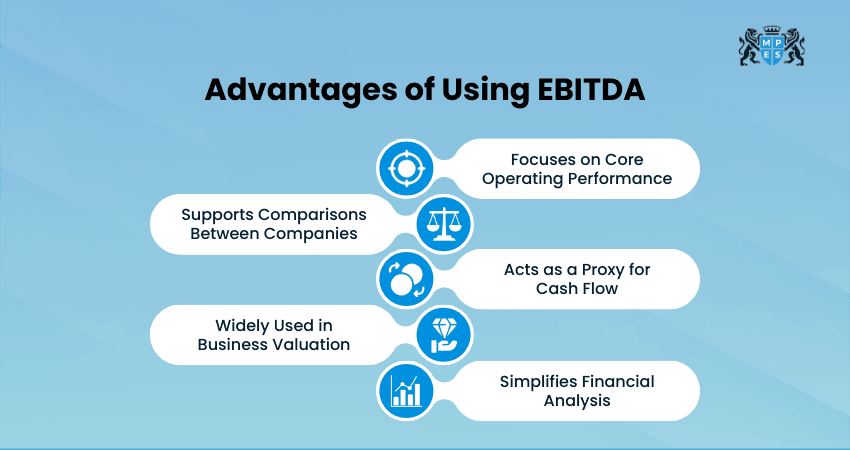
EBITDA is widely used because it provides a clear and simplified view of operating performance by focusing on core profitability and removing external financial factors. Below are the main advantages of using EBITDA:
1) Focuses on Core Operating Performance:
By excluding non-cash expenses like depreciation and amortisation, as well as interest and taxes, EBITDA highlights how profitable a company’s main business activities are.
2) Supports Comparisons Between Companies:
It allows fair comparisons between companies in the same industry, even if they have different debt levels, financing structures, or tax environments.
3) Acts as a Proxy for Cash Flow:
Although not a true cash flow measure, EBITDA provides a quick indication of a company’s ability to generate cash from operations to meet financial obligations.
4) Widely Used in Business Valuation:
EBITDA plays a key role in valuation metrics, especially Enterprise Value (EV)/EBITDA, which is commonly used in mergers, acquisitions, and Investment Analysis.
5) Simplifies Financial Analysis:
It is relatively easy to calculate from financial statements, making it a practical and efficient tool for assessing Financial Performance .
Build expertise in investment appraisal, funding strategies, and financial Performance Analysis through the
Financial Management (FM) Training
– Join now!
What are the Disadvantages of Using EBITDA?
While EBITDA helps assess operating performance, it can present an overly positive view of financial health by excluding key costs. Below are the main disadvantages of using EBITDA:
1) Ignores Capital Expenditure (CapEx):
EBITDA excludes spending needed to maintain or replace assets. In capital-intensive industries, companies may appear profitable even when large reinvestments are required to sustain operations.
2) Excludes Debt and Tax Obligations:
By removing interest and taxes, EBITDA does not show the full financial burden of borrowing or Taxation . This can make heavily indebted businesses seem stronger than they actually are.
3) Does not Represent Actual Cash Flow:
EBITDA is not a true measure of cash flow because it ignores changes in working capital, such as inventory or receivables, which directly affect available cash for Capital Expenditure .
4) Potential for Manipulation and Red Flags:
EBITDA is a non-GAAP financial metric, meaning there is no single standard for calculating adjusted EBITDA. EBITDA can overstate profitability and make comparisons between companies less reliable.
5) Expert Warnings:
Many financial experts caution against relying on EBITDA as a standalone measure of performance. Most analysts recommend using EBITDA alongside other financial metrics, such as operating cash flow, free cash flow, EBIT, and net income.
EBITDA vs Related Metrics
Now to further your understanding of EBITDA, let’s explore the key differences between EBITDA, EBT, EBIT and operating cash flow:
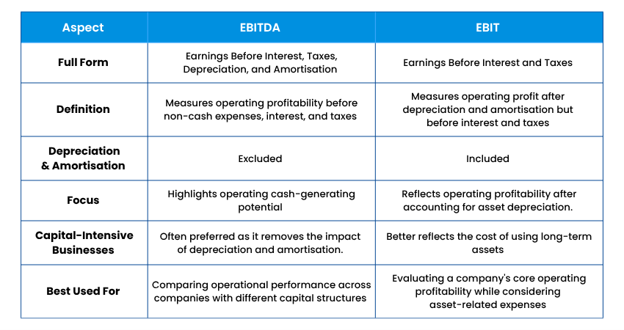
1) Difference Between EBITDA and EBIT
Here are the key differences between EBITDA and EBIT:
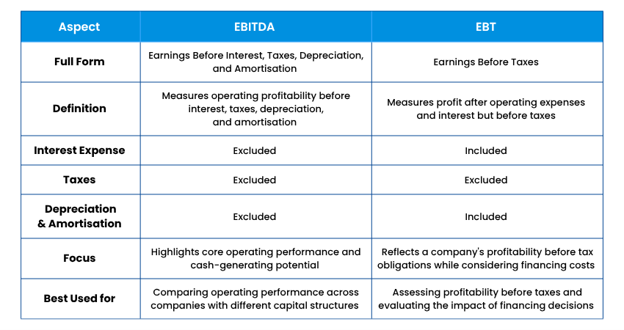
2) Difference Between EBITDA and EBT
Here are the key distinctions between EBITDA and EBT:
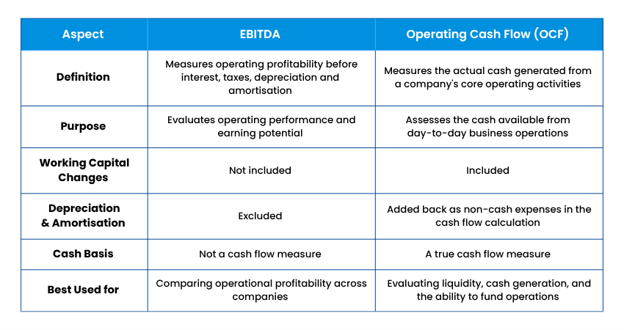
3) Difference Between EBITDA and Operating Cash Flow
Here are the key differences between EBITDA and Operating Cash Flow:
Example of EBITDA
The following example shows how the EBITDA formula works in practice using real financial figures:
Company Financial Data:
a) Revenue: £500,000
b) Operating Expenses: £300,000
c) Depreciation: £20,000
d) Amortisation: £10,000
e) Interest Expense: £15,000
f) Taxes: £25,000
Step 1: Calculate Net Profit: Net Profit = Revenue − Expenses − Depreciation − Amortisation − Interest − Taxes
Net Profit = £500,000 − £300,000 − £20,000 − £10,000 − £15,000 − £25,000 = £130,000
Step 2: Add Back Excluded Items:
EBITDA = Net Profit + Interest + Taxes + Depreciation + Amortisation
EBITDA = £130,000 + £15,000 + £25,000 + £20,000 + £10,000 = £200,000
Final EBITDA:
The company’s EBITDA is £200,000, showing its operating profitability before financing costs, taxes, and non-cash expenses.
Conclusion
Understanding financial performance becomes clearer when you focus on what truly drives business operations. EBITDA helps reveal operational efficiency by removing financing costs, tax effects, and non-cash accounting expenses. When used alongside other financial metrics, it offers valuable insight for comparing companies, assessing profitability, and making more informed business or investment decisions.
Gain advanced financial expertise and prepare for high-impact leadership roles in modern accounting through the ACA Advanced Level Training – Join now!
Frequently Asked Questions
Q. What is a Good EBITDA Ratio?
A good EBITDA margin is usually 10% or higher, with 15%+ considered strong, depending on the industry. An EV/EBITDA ratio below 10x may indicate a company is undervalued. Higher margins show better efficiency, while lower multiples can signal potential acquisition opportunities.
Q. What is the Rule of 40 EBITDA?
The Rule of 40 is a performance measure often used for high-growth companies, especially SaaS businesses. It combines revenue growth rate and EBITDA margin, and the total should be 40% or more. This shows the company balances growth and profitability well, indicating strong financial health and sustainable long-term performance.
Q. Is EBITDA the Same as Gross Profit?
No, they are not the same. Gross profit measures profitability after direct production costs, focusing on product-level efficiency and viability. EBITDA measures overall operating performance by removing non-operating expenses and financing effects, reflecting the broader financial health of the entire business.
Q. What is the Debt to EBITDA Ratio?
This is a financial leverage metric that compares a company's total debt to its EBITDA to assess its ability to service debt with operating earnings. A lower ratio generally indicates stronger financial health and lower credit risk, while a higher ratio may suggest greater financial leverage and repayment risk.
Q. What is Adjusted EBITDA?
Adjusted EBITDA is a variation of EBITDA that excludes one-time, non-recurring, or non-operating items, such as restructuring costs, legal settlements, acquisition expenses or stock-based compensation. It aims to present a clearer view of a company's underlying operating performance.