Have Any Question?
 +44 7452 122728




 Back
Back




How to Become an Accountant: Types, Education & Career Path
An Accountant is a professional who records, analyses, and reports financial information. To become an Accountant, you need to earn a degree in accounting or finance, obtain relevant certifications and gain practical experience in accounting roles. Accountants prepare financial statements, manage budgets, and support decision-making.
Table Of Contents


 44 7452 122728
 11-Feb-2026
Author-David Walter
Every successful business needs someone who understands money, controls risk, and keeps finances organised. They play a crucial role in ensuring the company remains profitable and financially stable. Those professionals are called Accountants. They track your income and expenses and monitor budgets. For anyone interested in pursuing this career, understanding How to Become an Accountant is the next step.
With the right support and planning, building a career in accounting is achievable. In this blog, we’ll explore How to Become an Accountant, what they do, and the different types of accounting careers available. Let's dive in!
What is an Accountant?
An Accountant is a finance professional responsible for managing financial records, ensuring compliance with regulations, and helping individuals and organisations make informed financial decisions. They keep track of your money, record income and expenses, organise financial data, and make sure everything is accurate and properly documented.
Accountants prepare reports such as balance sheets and income statements to show whether a business is profitable or operating at a loss. These reports help business owners and managers plan budgets, control spending, and set future goals. By analysing this information, Accountants support smarter planning and long-term financial stability.

What Does an Accountant Do?
An Accountant handles a wide range of responsibilities that help businesses and individuals manage money effectively. Their work ensures financial accuracy, compliance, and stability within an organisation. Here are some of the key responsibilities of an Accountant:
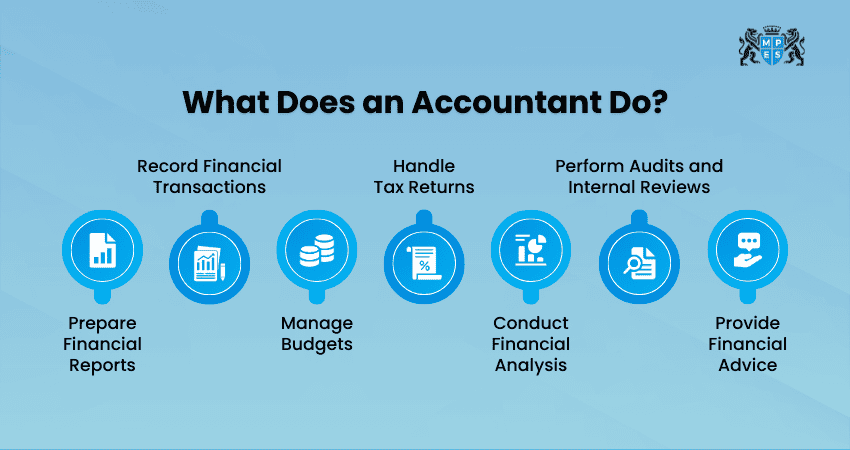
1) Prepare Financial Reports: Accountants prepare reports like balance sheets and income statements. These reports show how much money a business earns, spends, and saves.
2) Record Financial Transactions: T hey record everyday financial activities such as sales, payments, and expenses. This helps keep financial records organised and accurate.
3) Manage Budgets: Accountants help businesses plan how much money they can spend. They also check if the company is spending more or less than what was planned.
4) Handle Tax Returns: They prepare tax returns and make sure the business follows tax rules. This helps avoid fines and legal problems.
5) Conduct Financial Analysis: Accountants analyse financial data to identify trends, risks, and opportunities. Their insights help management make informed business decisions.
6) Perform Audits and Internal Reviews: They examine financial records to check for errors, fraud, or non-compliance. This strengthens internal controls and improves transparency.
7) Provide Financial Advice: Accountants guide business owners on saving money, increasing profits, reducing costs, and planning for future growth.
Types of Accountants
Accountants work across various specialisations. Below are the most common types:
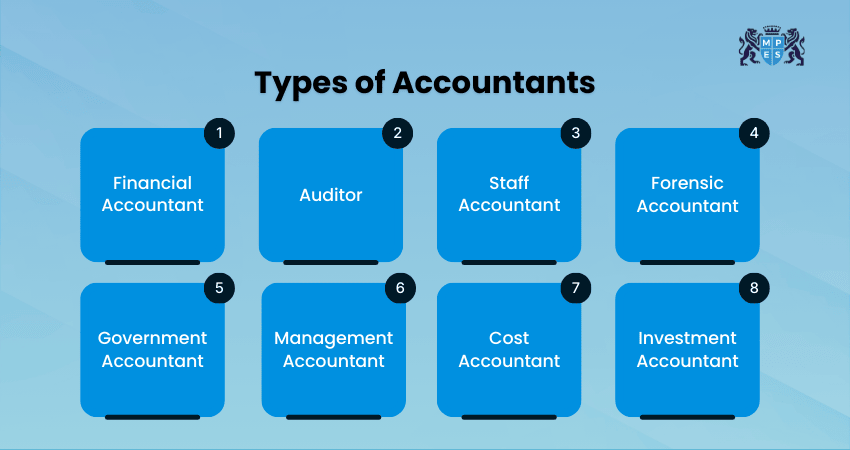
1) Financial Accountant
A Financial Accountant focuses on preparing and presenting financial reports for external stakeholders such as investors, creditors, and regulatory authorities. They prepare key financial statements such as the balance sheet, income statement, and cash flow statement, which help stakeholders understand the company’s financial health.
Key Roles and Responsibilities:
1) Prepare annual and quarterly reports
2) Record and organise financial data
3) Check and reconcile account balances
4) Work closely with external auditors
2) Auditor
An Auditor independently examines an organisation’s financial statements, accounting records, and internal financial systems. They check if the financial information is accurate, complete, and compliant with laws and accounting standards. They also provide financial advice to help improve processes and strengthen financial systems.
Key Roles and Responsibilities:
1) Review financial records for accuracy
2) Identify financial risks and issues
3) Prepare audit reports and findings
4) Ensure compliance with regulations
3) Staff Accountant
A Staff Accountant handles basic accounting tasks within a company. They manage journal entries, reconciliations, and maintain financial records. This is usually an entry-level position, and it provides exposure to different aspects of accounting. Over time, this role helps build strong technical skills and prepares individuals for advanced accounting positions.
Key Roles and Responsibilities:
1) Record daily financial activities
2) Support senior Accountants with tasks
3) Assist with monthly closing tasks
4) Keep financial documents organised
4) Forensic Accountant
A Forensic Accountant investigates financial crimes such as fraud, embezzlement, or money laundering. They carefully analyse financial data to detect unusual patterns or suspicious activities. Their work often supports legal proceedings, and they may be required to present findings in court.
Key Roles and Responsibilities:
1) Investigate suspected financial fraud cases
2) Analyse complex financial transactions
3) Gather and document financial evidence
4) Prepare reports for legal proceedings
5) Government Accountant
Government Accountants specifically manage public funds and ensure that government agencies use taxpayer money responsibly. They may work in local councils, state, or national departments. Their role focuses on budgeting, compliance, and financial accountability. Their work helps maintain public trust and ensures that government programmes operate efficiently.
Key Roles and Responsibilities:
1) Prepare and manage public budgets
2) Monitor government spending activities
3) Maintain accurate financial records
4) Report financial data to authorities
6) Management Accountant
Management Accountants focus on internal financial planning and decision-making. They provide insights that help managers plan budgets, control costs, and evaluate performance. Unlike Financial Accountants, Management Accountants primarily serve internal stakeholders. They analyse data, prepare forecasts, and support strategic initiatives.
Key Roles and Responsibilities:
1) Prepare internal financial reports
2) Identify and suggest areas for cost control
3) Support business planning activities
4) Track internal department financial performance
Make financial data meaningful and actionable with Management Information (MI) Training – Register today!
7) Cost Accountant
A Cost Accountant specifically focuses on analysing production and operational costs. They help businesses understand where money is being spent and identify ways to reduce expenses. They calculate the cost of manufacturing products or delivering services to determine accurate pricing. Their analysis supports better profit planning and improves overall efficiency.
Key Roles and Responsibilities:
1) Analyse production and overhead expenses
2) Identify cost-saving opportunities
3) Monitor inventory and material usage
4) Prepare detailed cost analysis reports
8) Investment Accountant
An Investment Accountant is a finance specialist who tracks, reviews, and reports on investment portfolios for organisations. They monitor portfolio performance and provide accurate financial information that supports investment decisions. They also work closely with Portfolio Managers and financial teams to maintain transparency and accuracy in reporting.
Key Roles and Responsibilities:
1) Prepare portfolio valuation reports
2) Calculate accurate gains and losses
3) Support portfolio performance analysis
4) Monitor changes in asset values
Understand how taxation shapes business decisions with the Principles of Taxation (PTX) Course – Join now!
How to Become an Accountant?
The process of How to Become an Accountant requires a collaboration of formal education, practical experience, and professional development. Here is what you can do to enter this profession:
1) Earn Your Bachelor's Degree
The first step towards becoming an Accountant is earning a bachelor’s degree in accounting, finance, or a related field. This degree provides the foundation you need to understand core financial concepts. During your studies, you will learn subjects such as financial accounting, managerial accounting, taxation, auditing, and business law.
These topics help you understand how businesses record transactions, prepare financial reports, and comply with legal requirements. You can also advance your studies with a master’s degree to obtain advanced accounting knowledge and opportunities.
2) Gain Experience Through an Internship or Entry-level Job
Earning a degree alone is not sufficient to become an Accountant. Practical experience is essential in helping you apply what you have learned in real-world situations. For that, you can gain experience through internships or entry-level roles such as Staff Accountant, Accounts Assistant, Bookkeeper, Accounts Payable/Receivable Clerk, or Junior Auditor.
These positions help you understand workplace processes, accounting systems, and professional expectations. You will learn how to prepare reports, manage transactions, and work with accounting software.
3) Strengthen Your Skills
To become a successful Accountant, you need both technical knowledge and strong workplace skills. Building these skills will help you perform your responsibilities efficiently and adapt to changing financial environments. Here is a list of the technical and workplace skills that you need to inculcate:
Technical Skills:
1) Strong mathematical skills
2) Knowledge of accounting software
3) Budgeting and forecasting skills
4) Data analysis and spreadsheet proficiency
5) Financial reporting
6) Business management software familiarity
Workplace Skills:
1) Ethical behaviour
2) Attention to detail
3) Problem-solving ability
4) Analytical thinking
5) Communication skills
6) Time management
4) Explore Certification
Gaining recognised professional qualifications can significantly improve your career prospects as an Accountant. They show your commitment to continuous learning and high industry standards. While a degree provides the foundation, many employers often look for professionals with reliable certifications.
You can pursue certifications such as the Associate Chartered Accountant (ACA) certification to strengthen your accounting expertise. These qualifications often lead to better job opportunities, higher salaries, and career advancement within the accounting field.
Develop essential accounting and finance skills with ACA Certificate Level Training – Sign up soon!
Conclusion
Accounting is about building trust, ensuring transparency, and helping businesses grow with confidence. From financial reporting to budgeting and strategic planning, Accountants play an essential role in every organisation. When you know the clear pathway of How to Become an Accountant, you can explore diverse opportunities and make a meaningful impact in the business world.
Align businesses with real-world accounting practice through the Business, Technology & Finance (BTF) Training – Begin your journey now!
Frequently Asked Questions
Q. Where can Accountants Work?
Accountants usually work in public accounting firms, private companies, government agencies, banks, schools, hospitals, non‑profits, and consulting firms. They are needed in every industry to manage finances, prepare reports, ensure compliance, and support business decision‑making. They can also work as independent consultants.
Q. Can I do Accounting Without Math?
Yes, Accounting mainly requires basic mathematical skills such as addition, subtraction and multiplication. It does not involve advanced mathematics like algebra or calculus. With a good understanding of numbers and attention to detail, people from non-math backgrounds can succeed in accounting.
Q. How Much is a CPA Salary?
According to Glassdoor, a Certified Public Accountant (CPA) in the UK typically earns an average annual salary between £20,000 and £30,000, depending on factors such as experience and location.