Have Any Question?
 +44 7452 122728




 Back
Back




Accounting vs Auditing: Characteristics and Core Differences
Accounting records and organises a business’s financial transactions, whereas Auditing checks those accounting records to ensure accuracy and compliance. While Accounting creates financial data, Auditing builds trust by confirming that the information is reliable. Together, both aim to strengthen financial control and accountability.Table Of Contents


 44 7452 122728
 18-Apr-2026
Author-James Smith
If financial records tell the story of a business, who ensures that the story is accurate and trustworthy? Businesses rely highly on numbers but simply recording them is not enough. What matters more is whether those numbers truly reflect reality.
This is where Accounting and Auditing step in with distinct roles. While Accounting focuses on creating financial records, Auditing ensures that those records can be trusted. In this blog, we will explore Accounting vs Auditing, their key differences, and show how they work together to maintain financial clarity. Let's dive in!
What is Accounting?
Accounting is the process of recording, classifying, summarising, and interpreting financial transactions of a business or organisation. It forms the backbone of Financial Management, ensuring that every transaction is properly documented and organised for future reference.
Accountants collect financial data from daily operations such as sales, purchases, income, expenses, assets, and liabilities. These are converted into meaningful reports like balance sheets, income statements, and cash flow statements. These reports help Business Owners, Managers, and Investors understand how the company is performing.
Characteristics of Accounting
1) Follows a systematic and structured process
2) Continuous in nature, carried out daily or regularly
3) Based on standard principles like Accounting rules and guidelines
4) Supports decision-making by providing financial insights
5) Mainly an internal function within an organisation

What is Auditing?
Auditing is the process of examining and verifying financial records prepared by the Accountant to ensure they are accurate and reliable. It usually happens after the Accounting work is done. An Auditor looks at the financial statements and supporting documents to confirm that everything is accurate.
Auditing also plays a significant role in building trust among stakeholders such as Investors, Regulators, and Creditors. A clean audit report assures them that the company’s financial statements are reliable and free from wrong statements.
Characteristics of Auditing
1) Independent and objective in nature
2) Conducted periodically, usually after Accounting is completed
3) Aims to detect errors, fraud, or inconsistencies
4) Provides assurance on the accuracy of financial statements
5) Often performed by external or independent professionals

Difference Between Accounting and Auditing
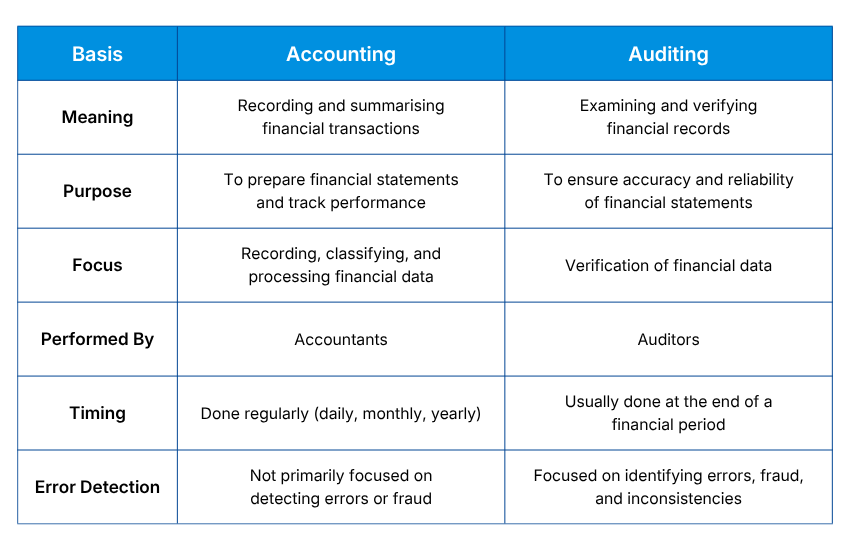
Although Accounting and Auditing are interconnected, they differ in their purpose, scope, and execution. Let's take a detailed look at the Accounting vs Auditing differences:
1) Education
The educational pathways for Accounting and Auditing are similar at the start but often diverge at advanced levels. Both fields typically require a degree in Accounting, Finance, or related fields. This foundation equips individuals with knowledge of financial principles, taxation, and reporting standards.
However, aspiring Accountants and Auditors often pursue additional qualifications like Chartered Accountant (CA), Certified Public Accountant (CPA), or Certified Internal Auditor (CIA). They enhance professional credibility and open doors to specialised roles.
2) Skills
Accounting vs Auditing share some common skills, but the focus is slightly different. Accountants usually need:
1) Strong numerical and analytical skills
2) Attention to detail for accurate record-keeping
3) Ability to interpret financial data and trends
4) Knowledge of accounting software and tools
5) Ability to organise and maintain large volumes of financial data
Auditors, on the other hand, require:
1) Critical thinking and problem-solving skills
2) Strong understanding of auditing standards and regulations
3) Ability to identify inconsistencies and risks
4) Good communication skills to explain the findings clearly
5) Strong ethical judgement to make unbiased decisions
3) Job Outlook
Both Accounting and Auditing offer stable and promising career opportunities. As businesses continue to expand and regulations become stricter, the demand for skilled professionals in both fields remains strong.
Accounting roles are available across all industries, from small businesses to multinational corporations. Accountants are essential for daily financial operations, making their roles consistently in demand. Auditing jobs are also growing, especially as companies face more rules and regulations. Businesses need auditors to make sure everything is done correctly and legally.
4) Starting Salary
Salaries of an Accountant and Auditor vary depending on location, qualifications, and employer. However, both the Accounting vs Auditing fields offer competitive entry-level packages.
Accountants typically begin with moderate salaries that grow steadily with experience and additional certifications. Their career progression can lead to roles such as Financial Analyst, Finance Manager, or Chief Financial Officer (CFO). Let's check the salary of an Accountant at different locations:
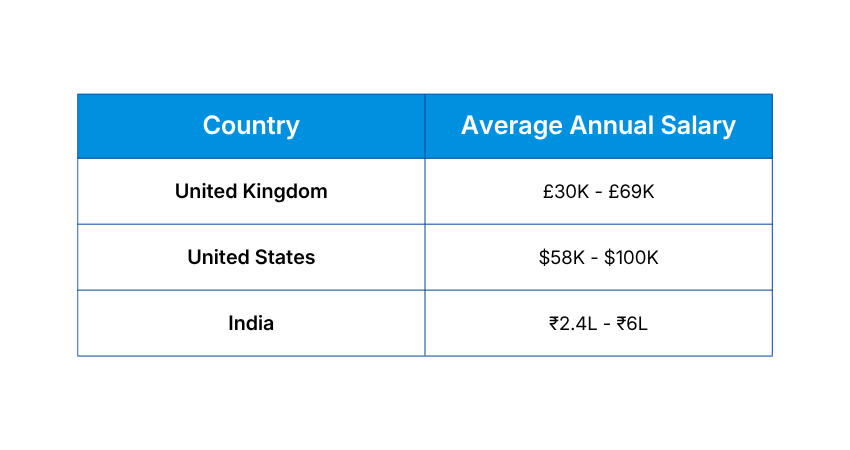
Source: Glassdoor
On the other hand, Auditors often start with slightly higher salaries, especially in large firms or multinational organisations. This is due to the specialised nature of their work and the responsibility associated with verifying financial information. Let's check their salary range for different locations:
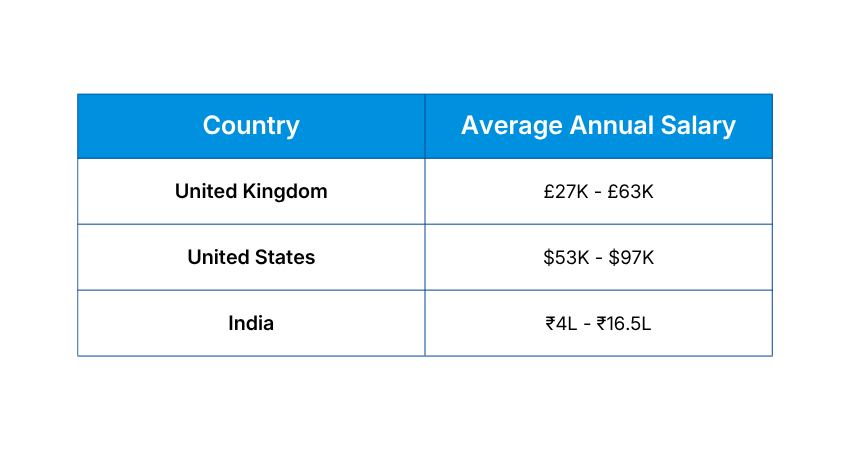
Source: Glassdoor
Similarities Between Accounting and Auditing
Despite their differences, Accounting and Auditing share several common features that highlight their close relationship. Here are those similarities:
1) Financial Data Focus: Both Accounting and Auditing deal with financial information. They rely on records, transactions, and reports to understand a company’s financial position.
2) Use of Standard Principles: Both follow established rules and frameworks such as Accounting standards and financial reporting guidelines to ensure consistency and accuracy.
3) Importance of Accuracy: Accuracy is critical in both fields. Errors in financial data can cause wrong decisions, legal issues, or financial losses.
4) Ethical Responsibility: Accountants and Auditors must maintain honesty and confidentiality while handling sensitive financial information.
5) Analytical Skills: Both roles require strong analytical thinking to interpret data, identify patterns, and understand financial performance.
6) Role in Decision-making: Both contribute to business decisions. Accounting provides the data, and Auditing ensures that the data is reliable and trustworthy.
7) Compliance with Regulations: Both help organisations follow financial laws and regulations, minimising the risk of penalties or legal issues.
8) Contribution to Business Success: Both functions are essential for smooth business operations. Together, they ensure financial stability, transparency, and accountability.
Conclusion
Accounting and Auditing are two sides of the same coin. While Accounting focuses on recording financial information, Auditing ensures that this information is accurate. If you are looking to strengthen your financial understanding, understanding Accounting vs Auditing can give you a clearer perspective on how businesses stay financially strong and secure.
Gain deeper insights into financial reporting and audit expertise with ACA Professional Level Training – Join now!
Frequently Asked Questions
Q. Is Auditing a Part of Accounting?
Auditing is closely related to Accounting but is not exactly a part of it. Accounting involves preparing financial records, while Auditing focuses on checking those records to ensure accuracy and compliance. In simple terms, Auditing builds upon Accounting by verifying the work done by Accountants.
Q. What is the Goal of an Audit Report?
The main goal of an audit report is to offer an independent opinion on whether a company’s financial records reflect a true and fair view. It assures stakeholders that the financial information is reliable and free from significant errors or fraud.
Q. When is an Audit Done?
Audits are usually conducted at the end of a financial year, but they can also be performed at other times depending on organisational needs. Internal audits may occur regularly throughout the year, while external audits are typically carried out annually to provide assurance on financial statements and meet statutory or regulatory requirements.