Have Any Question?
 +44 7452 122728




 Back
Back




What is an ERP System in Accounting? Features and Benefits
An ERP System in Accounting is software that manages financial data, automates accounting tasks and connects finance with all business operations in one system. It helps businesses improve accuracy and reduce manual work in daily accounting activities. This increases accuracy, enhances decision-making and supports real-time reporting.Table Of Contents


 44 7452 122728
 30-May-2026
Author-Richard Harris
Imagine closing your monthly accounts without chasing spreadsheets, emails and missing numbers. No last-minute confusion, no repeated data entry and no waiting for updates from different teams. Sounds easier, right? That's what an ERP System in Accounting offers.
It brings accounting, finance, inventory, payroll, sales and other operations together into one connected platform. It aids faster financial management. In this blog, we will discover What is an ERP System in Accounting, its key features, benefits and how it helps improve finance and accounting operations in modern businesses. Let’s get started!
What is an ERP System?
An Enterprise Resource Planning (ERP) System is software that helps businesses manage and connect different operations through one central platform. It combines functions such as accounting, finance, inventory management, payroll, sales, procurement and Human Resources (HR) into a single system.
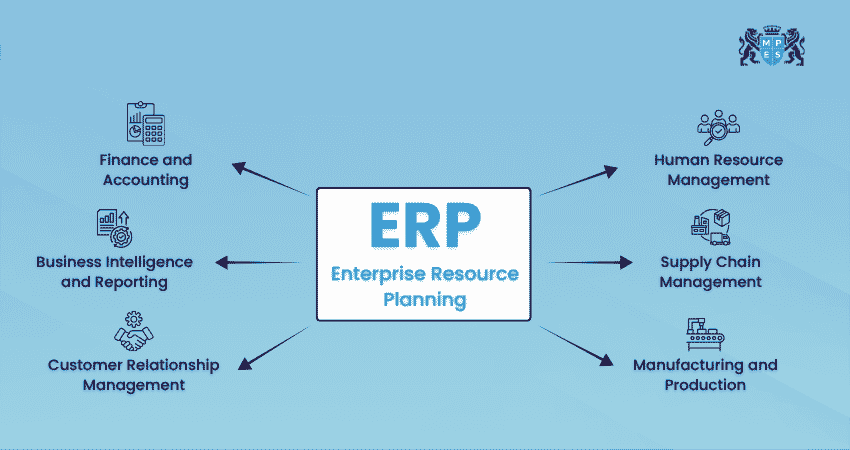
In accounting, ERP Systems help businesses handle tasks such as invoicing, payroll, taxes, budgeting, payments, financial reporting and expense tracking. For example, if a customer places an order, the ERP System can automatically update sales records, inventory levels, invoices and financial reports at the same time.

Features of a Good ERP Accounting Software
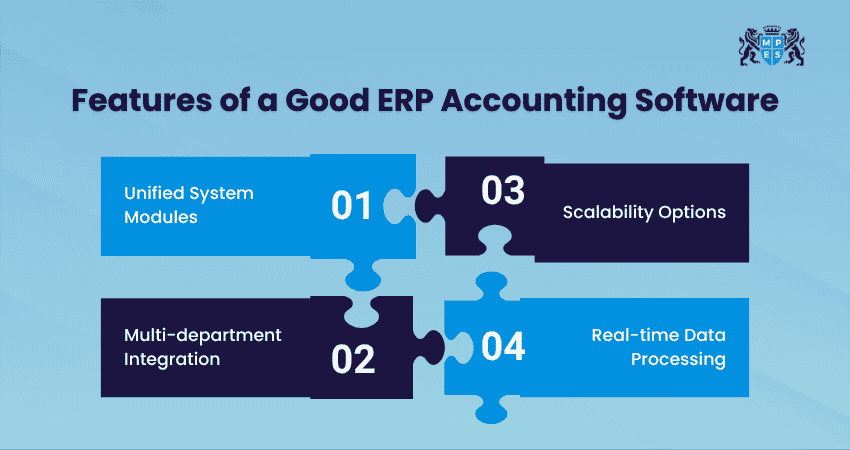
A good ERP system in accounting should not only manage financial data but also support broader business operations efficiently. It should integrate processes, improve visibility, and enable better decision-making across departments. Below are the key features businesses should look for:
1) Unified System Modules
One of the core features of ERP software is the integration of multiple business functions into a single system. Modules such as accounting, payroll, purchasing, sales, and HR operate within one platform. This eliminates the need for separate tools, reduces data duplication, and ensures faster access to accurate information across departments.
For example, when the purchasing team creates a purchase order, the finance team can immediately access the related payment details. This improves coordination and reduces manual effort.
2) Multi-department Integration
ERP systems help different departments share information easily. Finance teams often need information from HR, sales, procurement, and warehouse teams to complete accounting tasks. With ERP software, all departments can access and update information in real time. This helps businesses avoid delays and reduces the risk of errors caused by manual data transfers.
For example, when the sales team confirms a customer order, the ERP System automatically updates inventory records, generates invoices for the finance team and notifies the warehouse team for delivery.
3) Scalability Options
Businesses grow over time and their software should be able to grow with them. A good ERP System allows companies to add more users, features or modules as their needs increase. Cloud-based ERP Systems are especially useful because businesses can increase storage space and system features easily when required.
For example, a small business may initially use the ERP System only for accounting and payroll. As the company grows, it can later add inventory management or Customer Relationship Management (CRM) without changing the entire system.
4) Real-time Data Processing
ERP Systems are designed in a way to update information instantly whenever transactions happen. This means businesses always have access to the latest financial and operational data. This helps businesses identify problems quickly, such as delayed payments, rising expenses or low inventory levels.
For example, when a customer makes a payment, the ERP System immediately updates the company’s cash flow records, customer account status and financial reports.
Learn how businesses record and manage financial transactions with Recording Financial Transactions (FA1) Course – Register now!
Benefits of ERP Systems in Finance and Accounting
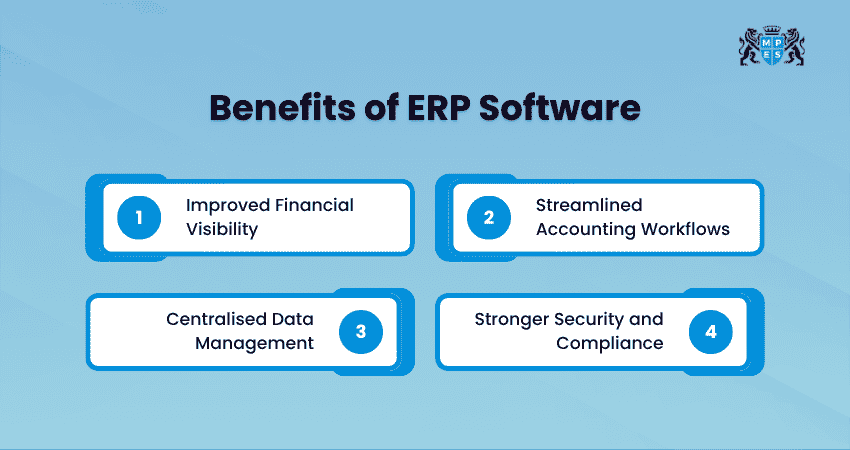
Modern businesses handle large volumes of financial data daily. ERP systems help automate processes, improve accuracy, and provide better insights. By centralising operations, they enable organisations to manage finances more effectively and make informed decisions.
1) Improved Financial Visibility
ERP Systems give businesses a clearer view of their financial performance. Since all financial data is stored in one system, managers can easily monitor income, expenses, profits and cash flow. This improves decision-making by providing accurate, real-time financial insights across departments.
1) Easier monitoring of business expenses and revenue
2) Faster decision-making using updated financial data
3) Improved visibility across multiple departments and branches
2) Streamlined Accounting Workflows
Manual accounting tasks can be time-consuming and prone to errors. ERP systems automate processes such as invoicing, payroll, tax calculations, and bank reconciliation. This reduces workload, improves accuracy, and allows finance teams to focus on more strategic activities.
1) Improved accuracy in financial transactions
2) Automated payroll and tax calculations
3) Increased productivity for finance and accounting teams
3) Centralised Data Management
One common problem that all businesses face is managing data that is stored across multiple systems and spreadsheets. ERP software solves this issue by storing all data in one central location. This makes it easier for employees to access accurate and updated information whenever needed.
1) Reduced duplication of financial records and files
2) Better collaboration between departments
3) Simplified auditing and financial tracking processes
4) Stronger Security and Compliance
Financial information is sensitive and must be protected carefully. ERP Systems include security features that help businesses protect their data from unauthorised access. These features may include password controls, user permissions, encrypted storage and activity tracking.
1) Controlled user access based on roles and permissions
2) Improved compliance with financial regulations
3) Reduced risk of fraud and unauthorised activities
How ERP Systems Improve Finance and Accounting Operations?
ERP Systems do more than simplify accounting tasks. They improve the overall way businesses manage finances, reporting and planning. Let's now check how they improve finance and accounting operations:
1) Centralised Financial Data Management
Instead of managing separate spreadsheets or disconnected software tools, businesses can access all financial data through one platform. Centralised data management also improves communication between departments and reduces duplicate entries.
Since all employees work with the same updated information using ERP Systems, businesses can improve accuracy and save time during financial operations.
2) Improved Financial Reporting and Accuracy
ERP Systems help businesses generate accurate financial reports more quickly. Businesses can create reports such as balance sheets, profit and loss statements, cash flow reports and tax summaries with greater accuracy.
Automated reporting also reduces the risk of calculation mistakes and improves consistency across financial documents. This helps businesses make confident decisions.
3) Smarter Budgeting and Forecasting
ERP Systems help businesses plan budgets and forecast future financial performance. The software analyses current and historical financial data to identify trends, spending patterns and future business needs.
Finance teams can compare actual business performance with planned budgets and identify differences quickly. Advanced ERP Systems may also include analytics tools that support long-term business forecasting and strategic planning.
Develop accounting skills required in modern businesses with Maintaining Financial Records (FA2) Course – Sign up soon!
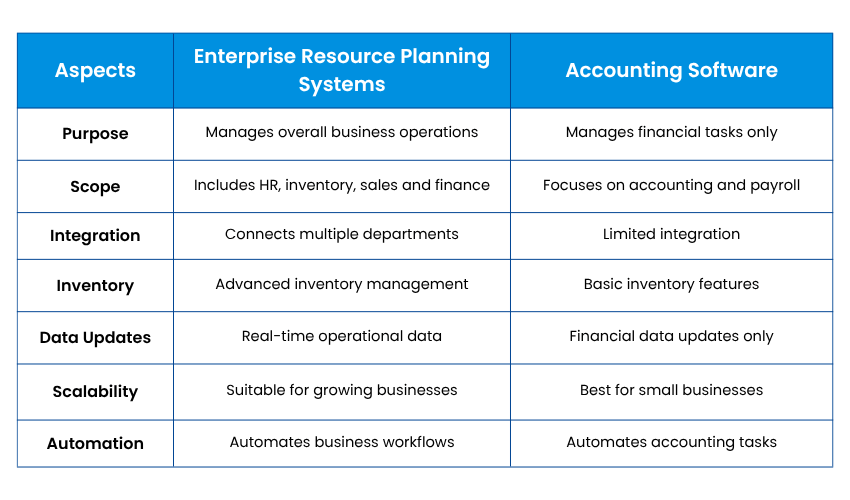
ERP Systems vs Accounting Software: 4 Major Differences
Many people assume that ERP Systems and accounting software are the same, but they serve different business needs. Accounting software is a digital tool that helps businesses manage financial tasks such as bookkeeping, invoicing, payroll, expense tracking and tax calculations. It helps businesses record financial transactions and generate financial reports.
While accounting software mainly focuses on managing financial tasks, ERP Systems provide a much broader solution. Understanding how these systems differ helps businesses choose the right solution based on their requirements. So, here are their differences:
1) Financial Operations Scope
Traditional accounting software mainly focuses on financial tasks such as bookkeeping, payroll, invoicing and tax management. However, ERP Systems cover accounting as well as other business areas like inventory management, sales, procurement, HR and production planning.
This wider scope helps businesses manage operations efficiently through one connected platform. ERP Systems are usually better suited for companies with multiple departments and complex workflows.
2) Inventory Management Capabilities
Basic accounting software provides limited inventory tracking features. But ERP Systems include advanced inventory management tools. With that, businesses can track stock levels, monitor warehouse operations, manage supplier orders and control inventory costs.
This is especially useful for retail, manufacturing, and distribution companies where inventory directly affects financial performance.
3) Manufacturing and Workflow Planning
ERP Systems support production management and workflow planning. Businesses can manage manufacturing schedules, supply chains, staff resources and operational processes within the same system. Traditional accounting software usually does not include these advanced operational features.
Manufacturing companies benefit greatly from ERP Systems because they help improve production efficiency while keeping financial records accurate.
4) Integration and Operational Costs
Accounting software is usually cheaper and easier to set up, making it suitable for smaller businesses with simple needs. On the other hand, ERP Systems often require a larger investment because they support wider business operations and more advanced features.
Despite that, ERP Systems can provide long-term value by improving efficiency, reducing manual work and helping businesses grow more smoothly.
How ERP Integrations Streamline Financial and Operational Workflows?
ERP system integrations help businesses connect accounting, inventory, CRM, supply chain, and other core operations into a unified platform. By eliminating data silos and enabling real-time information sharing, ERP integrations significantly improve efficiency, accuracy, and collaboration across departments. Here are the ways the integration streamlines financial and operational workflows:
1) Automated Cross-department Workflows
ERP integrations enable different departments to share information in real time. This reduces communication gaps and eliminates the need for manual data transfers. As a result, businesses can minimise duplicate work, improve coordination, and ensure smoother workflow execution across teams.
2) Better Decision-making and Productivity
ERP systems provide real-time financial and operational insights through integrated data. Managers can access accurate information instantly without relying on multiple systems. This supports faster decision-making, reduces manual workload, and significantly improves overall business productivity.
3) Accounting Software and Financial Reporting
ERP integrations connect accounting and financial reporting tools within one system. This reduces manual data transfers, improves reporting accuracy and provides businesses with real-time financial information.
4) Accounts Receivable Management
ERP systems streamline accounts for receivable processes by automating invoice tracking and payment processing. This improves cash flow management, reduces delays in payments, and enhances overall financial control within the organisation.
5) CRM Integration
ERP integrations connect customer and financial data in one platform. This helps sales and finance teams work together while improving forecasting and customer management.
6) Supply Chain and Inventory Management
ERP Systems connect procurement, inventory and accounting operations together. This improves inventory tracking, operational visibility and coordination between the warehouse and finance teams.
Conclusion
ERP Systems have transformed the way businesses manage finance and accounting operations. As businesses continue to grow and handle larger amounts of financial data, relying on disconnected systems can slow down operations. Knowing What is an ERP System in Accounting and implementing the right ERP solution can support long-term growth, productivity and financial control.
Gain the knowledge needed for a successful accounting career with ACCA Foundations Training – Join now!
Frequently Asked Questions
Q. Why Businesses Invest in ERP Systems for Accounting and Financial Operations?
Businesses invest in ERP Systems because they help improve financial visibility, automate accounting tasks, reduce manual errors and connect different departments through one platform. ERP Systems also improve reporting, budgeting, compliance and overall operational efficiency.
Q. Can Small Businesses Use ERP Systems for Accounting?
Yes, small businesses can use ERP Systems for Accounting. Many ERP providers now offer affordable and scalable solutions designed specifically for small and medium-sized businesses.
Q. Is ERP Better Than Traditional Accounting Software?
ERP Systems are generally more advanced than traditional accounting software because they support both accounting and wider business operations such as inventory, procurement and workflow management. However, the best choice depends on the business size and needs.