Have Any Question?
 +44 7452 122728




 Back
Back




Return on Equity Explained: Formula, Calculation & Example
Return on Equity (ROE) is a financial ratio that measures how effectively a company utilises its shareholders' equity to generate profits and create value. It provides useful insights into profitability, financial performance, and management efficiency while supporting informed business and investment decisions.Table Of Contents


 44 7452 122728
 20-Jun-2026
Author-Maria Thompson
Have you ever wondered how investors determine whether a company is using its money wisely to generate profits? Financial ratios play an integral role in evaluating business performance. Return on Equity is one of the most widely used metrics for measuring how efficiently a company generates earnings from shareholders’ investments.
It helps investors, business owners, and financial professionals make informed financial decisions while assessing how effectively a company creates value for its shareholders. In this blog, you will learn about what is Return on Equity, how it works, its formula, how to calculate it, and more. Let’s begin!
What is Return on Equity (ROE)?
Return on Equity (ROE) refers to a financial ratio that calculates how efficiently a company generates profit from its shareholders’ equity. To put it simply, it shows how much profit a business earns from the money invested by shareholders.
ROE is widely used to evaluate an organisation’s profitability and financial performance over a specific period, usually a fiscal year. Also, it helps businesses and investors compare performance with competitors within the same industry.

How Does Return on Equity (ROE) Work?
Return on Equity (ROE) works by measuring how effectively a company uses shareholder’s equity to generate profit. It is written as a percentage and is measured by dividing a company's net income by its average shareholders' equity. This shows how much profit the company generates for every unit of shareholder investment. Generally, a higher ROE indicates that a company is using its resources efficiently to create profits for shareholders.
ROE values can vary across industries, so it is important to compare a company’s ROE with businesses in the same sector. For example, technology companies may have a higher average ROE than utility companies due to differences in assets and operating structures.
Formula of Return on Equity
The formula of Return on Equity measures a calculates an organisation’s profitability in relation to the equity of the its shareholders. It helps businesses and investors understand how efficiently a company uses shareholders’ funds to generate profits. Let’s look at its formula below:

In the ROE formula, net income refers to the company’s profit after expenses, taxes, and interest. The shareholders’ equity represents the company’s net assets owned by shareholders. Multiplying the result by 100 converts ROE into a percentage, making profitability comparisons easier.
How to Calculate Return on Equity (ROE)?
The basic ROE formula has been covered above. In simple terms, Return on Equity is calculated by comparing a company’s profit with its shareholders’ equity to measure how efficiently the business generates returns from shareholders’ investments. Now, net income can be calculated by subtracting total expenses from total revenue during a specific period:

Usually, net income is reported on a company’s income statement, while shareholders’ equity is listed on the Balance Sheet. Since equity levels can change over time, many businesses use average total equity for a more accurate ROE calculation. Let’s look at it below:

Using average equity provides a clearer view of an organisation's financial performance over a specific period. As a result, investors and analysts can gain a more accurate understanding of the company's ability to generate returns from shareholder investments.
Build smart financial decision-making and planning skills with the Financial Management (FM) Training – Join now!
When Should You Use the Return on Equity Formula?
Businesses, investors, and Financial Analysts use the ROE formula in different situations to understand how effectively a company generates returns from shareholders’ investments. Let’s look at when to best use it. Using ROE in the right context helps stakeholders make more informed financial and investment decisions.
1) Assessing Profitability and Operational Efficiency
ROE is useful for measuring how effectively a company uses shareholders’ equity to generate profit. Investors often compare ROE between companies in the same industry to identify businesses that use their resources more efficiently and deliver stronger profitability. This comparison helps highlight companies that manage their capital more effectively than competitors.
2) Evaluating Stock Performance
Investors use ROE to evaluate a company’s stock performance over time. A consistently high ROE may indicate that the company has a strong track record of creating value for shareholders and generating stable returns. It also helps investors assess whether a company can maintain consistent financial performance over the long term.
3) Identifying and Assessing Risk
While a high ROE is generally positive, an extremely high ROE may sometimes indicate financial risk. For example, companies with high debt levels can show inflated ROE figures, so businesses and investors should also assess whether the returns are sustainable in the long-term. Analysing ROE alongside other financial metrics provides a more balanced view of risk and performance.
Example of Return on Equity Calculation
Understanding Return on Equity becomes easier with a practical example. The following example shows how a company’s profit and shareholders’ equity are used to calculate ROE and measure financial performance. Let’s look at it below:
Suppose XYZ Ltd. has Earnings After Tax (EAT) of £80,000 and total shareholders’ equity of £500,000. The shareholders’ equity includes:
1) Common Shares: £250,000
2) Preferred Shares: £120,000
3) Contributed Capital: £80,000
4) Retained Earnings: £50,000
Then, the ROE can be calculated as follows:

This means XYZ Ltd. generates a return of 16% from the shareholders’ equity invested in the business.
Learn to prepare accurate and professional financial reports with the Financial Reporting (FR) Training – Sign up now!
Why Do Finance Teams Use Return on Equity (ROE)?
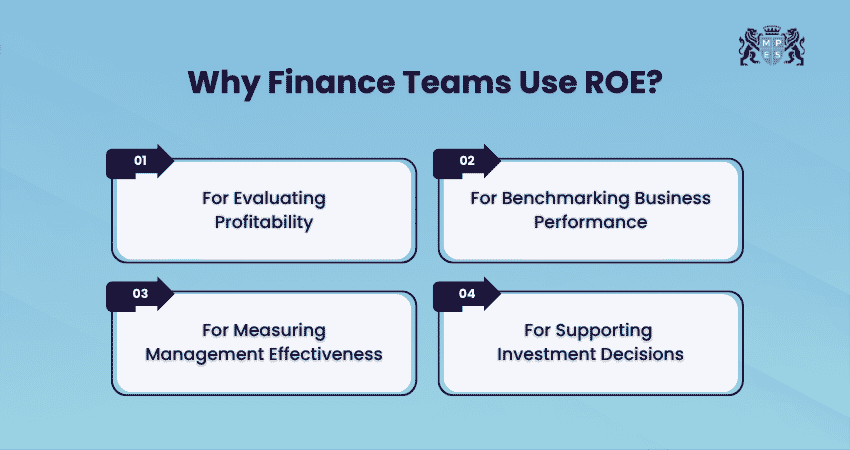
Finance teams use Return on Equity to understand how efficiently an organisation generates profit from the equity of the shareholders. It provides valuable insights into profitability, management performance, and the company’s overall financial efficiency. Let’s look at it more below:
1) Evaluating Profitability
ROE helps finance teams measure how effectively a company converts shareholders’ equity into profit. Generally, a higher ROE indicates that the business is utilising its invested capital efficiently to generate stronger earnings and improve overall profitability.
2) Benchmarking Business Performance
Finance teams and investors often use ROE to compare companies within the same industry. This helps identify businesses that manage their equity more effectively and consistently deliver better financial performance than their competitors. Benchmarking supports competitive analysis and highlights market leaders within an industry.
3) Measuring Management Effectiveness
ROE helps evaluate how efficiently a company’s management team uses available resources to support business growth. A consistently high ROE may indicate strong decision-making, effective financial management, and better use of shareholders’ investments. It reflects how well leadership strategies translate into financial outcomes.
4) Supporting Investment Decisions
Investors and finance professionals use ROE to assess the potential returns a company may generate in the future. A strong and stable ROE often reflects good financial health, making the organisation desirable to investors and increasing its ability to secure capital. This makes ROE a key metric in investment analysis and portfolio selection.
Limitations of Return on Equity (ROE)
While Return on Equity is a useful financial metric, it also has certain limitations. In some situations, ROE may not provide an accurate picture of a company’s profitability or overall financial performance. Let’s read about it below:
1) Negative ROE
Usually, a negative ROE occurs when a company records a net loss or has negative shareholders’ equity. In such cases, ROE cannot be effectively used to evaluate the company’s performance or compare it with businesses that have a positive ROE. This can make it difficult for investors and finance teams to accurately assess profitability and financial stability.
2) Comparisons Across Industries
ROE is not always suitable for comparing companies from different industries. This is because industries have different operating margins, debt levels, and financing structures, which can significantly affect ROE values. Additionally, large established companies may naturally have different ROE levels compared to smaller or newer businesses.
Improve business performance through smarter financial decisions by joining the Performance Management (PM) Training today!
ROE vs Other Financial Performance Metrics
While Return on Equity (ROE) is widely used to measure profitability and financial efficiency, businesses and investors also use other financial metrics to evaluate company performance. Each metric focuses on a different area, such as investment returns, asset efficiency, or capital usage. Let’s explore them below:
1) Return on Investment (ROI)
Return on Investment measures the profitability of an investment compared to its total cost. While ROE focuses only on shareholders’ equity, ROI can be used to evaluate almost any type of investment, such as software, marketing campaigns, or business projects. This flexibility makes ROI a widely used metric across different business functions.
2) Return on Invested Capital (ROIC)
Return on Invested Capital (ROIC) calculates how efficiently a company generates profit from all invested capital, including both debt and equity. It provides a broader financial view than ROE because it considers the company’s total capital structure. ROIC is particularly useful for analysing how effectively a company uses its overall funding sources.
3) DuPont Analysis
DuPont Analysis breaks ROE into smaller components, including profit margin, asset efficiency, and financial leverage. This helps finance teams identify the key factors affecting a company’s profitability and gain a deeper understanding of a company’s overall financial performance. It allows organisations to pinpoint strengths and weaknesses within their financial structure.
4) Return on Assets (ROA)
Return on Assets calculates how efficiently a company uses its total assets to generate profit. ROA focuses on all company assets rather than only shareholders’ equity, making it useful for analysing asset-heavy industries. This makes ROA ideal for comparing companies with large asset bases.
5) Rate of Return (ROR)
The Rate of Return (ROR) measures the gain or loss earned from an investment over a period. It is a broader investment metric commonly used for stocks, bonds, real estate, and other types of investments to evaluate overall returns. ROR helps investors understand the overall profitability of their investments over time.
Conclusion
Understanding Return on Equity helps businesses and investors measure profitability and financial efficiency. It shows how effectively a company generates returns from shareholders’ investments. By understanding its formula, uses, and benefits, finance teams can make better financial and investment decisions.
Learn essential accounting and finance concepts confidently with the ACCA Applied Skills Training – Sign up today!
Frequently Asked Questions
Q. What Does a 20% ROE Mean?
A 20% Return on Equity (ROE) means a company earns 20 cents in net profit for every dollar invested by shareholders. It indicates strong profitability and efficient use of shareholder funds.
Q. What Financial Statements are Needed to Calculate ROE?
To calculate ROE, businesses mainly use two financial statements: the Income Statement and the Balance Sheet. The Income Statement provides the net income, while the Balance Sheet provides total assets, total liabilities, and shareholders’ equity.
Q. What is the Difference Between ROE and Earnings Per Share (EPS)?
Earnings Per Share (EPS) measures the amount of net profit earned for each outstanding share of stock. In contrast, Return on Equity (ROE) measures how efficiently a company uses shareholders’ equity to generate profit. While EPS focuses on profit per share, ROE focuses on overall financial efficiency and profitability.