Have Any Question?
 +44 7452 122728




 Back
Back




ROE vs ROCE: Key Differences and Which Metric Matters More?
ROE measures the profits generated from shareholders' equity, while ROCE assesses how efficiently a business uses its total capital, including equity and debt. Although both are profitability ratios, they evaluate business performance from different perspectives. Together, they evaluate financial performance and operational efficiency.Table Of Contents


 44 7452 122728
 04-Jul-2026
Author-Grace Mitchell
Understanding a company’s profitability is not always as simple as looking at its earnings. Some businesses generate impressive returns for shareholders, while others excel at using all available capital efficiently. This is where understanding ROE vs ROCE come into play, helping investors uncover different sides of a company's financial performance.
In this blog, we'll compare ROE vs ROCE, explore their key differences, calculation methods, advantages, and practical uses. You'll also learn when to use each metric and which one matters more when evaluating a company's long-term growth potential. So, let’s get started!
What is ROE in the Share Market?
Return on Equity (ROE) measures how much profit a company generates from the money invested by its shareholders. It helps investors assess how efficiently a company uses shareholders' equity to create earnings.
A higher ROE usually indicates that the company is using its equity efficiently to generate profits. However, an unusually high ROE may sometimes result from excessive financial leverage or a relatively low equity base rather than stronger business performance. ROE also provides valuable insight into a company's profitability and overall financial health.

How to Calculate ROE?
Return on Equity (ROE) is calculated by comparing a company's net profit with its shareholders' equity. The formula to calculate ROE is:

Here,
1) Net Profit = The profit left after paying all expenses, taxes, and interest.
2) Shareholders’ Equity = The total money that belongs to the shareholders, calculated as total assets minus total liabilities.
ROE can also be expressed using Earnings Per Share (EPS) and Book Value per Share (BVPS) as follows:

This formula shows the return a company generates on shareholders’ equity on a per-share basis. Here:
1) Earnings Per Share (EPS) indicates the profit earned by the company for each share.
2) Book Value per Share represents the value of each share based on the company’s total equity.
Consider Company PQR Ltd. with a net profit of £12 million and shareholders’ equity of £60 million. The ROE of the company will be:

So, ROE = 20%
This means the company generated a 20% return on the funds invested by shareholders. In other words, for every £100 of equity, the company earned £20 in profit. A consistently high ROE often indicates efficient use of shareholder capital. Therefore, investors should compare a company's ROE with its historical performance and industry peers.
Now, consider Company LMN Ltd. with an EPS of £2 and a Book Value Per Share of £10. The ROE of the company based on this data will be:

So, ROE = 20%
This means the company earns a 20% Return on Equity. Although the calculation uses per-share values, it represents the company's overall return on shareholders' equity.
What is ROCE in the Share Market?
Return on Capital Employed (ROCE) is a financial ratio that evaluates how effectively a company uses its total capital to generate profits. It compares a company's Earnings Before Interest and Tax (EBIT) or operating profit with the capital employed, which includes both shareholders' equity and debt.
A higher ROCE generally indicates that a company is using its capital efficiently to generate profits and create value. It also helps investors compare the financial performance of companies within the same industry, particularly those with significant investments in assets or borrowed funds.
How to Calculate ROCE?
Return on Capital Employed (ROCE) is calculated by comparing a company's operating profit with the capital employed in the business. The formula for ROCE is:

Consider Company XYZ Ltd., which reports an EBIT of £18 million and capital employed of £90 million (including shareholders’ equity and long-term debt). The ROCE can be calculated as follows:

ROCE = 20%
This indicates that the company generates a 20% return on its capital employed. In other words, for every £100 invested in the business by shareholders and lenders, the company earns £20 in operating profit.
Boost business confidence through auditing. Learn how in our Audit and Assurance (AA) Course - Sign up now!
Difference Between ROE and ROCE
Understanding the difference between ROE and ROCE is essential for evaluating a company’s financial performance from multiple perspectives. So, here are the key differences between ROE and ROCE:
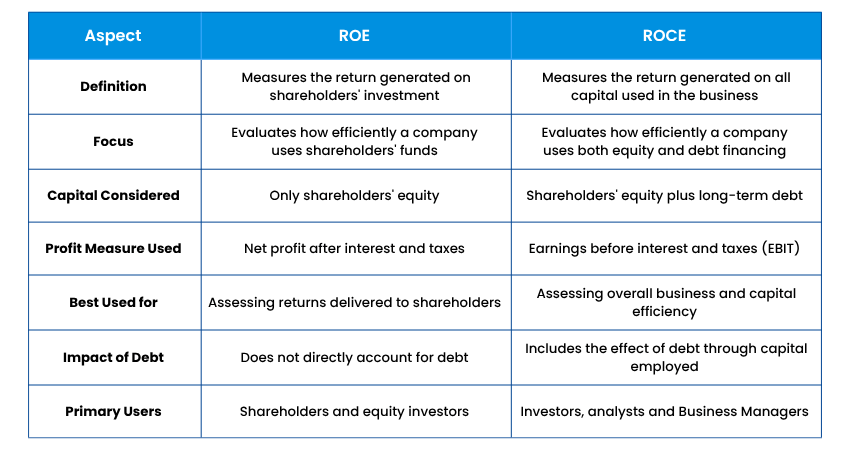
While ROE and ROCE serve different purposes, using both ratios together provides a more comprehensive understanding of a company's profitability, capital efficiency, and overall financial performance.
When Should ROE be Used?
Understanding when to use ROE helps in assessing whether a business is delivering strong value to its shareholders. So, let’s check when to use ROE:
1) Evaluating Management Performance
ROE is a great way to see how well management is handling shareholders’ money. If the ROE is consistently high, it usually means the leadership is making smart decisions and using the company’s resources efficiently.
2) Creating Shareholder Value
Since ROE focuses on returns generated from shareholders’ equity, it clearly shows how much value the business is creating for its owners. Generally, a higher ROE means the company is giving better returns on the money invested.
3) Attracting Investors and Capital
Investors often look at ROE to identify companies that can deliver strong returns. A steady and healthy ROE strengthens investor confidence and makes the company more attractive to potential investors.
4) Measuring Investment Returns
ROE gives a simple and clear view of how much return shareholders are getting. It also makes it easier to compare companies within the same industry and identify which ones are using their equity more effectively.
5) Assessing Profitability and Growth
A steadily increasing ROE is usually a good sign. It shows that the company is growing profits while using its resources wisely. Tracking ROE over time can help investors understand how well the business is expanding.
When Should You Use ROCE?
The following are some common situations where ROCE provides valuable insights:
1) Evaluating Overall Capital Efficiency
ROCE looks at how efficiently a company is using all its capital, including both equity and debt. This provides a broader view of how effectively the business generates returns from its available capital.
2) Analysing Capital-intensive Industries
ROCE is especially useful for industries like manufacturing, telecommunications, or infrastructure, where businesses need significant investments in assets. It helps assess whether those big investments are actually paying off.
3) Comparing Companies with Different Capital Structures
Because ROCE takes both debt and equity into account, it is useful for comparing companies with different capital structures. This provides a more balanced assessment of how efficiently each company uses its capital.
4) Assessing Long-term Investment Viability
ROCE is a solid metric for judging long-term business performance. If a company consistently shows a high ROCE, it’s a good sign that it’s using its capital well and creating value over time. However, it should be considered alongside other financial ratios.
Become the brains behind sustained financial success with the Financial Management (FM) Course – Sign up now!
Example of ROE and ROCE
Understanding ROCE vs ROE becomes easier with a practical example. So, let’s consider two companies to understand how ROE and ROCE are calculated and interpreted:
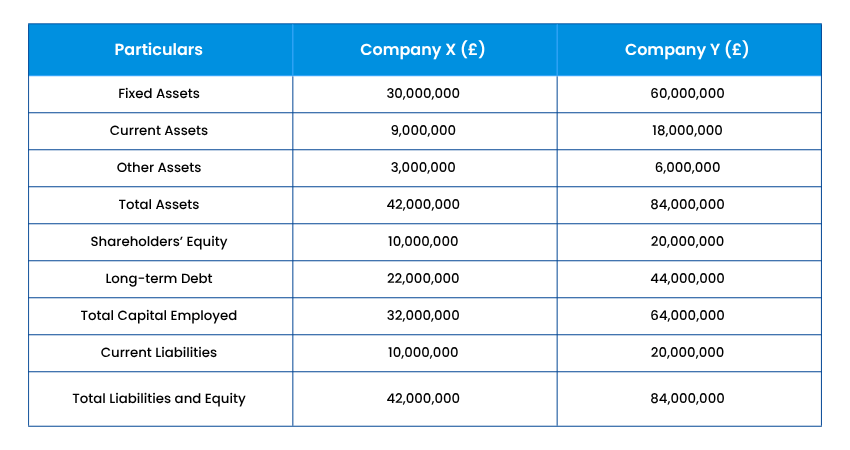
Here’s the income statement for the companies:
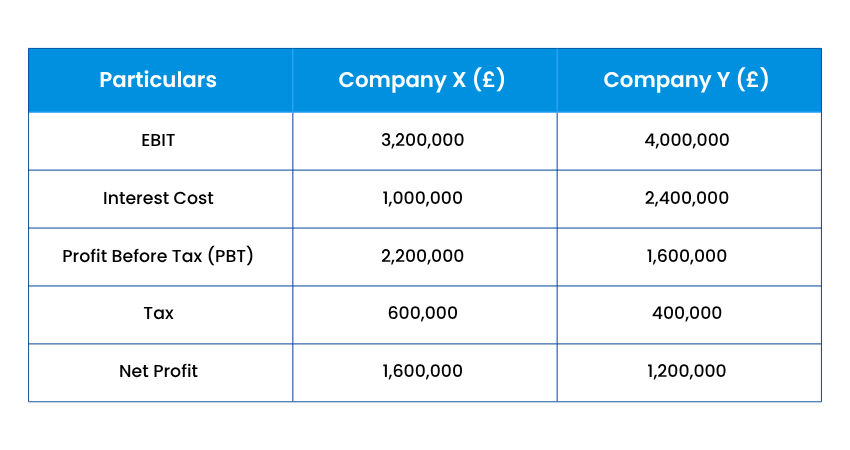
Applying the formulas for ROE and ROCE will give the following results:
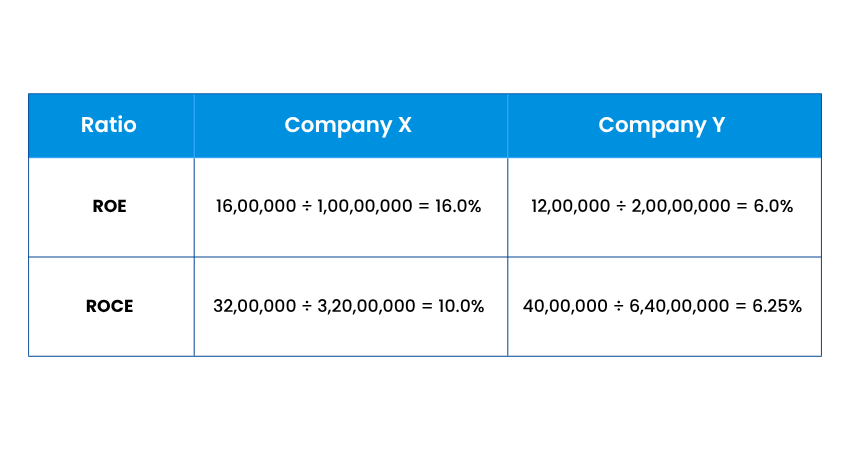
Although Company Y has larger assets and capital employed than Company X, it generates relatively lower returns from its assets and capital. As a result, both its ROE and ROCE are significantly lower. To improve performance, Company Y could focus on increasing profitability or making better use of its assets to generate higher returns.
Which is Better: ROE or ROCE?
ROE and ROCE highlight different aspects of a company’s performance. ROE is helpful if you want to understand how well a company is using shareholders’ equity to generate profits, while ROCE gives a more complete picture by considering both equity and debt.
Rather than relying on a single ratio, it is best to evaluate ROE and ROCE together to gain a more comprehensive understanding of a company's profitability, capital efficiency, and overall financial performance.
Conclusion
ROE vs ROCE provides different sides of a company’s performance. While ROE highlights the returns to shareholders, ROCE shows how efficiently the overall capital is used. The real insight comes from combining both, giving you a clearer, more balanced view to make smarter investment decisions and gain long-term financial strength.
Develop the expertise that defines future finance leaders. Sign up for our ACCA Applied Skills Training today!
Frequently Asked Questions
Q. Can a Company Have a High ROE but a Low ROCE?
Yes, a company can have a high ROE and a low ROCE. This often happens when a business uses significant debt financing. While borrowing can increase returns to shareholders and boost ROE, ROCE considers both equity and debt, providing a broader view of how efficiently the company uses its total capital.
Q. What is Considered a "Good" ROE or ROCE Value?
A good ROE or ROCE varies by industry, but values above 15% are generally considered strong. However, these metrics must always be compared with industry averages, competitors and the company's historical performance to gain meaningful insights.
Q. Which Sectors are Best Evaluated Using ROE?
ROE is particularly useful for evaluating sectors with relatively low debt and strong shareholder funding, such as banking, financial services, technology, consumer goods and asset-light businesses. It helps investors assess how effectively these companies generate profits from shareholders' equity.