Have Any Question?
 +44 7452 122728




 Back
Back




How to Become a Forensic Accountant? Skills and Salary Explained
To Become a Forensic Accountant, earn a degree in accounting, gain auditing or finance experience, and develop investigative skills for fraud analysis. This role blends accounting expertise with investigative thinking to uncover financial irregularities. It also supports legal cases and helps organisations prevent financial misconduct.Table Of Contents


 44 7452 122728
 21-Jul-2026
Author-Maria Thompson
Ever wondered who uncovers the truth behind financial fraud, corporate scandals, or missing money? That is where Forensic Accountants play a critical role. This career blends accounting with investigation, making it ideal for people who enjoy solving puzzles, questioning numbers, and uncovering what others miss.
In this blog, you will learn How to Become a Forensic Accountant, explore the role, understand the key skills required, and discover career opportunities. Everything is explained clearly for beginners and career switchers. Let’s get started.
How to Become a Forensic Accountant?
Becoming a Forensic Accountant involves education, professional qualifications, and practical experience. Understanding How to Become a Forensic Accountant follows a structured pathway that builds strong accounting and investigative expertise, as outlined in the steps below.
1) Pursue Education or Vocational Pathways
The first step on the path to becoming a Forensic Accountant is gaining the right education or vocational training. Most professionals begin with an undergraduate degree in accounting or finance, as it builds a strong foundation in auditing, financial reporting, and business principles.
Vocational pathways such as apprenticeships offer a practical alternative, combining learning with workplace experience to build accounting knowledge and essential professional skills early in a career.

2) Secure a Professional Accounting Qualification
After completing education or vocational training, securing a professional accounting qualification is essential. These qualifications strengthen accounting expertise and demonstrate the ethical standards required for sensitive financial investigations and legal work.
They cover areas such as fraud detection, financial investigations, and litigation procedures. A recognised qualification enhances credibility, boosts employability, and prepares professionals for complex forensic roles across corporate and regulatory environments.
3) Begin Your Job Search in Forensic Accounting
Once qualified, professionals can begin their job search in Forensic Accounting. Many start in related roles such as auditing, finance, or compliance to gain practical experience, develop investigative skills, and understand how financial systems operate in real organisations.
Forensic Accounting roles exist across both public and private sectors, including firms, government agencies, and large organisations. With experience, professionals may specialise in specific industries or work independently as expert consultants.
Role of a Forensic Accountant
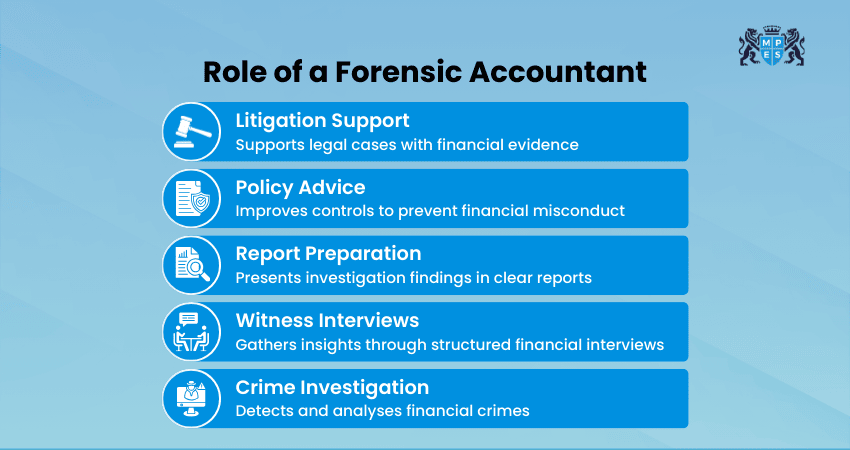
The role of a Forensic Accountant extends beyond traditional accounting, combining financial expertise with investigation to uncover fraud and support legal decisions. These responsibilities are carried out across several key areas, explained below:
1) Litigation Support
One of the key responsibilities of a Forensic Accountant is providing litigation support during legal proceedings. They help lawyers understand complex financial data related to suspected crimes, enabling courts to clearly assess how financial irregularities occurred.
Forensic Accountants may also serve as expert witnesses, presenting evidence and professional opinions based on their investigations. They prepare legal teams before trials, ensuring financial aspects are clearly explained and arguments are supported by accurate, reliable evidence.
2) Policy Advice
Forensic Accountants advise organisations on improving internal controls and accounting policies to reduce financial risk. When irregularities are identified, they review existing systems to uncover weaknesses or process gaps that may have enabled misconduct.
Using their findings, they recommend practical changes to policies, procedures, and controls. This proactive guidance helps organisations strengthen financial security, improve regulatory compliance, and reduce the possibility of similar issues occurring again.
3) Report Preparation
After completing investigations, Forensic Accountants prepare detailed reports summarising their findings. These reports must be accurate, impartial, and legally admissible, as they are often used during court proceedings or regulatory assessments.
A key challenge is converting complex financial information into clear, simple language. Well-structured reports help judges, lawyers, and regulators understand evidence easily and support informed, fact-based decision-making.
4) Witness Interviews
Witness interviews form an important part of Forensic Accounting investigations. Forensic Accountants speak with employees, management, or third parties who may hold relevant information connected to suspected financial misconduct.
Strong interviewing skills help gather reliable evidence, clarify inconsistencies, and verify financial records. Information collected during interviews often provides valuable insights that strengthen findings and support the overall investigative process.
Advance your career by mastering strategic decision-making with Strategic Business Leader (SBL) Training – Join now!
5) Crime Investigation
Crime investigation lies at the core of Forensic Accounting work. Financial crimes usually leave traces in accounting records, and Forensic Accountants are trained to identify, analyse, and interpret these indicators accurately.
They examine financial statements, transaction histories, and supporting documents to trace suspicious activities. By reviewing journal entries and linked transactions, they uncover missing links, detect fraud, and present clear conclusions to authorities.
Skills Required to Become a Forensic Accountant
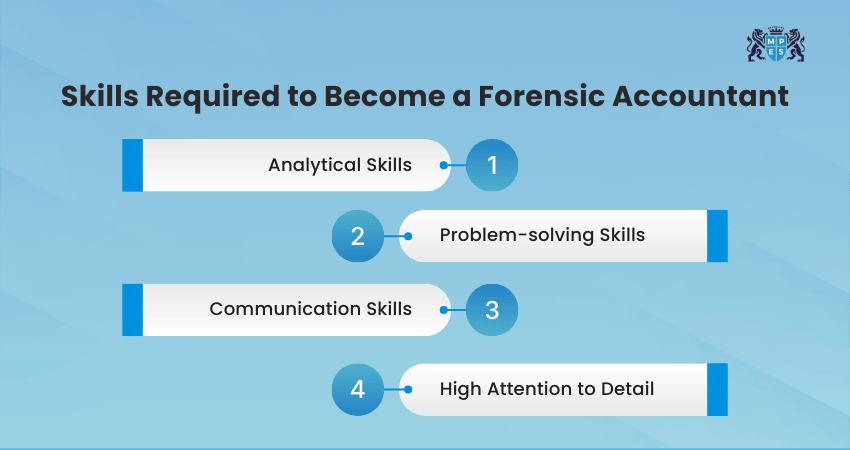
Success in Forensic Accounting depends on a diverse skill set that goes beyond conventional accounting knowledge, as outlined in the key skills below:
Analytical Skills
Analytical skills are essential for examining financial records and identifying unusual patterns or discrepancies. Forensic Accountants often review large volumes of financial data, valuations, and transaction histories to determine how and where irregularities occurred.
These skills also support deeper investigations, such as assessing losses, evaluating business performance, or analysing financial behaviour. Strong analytical ability enables Forensic Accountants to draw accurate conclusions based on evidence.
Problem-solving Skills
Problem-solving skills help Forensic Accountants handle the unpredictable nature of investigations. As new evidence emerges, they must reassess situations, adapt strategies, and address challenges that may alter the direction of an ongoing financial investigation.
Effective problem-solving enables professionals to think critically, manage complex scenarios, and develop practical solutions. This skill is especially important in high-pressure cases involving financial crime, where decisions must be logical, timely, and well-supported.
Communication Skills
Clear communication is vital in Forensic Accounting, as findings must be shared with both financial and non-financial audiences. Forensic Accountants regularly explain complex financial matters to lawyers, judges, regulators, and organisational leaders.
Strong written and verbal communication skills ensure reports and testimonies are clear and accurate. Effective communication helps stakeholders understand evidence and supports confident decision-making in legal or regulatory proceedings.
High Attention to Detail
Close attention to detail is crucial when examining financial records for irregularities. Even minor discrepancies may indicate fraud, so Forensic Accountants must carefully review every transaction, document, and supporting record during investigations.
This skill ensures no evidence is overlooked and conclusions are based on complete, accurate information. Attention to detail is especially important in legal and regulatory contexts, where precision and accuracy directly impact case outcomes.
Boost your strategic accounting skills and excel with Advanced Performance Management (APM) Training – Register now!
Career Opportunities in Forensic Accounting
Forensic Accounting offers diverse career opportunities across multiple sectors. As financial crimes become more complex, demand continues to grow in public bodies, corporate organisations, and independent consultancies. These career pathways are outlined below:
Public Sector
In the public sector, Forensic Accountants work with government bodies and law enforcement to review financial records, trace illegal funding, and build financial profiles linked to criminal activity.
They also collect and analyse evidence to support investigations and collaborate closely with prosecutors during legal proceedings. These roles contribute to public accountability, financial transparency, and the effective enforcement of financial laws and regulations.
Corporate Sector Positions
Forensic Accountants in the corporate sector focus on safeguarding organisations from financial risk and misconduct. They work in areas such as risk management, internal auditing, corporate security, and compliance to ensure adherence to financial regulations.
Many professionals also work in law firms or financial consulting organisations, offering expert advice on disputes, negligence cases, and regulatory changes. These roles often involve advising senior leaders and strengthening organisational financial controls.
Self-employed
With sufficient experience, Forensic Accountants may choose to work independently by establishing their own consultancy or practice. Self-employed professionals provide services such as fraud investigations, litigation support, and specialised financial advisory work.
This career path offers greater flexibility and opportunities to handle complex or high-profile cases. Experienced professionals may also progress into leadership roles, managing teams or leading major investigations across different industries.
Average Salary for Forensic Accountants
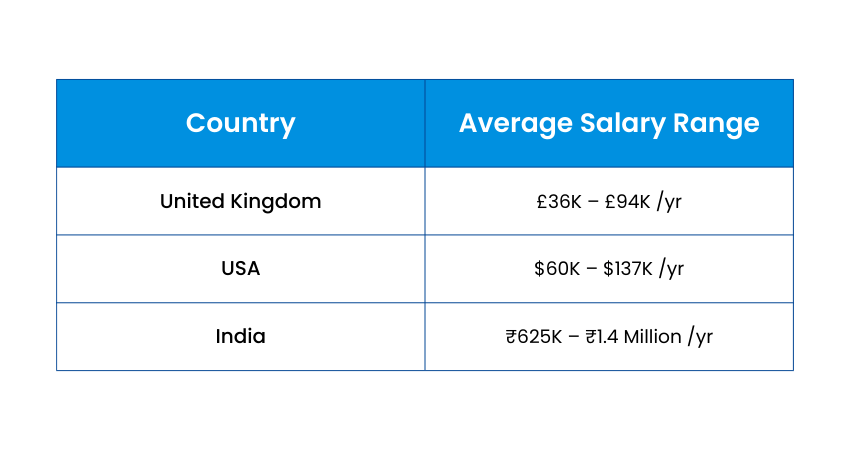
Forensic Accountant salaries vary by experience, location, and sector. Due to the specialised nature of the role, it offers strong earning potential across global markets, as outlined below.
Source: Glassdoor
United Kingdom
Forensic Accountant salaries in the UK typically range from £36,000 to £94,000 per year. Entry-level roles sit at the lower end, while experienced professionals and consultants earn significantly more.
USA
In the United States, Forensic Accountants earn between $60,000 and $137,000 per year. Professionals working in major financial centres or large consulting firms often receive higher compensation, especially at senior or expert witness levels.
India
In India, Forensic Accountant salaries generally range from ₹625,000 to ₹1,400,000 per year. While starting salaries may be lower, experienced professionals and consultants benefit from rising demand driven by increased regulatory scrutiny and financial crime investigations.
Conclusion
Forensic Accounting is a dynamic career that combines financial expertise with investigation and legal impact. Learning How to Become a Forensic Accountant opens doors to high-demand roles across sectors. With the right education, skills, and experience, professionals can enjoy meaningful work, long-term career growth, and strong earning potential worldwide.
Unlock advanced accounting mastery and boost your career with ACCA Strategic Professional Training – Join now!
Frequently Asked Questions
Q. What are the Three Main Areas of Forensic Accounting?
The three essential areas of Forensic Accounting are fraud investigation, litigation support, and regulatory or compliance analysis. These areas focus on detecting financial misconduct, supporting legal cases, and ensuring financial transparency.
Q. Are Forensic Accountants in Demand in the UK?
Yes, Forensic Accountants are in high demand in the UK due to increasing financial regulations, corporate fraud risks, and compliance requirements across industries.
Q. What's the Difference Between Forensic Accounting and Auditing?
Forensic accounting investigates financial irregularities and provides evidence for legal cases. Auditing reviews financial statements to ensure accuracy and compliance.