Have Any Question?
 +44 7452 122728




 Back
Back




Profitability Analysis: Meaning, Types, Benefits and Examples
Profitability Analysis assesses business performance using financial metrics and ratios, helping organisations improve profitability, efficiency, and growth. It also supports informed financial decision-making by identifying business strengths, reducing operational inefficiencies, and enhancing long-term financial performance.Table Of Contents


 44 7452 122728
 27-Jun-2026
Author-Gary Moore
Running a successful business is about understanding where profits are coming from and where losses may be affecting growth. Many organisations struggle to identify which products, services, or operations deliver the highest returns. This is why Profitability Analysis plays a crucial role in helping businesses measure financial performance.
By evaluating costs, revenues, and profit margins, businesses gather valuable insights that support efficiency, strategic planning, and long-term success. In this blog, you will learn what is Profitability Analysis, along with its importance, components, types, and more. Keep reading to discover how it helps organisations strengthen financial performance.
What is Profitability Analysis?
Profitability Analysis is the process of evaluating a company’s ability to generate profit from its revenue, assets, and investments using financial ratios and performance metrics. It helps businesses understand which products, services, customers, or operations contribute the most to profitability and where improvements may be needed.
Profitability Analysis provides deeper insights into the factors influencing financial performance. Combining financial data with operational factors like pricing, customer behaviour, and rising costs helps organisations make informed decisions, improve efficiency, and strengthen business growth.

Importance of Profitability Analysis
Profitability Analysis is important because it helps businesses understand which products, services, customers, or operations generate the highest profits. It supports better financial decision-making by identifying areas where fixed and variable costs can be reduced. By evaluating operational efficiencies and inefficiencies, organisations can improve performance and allocate resources effectively.
Additionally, Profitability Analysis helps businesses identify opportunities to optimise their product mix and strengthen valuable customer or supplier relationships. It supports short-term and long-term business planning by tracking profitability trends over time and benchmarking performance against competitors and industry standards.
Key Components of a Profitability Analysis
Profitability Analysis involves several key components that help businesses evaluate financial performance, identify profit drivers, and improve decision-making. Let’s look at some of the most important components used in Profitability Analysis below:
1) Customer Profitability Analysis
Customer Profitability Analysis measures the profit generated from individual customers compared to the cost of serving them. This helps businesses identify high-value customers and focus on relationships that contribute the most to profitability. It also supports better customer segmentation and targeted business strategies.
2) Qualitative Analytics
Qualitative analytics uses insights from customer feedback, market research, SWOT analysis, and focus groups to understand factors influencing profitability. It provides valuable context about customer preferences, market trends, and business opportunities. These insights help organisations make informed strategic decisions beyond numerical data.
3) Break-even Analysis
Break-even analysis helps businesses determine the point at which total revenue equals total costs, resulting in neither profit nor loss. It allows organisations to identify the minimum sales required to cover fixed and variable expenses and start generating profit. This helps businesses plan pricing strategies and manage financial risks effectively.
4) Profitability Ratios
Profitability ratios are financial metrics used to measure a company’s ability to generate profit from revenue, assets, and investments. Commonly used ratios include margin ratios, which assess profit from sales, and return ratios, which evaluate returns generated for shareholders. These ratios provide measurable indicators of financial performance and efficiency.
5) Benchmarking Industry Profitability Ratios
Benchmarking industry profitability ratios helps businesses compare their financial performance with competitors and industry standards. It allows organisations to identify strengths, measure efficiency, and find opportunities to improve profitability and competitive performance.
Improve strategic thinking and workplace decision-making abilities with the CIMA’s CGMA® Managing Performance (E2) Training – Join now!
Types of Profitability Ratio
Profitability ratios are financial metrics used to measure how a business generates profit from its revenue, assets, and investments. These ratios help organisations evaluate financial performance, improve operational efficiency, and compare results with competitors. Let’s look at them below:
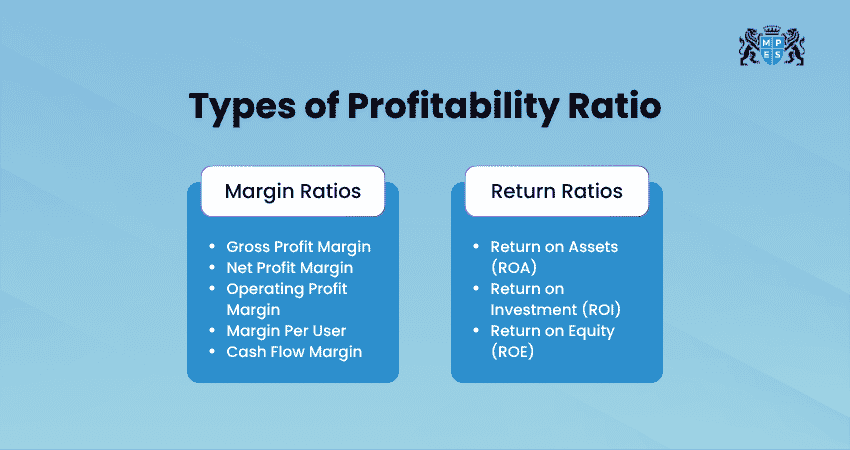
1) Margin Ratios
Margin ratios measure how much profit a business retains after covering different business costs. They help organisations understand how efficiently sales are converted into profit and where operational costs may be affecting profitability. Let’s look at these ratios below:
a) Gross Profit Margin
Gross profit margin measures the profit remaining after deducting the Cost of Goods Sold (COGS). It helps businesses evaluate pricing strategies, production efficiency, and cost control before operating expenses are considered. It highlights how efficiently a business manages production costs.
b) Net Profit Margin
Net profit margin measures the profitability after accounting for all operating expenses, taxes, and interest. It shows how much revenue is converted into actual profit and provides a clear picture of a company’s financial health and overall efficiency. This ratio reflects the overall profitability of the business.
c) Operating Profit Margin
Operating profit margin measures the profitability generated from core business operations before interest and taxes. It helps businesses assess operational efficiency and understand how effectively day-to-day activities contribute to overall profitability. It focuses on core business performance without external financial factors.
d) Margin Per User
Margin per user calculates the profit generated from each customer or user during a specific period. This metric is mainly used in subscription-based and usage-based businesses to evaluate customer value, revenue generation, and sustainable growth.
e) Cash Flow Margin
Cash flow margin measures how effectively a business converts sales into operating cash flow. It helps organisations assess liquidity, manage working capital efficiently, and understand the company’s ability to maintain healthy cash flow.
2) Return Ratios
Return ratios measure profitability based on the resources invested in the business. They help organisations evaluate how efficiently assets and shareholder investments generate financial returns. Let’s look at these ratios below:
a) Return on Assets (ROA)
Return on Assets measures how effectively a company uses its total assets to generate profit. It is particularly useful for businesses that rely heavily on equipment, infrastructure, or inventory. Generally, a higher ROA value indicates better asset utilisation and operational efficiency.
b) Return on Investment (ROI)
Return on Equity measures how effectively a business generates returns for shareholders using invested capital. A higher ROE indicates efficient capital management and strong financial performance, making it an important metric for investors.
c) Return on Equity (ROE)
Return on Equity measures the returns generated for shareholders using invested capital. It is widely used to evaluate financial performance from an investor perspective, as a higher ROE indicates efficient capital management and strong profitability.
Strengthen compliance and corporate reporting knowledge by signing up for the CIMA’s CGMA® Advanced Financial Reporting (F2) Training today!
Steps to Conduct a Profitability Analysis
Conducting a Profitability Analysis helps businesses evaluate financial performance, identify profit drivers, and improve decision-making. Let’s look at the steps involved in performing an effective Profitability Analysis below:
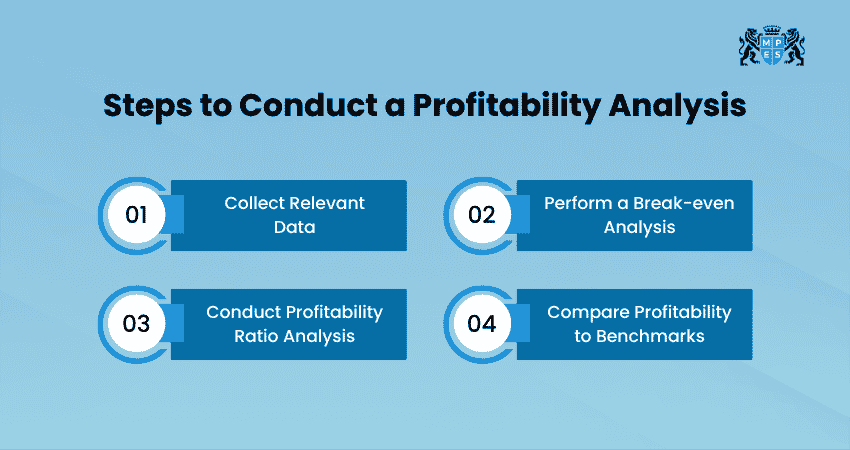
1) Collect Relevant Data
The first step is to gather financial information from reports like the balance sheet, income statement, profit and loss statement, and cash flow statement. Also, businesses may collect competitor data to compare financial performance with industry standards. Accurate and comprehensive data collection forms the foundation for reliable analysis.
2) Perform a Break-even Analysis
A break-even analysis helps determine the level of sales needed to cover both fixed and variable costs. Also, businesses can test different pricing or cost scenarios to understand how changes may affect profitability. This step helps organisations evaluate financial viability and pricing strategies.
3) Conduct Profitability Ratio Analysis
Businesses use profitability ratios, such as margin and return ratios, to measure financial performance over time. This step helps identify trends, evaluate operational efficiency, and analyse the profitability of specific products, services, or customers. Ratio analysis provides measurable insights into business performance.
4) Compare Profitability to Benchmarks
The final step is to compare profitability results with competitors and industry benchmarks. This helps organisations understand their market position, identify performance gaps, and discover opportunities for improvement. Benchmarking supports strategic decision-making and continuous improvement.
Benefits of a Profitability Analysis
Profitability Analysis provides businesses with valuable insights into financial performance, operational efficiency, and growth opportunities. Let’s look at some of the key benefits of conducting a Profitability Analysis below:
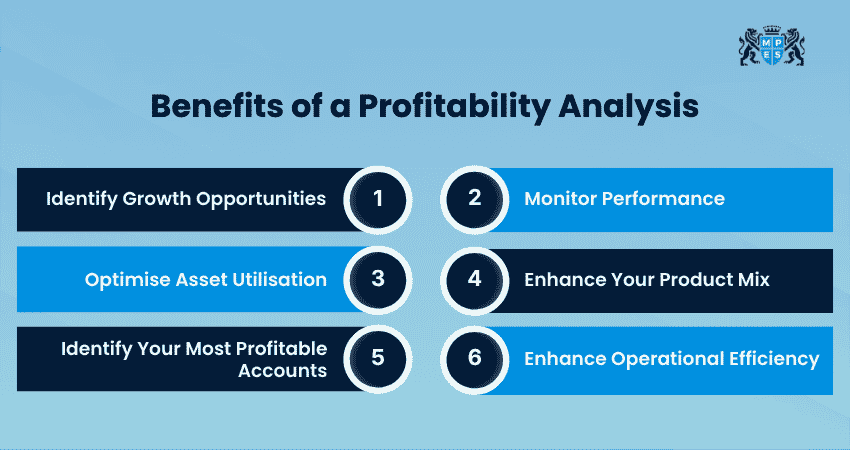
1) Identify Growth Opportunities
Profitability Analysis helps businesses identify products, services, or operations that generate the highest returns. This allows organisations to focus resources on the most profitable areas and support business growth.
2) Monitor Performance
By tracking profitability trends over time, businesses can evaluate financial performance, forecast future results, and support better strategic planning. Also, it helps organisations identify changes in profitability patterns early. Continuous monitoring helps businesses respond quickly to performance changes.
3) Optimise Asset Utilisation
Profitability Analysis helps businesses understand how effectively assets are being used to generate revenue and profit. This supports smarter asset management and improved operational efficiency. Efficient asset utilisation improves return on investment and productivity.
4) Enhance Your Product Mix
Businesses can identify which products or services are the most profitable and which are less cost-efficient. This enables organisations to improve their product mix and focus on offerings that maximise returns. A refined product mix supports higher profitability and market competitiveness.
5) Identify Your Most Profitable Accounts
Profitability Analysis helps businesses determine which customer accounts or revenue sources contribute the most to the bottom line. This supports better customer relationship management and financial decision-making. It helps organisations prioritise high-value customers and improve retention strategies.
6) Enhance Operational Efficiency
By analysing costs and business activities, organisations can identify inefficient processes that increase expenses. Methods such as activity-based costing, marginal costing, and standard costing help businesses improve cost control and operational performance. Improved efficiency leads to cost savings and stronger financial outcomes.
Enhance budgeting and advanced management accounting skills with the CIMA’s CGMA® Advanced Management Accounting (P2) Training – Join now!
Common Challenges in Profitability Analysis and How to Overcome Them?
Profitability Analysis can provide valuable financial insights, but inaccurate data or poor interpretation may lead to misleading conclusions. Understanding these common challenges and addressing them effectively helps businesses make accurate financial decisions and improve long-term performance. Let’s look at them below:
a) Using Incomplete or Outdated Data: Inaccurate or outdated financial records can distort profitability results and affect decision-making. Businesses should regularly update financial statements and ensure data accuracy before conducting analysis.
b) Misinterpreting Ratios: Relying on a single profitability ratio may provide an incomplete picture of business performance. Organisations should analyse multiple financial metrics together to understand costs, pricing, and operational efficiency.
c) Ignoring External Factors: Market conditions, seasonality, and competition can significantly impact profitability. Comparing performance with industry benchmarks helps businesses understand external influences and evaluate their market position more effectively.
d) Overlooking Indirect Costs: Indirect expenses such as administrative overhead and operational inefficiencies can reduce overall profitability if not properly allocated. Businesses should include all relevant costs to gain a more accurate financial assessment.
e) Focusing Only on Short-term Results: Analysing profitability for a single period may lead to misleading conclusions. Tracking profitability trends over time helps businesses identify long-term patterns and make more informed strategic decisions.
Profitability Analysis Example
Let’s consider a manufacturing company, XYZ Ltd, that wants to analyse the overhead costs involved in producing Product B using the activity-based costing method. The company operates 12 production machines and incurs total overhead costs of £24,000 per month. Out of these 12 machines, four machines are dedicated to producing 200 units of Product B every day. Let’s look at the calculation below:
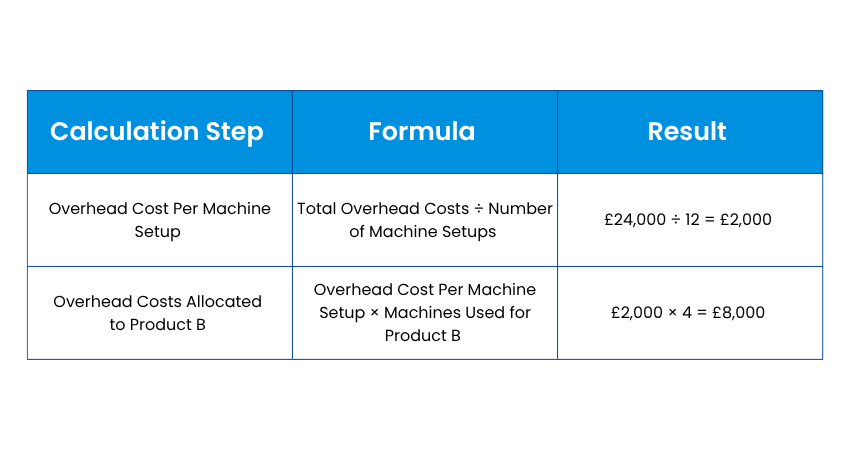
Therefore, the total overhead cost allocated to producing Product B is £8,000 per month. This helps the company understand product-level costs more accurately and improve profitability decisions.
Best Practices for Profitability Analysis
Following the right practices during Profitability Analysis helps businesses gain accurate financial insights and make better strategic decisions. Let’s look at some of the best practices organisations should follow below:
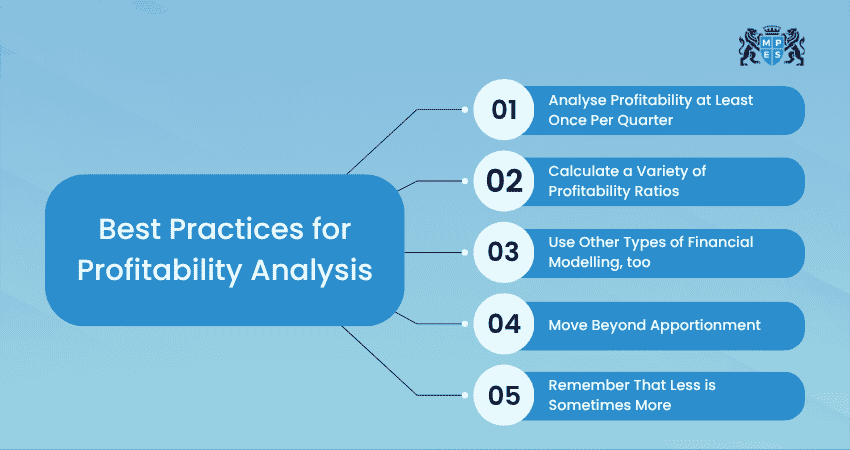
1) Analyse Profitability at Least Once Per Quarter
Businesses should analyse profitability regularly to monitor financial performance effectively. Monthly analysis is ideal for financial planning, while quarterly analysis should be considered the minimum standard for tracking profitability trends.
2) Calculate a Variety of Profitability Ratios
Relying on a single profitability ratio may not provide a complete picture of business performance. Organisations should use multiple ratios for different purposes, such as:
a) Gross profit margin to evaluate cost control
b) Net profit margin to assess pricing strategy effectiveness
c) Operating profit margin to measure operational efficiency
Using a combination of metrics provides a more comprehensive understanding of Profitability Analysis.
3) Use Other Types of Financial Modelling, too
Businesses should combine Profitability Analysis with other financial models, such as valuation models and break-even analysis. These methods help organisations evaluate growth scenarios, forecast financial performance, and understand the long-term impact of business decisions.
4) Move Beyond Apportionment
Traditional cost apportionment methods may not always provide accurate Profitability Analysis insights because indirect costs are not equally linked to all products or business units. Businesses can improve accuracy by using methods such as activity-based costing or throughput accounting to allocate costs effectively.
5) Remember That Less is Sometimes More
Businesses should avoid focusing only on short-term profits, as this may affect long-term growth and sustainability. Some initiatives may not generate immediate profits but can still provide important long-term benefits, such as:
a) Gaining a competitive advantage
b) Retaining valuable customers
c) Improving long-term efficiency and cost control
d) Strengthening brand identity and business value
Conclusion
Profitability Analysis helps businesses understand financial performance, improve operational efficiency, and make informed strategic decisions. By using the right ratios, analysing costs accurately, and monitoring performance regularly, organisations can identify growth opportunities, optimise resources, and achieve long-term business success.
Learn how to apply finance knowledge to practical business case studies with the CIMA’s CGMA® Management Level Case Study Training – Join now!
Frequently Asked Questions
Q. How can I Perform Profitability Analysis for Small Businesses Effectively?
Small businesses can perform Profitability Analysis by using accurate financial statements, separating fixed and variable costs, and calculating break-even points. Also, analysing gross, operating, and net profit margins helps identify profitable areas and compare performance with industry benchmarks.
Q. What are the 5Ps of Profitability?
The 5Ps of Profitability are:
a) Purpose: Aligns business goals and strategy
b) People: Improves workforce productivity and performance
c) Product: Delivers customer value and profitability
d) Process: Enhances efficiency and reduces costs
e) Performance: Tracks success using financial metrics
Q. What is the Difference Between Profit and Profitability?
Profit is the total amount of money a business earns after deducting expenses, showing the company’s financial gain. In contrast, profitability measures how efficiently a business generates that profit relative to revenue, assets, or investments.