Have Any Question?
 +44 7452 122728




 Back
Back




Pricing Strategies: Meaning, Tips, and Factors Explained
Pricing Strategies are methods businesses use to set product or service prices based on costs, demand, competitor pricing, and organisational objectives. Choosing the right strategy requires research, accurate calculations, and a clear understanding of market conditions to maximise profitability and support long-term business growth.Table Of Contents


 44 7452 122728
 18-Jul-2026
Author-Gary Moore
The price of a product is rarely set at random. If you've ever wondered why similar products have different price tags, the answer lies in the Pricing Strategy businesses adopt. This is a crucial business tool that goes far beyond simply determining the price of a product. The right strategy can attract customers, strengthen your brand and drive long-term profitability.
In this blog, we'll break down what are Pricing Strategies and explore practical tips for setting effective prices. We’ll also examine the key factors businesses must consider to stay competitive and maximise their revenue. So read on to discover how effective pricing can transform customer perception and fuel sustainable growth!
What are Pricing Strategies?
Pricing is often described as the amount of money you charge for a product. But the truth is it’s much more than that. The price you set sends a clear message to potential customers about how you value your brand, your product and, most importantly, your customers. In many cases, pricing is one of the first things people notice. It can strongly influence whether they make a purchase or move on to a competitor.
Businesses bring in different Pricing Strategies to determine the ideal price for their products or services. These are the approaches and methods used to decide how much a product or service should cost. In simple terms, pricing refers to the amount charged, while Pricing Strategies explain how that amount is determined.

Importance of Pricing Strategy
A well-planned Pricing Strategy helps organisations attract customers, increase sales, improve profitability and support long-term business growth. The importance of pricing can be understood through the following points:
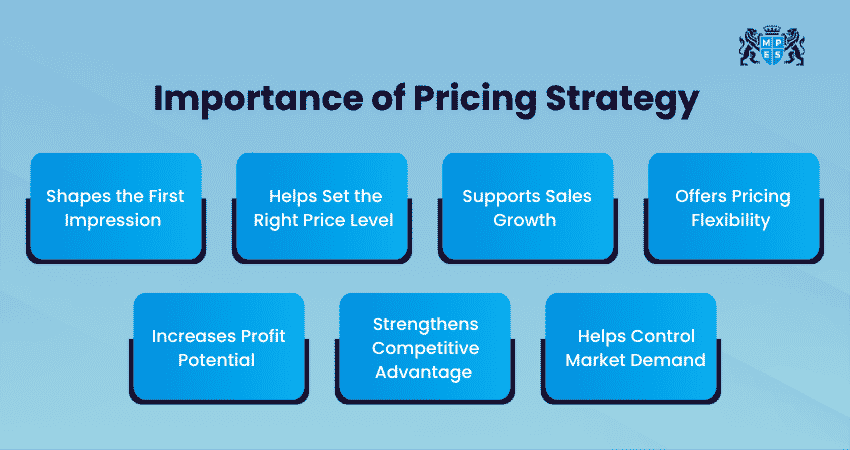
1) Shapes the First Impression
It’s no surprise that Price is often one of the first things a customer will notice when looking for a product. Before making the purchase, they’ll compare the prices with similar alternatives in the market. If the price is too high, potential buyers may be discouraged. A well-balanced and competitive price can attract attention. This can build trust and encourage customers to consider the offering.
2) Helps Set the Right Price Level
Setting the right price is prominent for maintaining business sustainability. Pricing products too high can reduce demand. Meanwhile. pricing them too low may affect the profitability of your business. Businesses need to carefully analyse market conditions, customer expectations, competitor pricing and operational costs. This will help them set a price that supports both sales and the financial goals.
3) Supports Sales Growth
Pricing can be an indispensable tool for sky-high sales. Businesses often harness the power of discounts, promotional offers and temporary price reductions to attract new customers. This can go a long way to help encourage repeat purchases. Proper Pricing Strategies can also help clear excess inventory and improve market penetration.
4) Offers Pricing Flexibility
Among all elements of the marketing mix like product, price, place and promotion, price is the most flexible. This is because it can be adjusted quickly. Businesses can modify pricing in response to changes in market demand, competitive actions, economic conditions or customer preferences. This flexibility allows organisations to remain competitive and adapt no matter how much the business environment changes.
5) Increases Profit Potential
Pricing involves a direct impact on a company's profitability. The proper Pricing Strategy ensures that the revenues exceed the costs. This helps the business cover expenses and generate profits. Strong profitability provides the resources needed for expansion, innovation, marketing efforts and improved customer service.
6) Strengthens Competitive Advantage
A well-planned Pricing Strategy can help a business differentiate itself from competitors. Competitive pricing can attract price-conscious customers. At the same time, premium pricing can reinforce perceptions of quality and exclusivity. By keeping pricing in line with customer value, businesses can boost their market position and brand image.
7) Helps Control Market Demand
Pricing is a potent tool for influencing customer demand. Lower prices, discounts and special offers can stimulate demand during slower periods. On the other hand, higher prices can help manage demand during peak seasons. This allows businesses to balance supply and demand. It’s the key to optimising resource allocation and maintaining customer satisfaction.
Go beyond the numbers and uncover the story behind financial performance with CIMA’s CGMA® Advanced Financial Reporting (F2) Course - Sign up now!
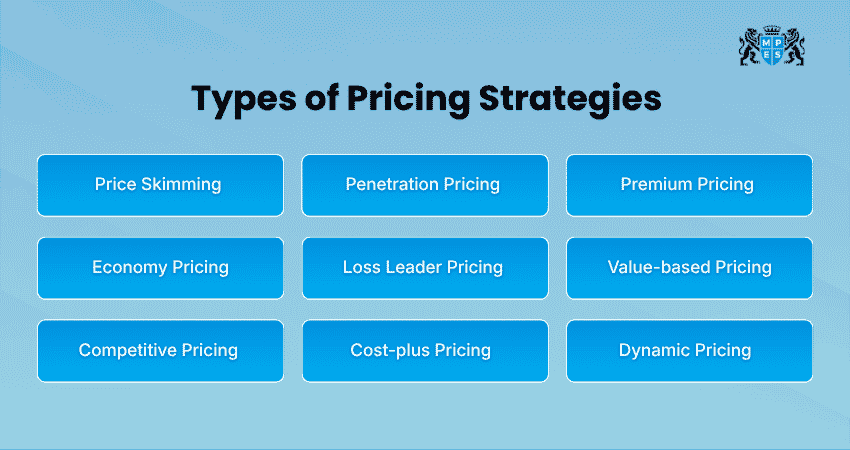
9 Types of Pricing Strategies
Businesses use different Pricing Strategies depending on their goals, target customers, competition and market conditions. Some of the most commonly used types of Pricing Strategies are discussed below:
1) Price Skimming
Price skimming is a strategy in which a business initially sets a high price for a product and gradually lowers it over time. The goal is to maximise profits from customers who are willing to pay a premium before the competitors enter the market. This approach is commonly employed in industries such as electronics and fashion. That’s because innovation and trends play a significant role in these industries. Trend-conscious customers are often willing to pay higher prices to access new products first.
2) Penetration Pricing
Penetration pricing is all about introducing a product at a lower price to attract customers. This helps the company gain market share quickly. Once the product sets up a customer base and gains popularity, the company may gradually increase the price. This strategy is particularly helpful in highly competitive markets. However, it may result in lower profits or short-term losses during the initial stages.
3) Premium Pricing
Businesses that boast strong brand recognition, superior product quality or a unique market position opt for premium pricing. In order to create an image of exclusivity and luxury, the products are intentionally priced higher than the competing products. Customers who associate higher prices with better value are often willing to pay more for premium brands. This strategy is common in luxury goods, high-end electronics, designer products, etc.
4) Economy Pricing
Economy pricing attracts cost-conscious consumers by offering exciting products at lower prices than the competitors. Businesses that go for this strategy typically maintain low production, marketing and operational costs. Even though profit margins may be relatively small, companies can compensate through large sales volumes. This pricing approach is commonly used for everyday consumer goods and budget-friendly products.
5) Loss Leader Pricing
In this powerful approach, a company offers a product at a more discounted price or even at a minimal profit. The goal is to motivate customers to purchase additional products with higher profit margins. This strategy is often employed to generate store traffic, increase brand awareness or introduce new products. While it’s effective, businesses must carefully manage customer expectations when the prices return to normal levels.
6) Value-based Pricing
Value-based pricing is focused on the perceived value of a product rather than its production cost. Companies set prices according to the benefits and value that customers believe they receive from the product. Successful implementation needs a clear understanding of customer preferences, market conditions and brand reputation.
7) Competitive Pricing
In this strategy, businesses set the prices based on competitors' prices. Depending on their market objectives, businesses may price their products slightly above, below or equal to competitors. This strategy is often adopted by startups and businesses operating in highly competitive markets.
8) Cost-plus Pricing
Cost-plus pricing is among the simplest pricing methods. Under this approach, a company determines the total cost of producing a product and adds a predetermined profit margin to calculate the selling price. Since it is based primarily on production costs, it requires minimal market research. This strategy is widely used for physical goods, although it may not fully account for customer demand or competitors' prices.
9) Dynamic Pricing
Dynamic pricing involves modifying the price of a product or service based on factors such as demand, supply, customer behaviour, timing and market conditions. Airlines, hotels and ride-sharing services frequently use this approach to optimise revenue.
Sign up for our CIMA’s CGMA® Managing Finance in a Digital World (E1) Course and learn how technology, data and innovation are transforming modern business.
What are the Factors Influencing Pricing Strategy?
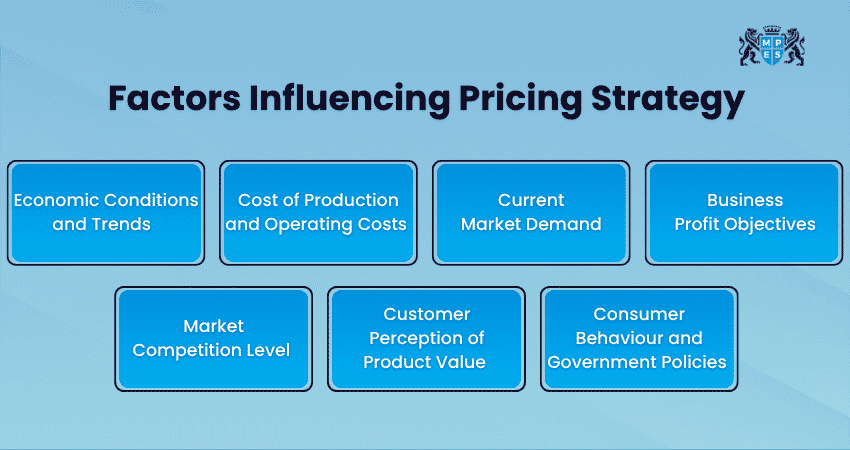
Setting the right price is never a one-time decision; it requires continuous evaluation and adjustment as market conditions change. Understanding these factors helps businesses choose Pricing Strategies that align with the market environment:
1) Economic Conditions and Trends
In times of economic downturns, consumer spending tends to decline. This prompts businesses to adjust the prices to maintain sales. Lower prices, discounts and promotional offers often become necessary, especially for non-essential products and services. On the other hand, during periods of economic growth, customers are generally more willing to spend. This allows businesses to charge premium prices for their offerings.
2) Cost of Production and Operating Costs
The cost of producing and delivering a product is a vital factor that influences Pricing Strategies. When setting prices, businesses must consider the expenses such as raw materials, labour, manufacturing, transportation, marketing and overhead costs. A selling price that does not cover these costs can reduce profitability. Meanwhile pricing products significantly above their cost without delivering additional value may put off the customers.
3) Current Market Demand
Demand plays a major role in determining Pricing Strategies. According to the law of supply and demand, prices can increase when demand exceeds supply. In such scenarios, customers may be willing to pay more to secure a product or service that is in limited supply. Conversely, when the demand is low, businesses may need to reduce prices or give incentives to encourage purchases.
4) Business Profit Objectives
A company's Pricing Strategy is often shaped by its profit goals. Businesses that focus on increasing short-term sales may use lower prices, discounts or promotional pricing. This helps them boost their short-term sales. In contrast, the companies that aim for long-term profitability may invest in strategies that build customer loyalty and brand value. This allows them to maintain premium pricing over time.
5) Market Competition Level
The degree of competition within a market can exert heavy influence on pricing decisions. In highly competitive industries, businesses often need to embrace flexible Pricing Strategies to attract and retain customers. Conducting a competitive analysis helps companies understand the prices competitors charge and the customer segments they target. This also helps them understand the products, services or benefits included in their offerings and how they are positioned in the market.
6) Customer Perception of Product Value
Customers often associate price with quality. Well-established brands can command higher prices because consumers perceive their products as more reliable or prestigious. In contrast, products priced significantly lower than competitors may sometimes be viewed as lower quality. For businesses offering high value at affordable prices, proper marketing and branding are key to communicating product quality.
7) Consumer Behaviour and Government Policies
Customer demographics like age, income, education level, lifestyle and geographic location affect the purchasing behaviour and price sensitivity. For instance, the products that are targeted at high-income consumers may support premium pricing. Meanwhile those aimed at budget-conscious customers often require more affordable price points. At the same time, government regulations and policies, including taxes, duties, trade restrictions, inflation and monetary policies, can impact business costs and Pricing Strategies.
Equip yourself with the right leadership and management skills needed to drive business success with CIMA’s CGMA® Managing Performance (E2) Course - Sign up now!
Best Pricing Strategy Tips that Must be Kept in Mind
If you're looking to fine-tune your Pricing Strategy and maximise profits, a few tips can make a big difference. Here are some practical tips to help you get started:
1) Localise Your Pricing by Region
Not all customers have the same purchasing power or expectations. What feels affordable in one region may seem expensive in another. By adjusting your pricing based on local market conditions, you can make your product more accessible and support long-term growth across different geographies.
2) Freemium is an Acquisition Model, not Pricing
Freemium is a business model used by companies to offer limited or basic features for free to users. It combines a pricing model with a customer acquisition strategy. The goal is to entice users with a free offering and then prompt them to upgrade by showcasing the added value of premium features. A successful freemium approach focuses on turning free users into loyal paying customers.
3) Strong Value Propositions Increase Willingness to Pay
It’s important to remember that customers are willing to pay more when they clearly understand what they're getting in return. Instead of stressing the features, go ahead and highlight the real benefits, outcomes and competitive advantages your product provides. The stronger your value proposition, the easier it becomes to justify your pricing.
4) Experiment With Pricing Every Quarter
Pricing shouldn't be a set-it-and-forget-it decision. Customer preferences, market conditions and business objectives change over time. Regularly test and refine your pricing whether through promotions, packaging changes, or price adjustments. This can help uncover new opportunities to increase revenue and improve conversions.
5) Case Studies Boost Trust and Conversions
Customer success stories and case studies are powerful tools for influencing purchasing decisions. When potential customers see how others have benefited from your product, they're more likely to place their trust in your brand and feel confident about making a purchase. Strong social proof can often be the final push needed to convert prospects into customers.
Conclusion
Pricing is a strategic decision that shapes how customers perceive your brand and how much they value your offerings. By understanding different Pricing Strategies, considering key market factors and continually refining your approach, you can strike the delicate balance between profitability and competitiveness. Remember, the best Pricing Strategy isn’t always the lowest or highest price. It’s the one that delivers value for both your business and your customers.
Your journey from finance professional to business leader starts with CIMA’s CGMA® Management Level Training - Join now!
Frequently Asked Questions
Q. How to Create a Winning Pricing Strategy?
A winning Pricing Strategy starts with understanding your target audience, competitors and the value your product provides. Set clear business goals, choose a pricing model that matches customer expectations and regularly review its performance to optimise revenue and stay competitive.
Q. Give Some Examples of Pricing Strategies
Examples of Pricing Strategies include penetration pricing, which uses a low introductory price to attract customers, and premium pricing, where businesses charge higher prices for a product's exclusivity and perceived quality. In value-based pricing, prices are determined by the value customers believe a product or service provides.
Q. What are Pricing Strategies in Marketing Mix?
Pricing Strategy is the price element of the four Ps of the marketing mix, alongside Product, Place, and Promotion. It determines how much customers pay for a product or service while balancing profitability, customer value, market demand and competitive positioning.