Have Any Question?
 +44 7452 122728




 Back
Back




Balance Sheet: Definition, Components, and Examples Explained
A Balance Sheet is a financial statement that shows a company's assets, liabilities and equity at a specific time, helping assess its financial health. By reviewing it, stakeholders can make informed decisions about investments, lending, and management strategies, and compare financial positions to track growth or potential risks.
Table Of Contents


 44 7452 122728
 20-Mar-2026
Author-Jenny Morris
Understanding a company’s financial health begins with one essential document: the Balance Sheet. It’s actually a snapshot of a company’s financial story, including what it owns, what it owes and what’s left over. By examining its key components, readers can gain valuable insights into liquidity, stability and overall performance.
In this blog, we break down What is a Balance Sheet, its core elements, benefits and drawbacks to help you understand how organisations track and manage their financial position. So read on and craft a compelling story of your organisation!
What is a Balance Sheet?
A Balance Sheet outlines a company’s assets, liabilities and equity at the end of the latest reporting period. This also includes figures from the previous period for comparison. It forms the foundation of financial reporting. Unlike an income statement, which shows financial performance over a period of time, a Balance Sheet provides a snapshot of an organisation’s financial position at any specific point in time.
Why Balance Sheet is Important?
A Balance Sheet in Accounting is essential for senior management, shareholders, investors and employers to evaluate a company’s financial health. It helps stakeholders assess the level of risk within a business by showing whether the organisation can meet its obligations using its available assets.
For external stakeholders, the Balance Sheet provides transparency into how a company uses its resources, where its funding originates, the level of financial risk involved, and the liquidity of its assets. Auditors also rely on Balance Sheets to verify that organisations comply with debt agreements and financial regulations.
How a Balance Sheet Works?
Investors and analysts often use various financial ratios derived from the Balance Sheet, such as the debt-to-equity ratio and the acid-test ratio, to evaluate a company’s financial stability:
Debt-to-Equity Ratio:
This measures how much of a company’s operations are financed through debt compared to shareholders’ equity. It shows the level of financial leverage used by the business. A higher ratio indicates the company relies more on borrowed funds. On the other hand, a lower ratio suggests the business is mainly funded through equity and may have lower financial risk.
Acid-test Ratio (Quick Ratio):
It measures a company’s ability to meet its short-term liabilities using its most liquid assets. It shows whether the company can pay its immediate obligations without selling inventory. A ratio above 1 generally indicates good short-term financial health. A low ratio may suggest potential liquidity problems.
Additional insights are gained by reviewing the income statement, cash flow statement and accompanying notes in financial reports, which provide further context for interpreting Balance Sheet data.
Nurture your mindset of Management Accounting with our
Management Accounting (FMA) Course
. Sign up now and level up your financial thinking!
Components of Balance Sheet
The main components of a Balance Sheet include assets, liabilities and equity. Here, we dive into these concepts in detail:
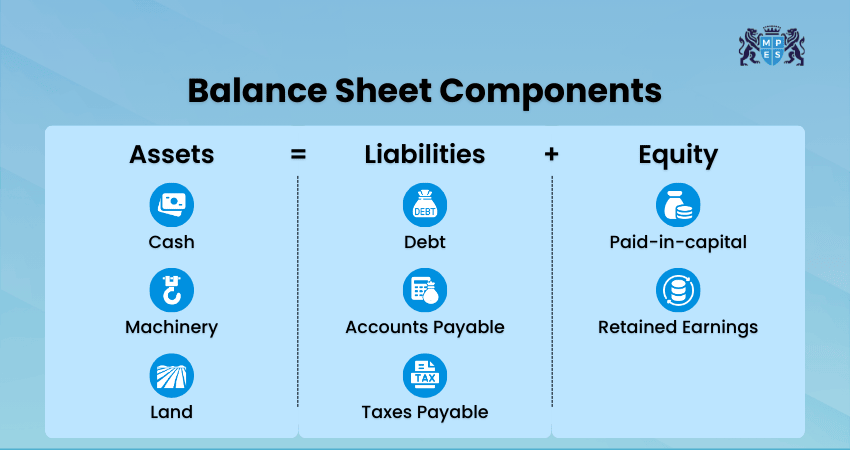
1) Assets
Accounts are arranged from top to bottom based on their liquidity, meaning how quickly they can be converted into cash. Assets are generally classified into:
a) Current Assets: These can be turned into cash within one year.
b) Non-current (or Long-term) Assets: These are expected to provide value for more than one year and cannot be easily converted into cash in the short term.
Now let’s explore the various kinds of assets:
a) Cash and Cash Equivalents
These consist of cash and highly liquid assets with very short maturity periods, typically 90 days or less. These assets can be accessed or converted into cash quickly, which is why they are always classified as current assets.
b) Short Term Investments
Short-term investments, often referred to as marketable securities, are financial assets that can be rapidly converted into cash. Businesses may invest surplus cash in these instruments temporarily until they decide on longer-term investment opportunities.
c) Inventories
Inventory represents the cost of goods purchased or produced for resale. In a manufacturing business, it includes raw materials, work in progress and finished goods. Inventory contributes to the Cost of Goods Sold (COGS) and is typically valued using methods such as First-In, First-Out (FIFO) or Last-In, First-Out (LIFO). These items are considered assets because they can be sold to generate revenue.
d) Accounts Receivable
Accounts receivable refers to the amounts owed by customers for goods and services sold on credit, after accounting for expected returns or allowances. Since these payments are usually collected within a short timeframe, they are classified as current assets.
e) Property, Plant and Equipment (PP&E)
PP&E are tangible long-term assets that a business uses in its operations for more than one year. Examples include buildings, machinery and equipment. Although these assets often involve high initial costs, they provide value over several years. Their cost is slowly allocated to the income statement through depreciation, and they are categorised as non-current or long-term assets.
2) Liabilities
Liabilities represent the financial obligations a company owes to external parties. Liabilities are generally divided into:
a) Current Liabilities: These are obligations that must be settled within one year and are usually arranged based on their due dates.
b) Long-term Liabilities: These are financial commitments that are payable after more than one year.
Now let’s explore the various kinds of liabilities:
a) Accounts Payable
This refers to the amount that a company owes to suppliers for goods and services that have already been received but not yet paid for.
b) Income Taxes Payable
Income taxes payable represent the tax obligations owed by a company depending on its taxable income, including adjustments made to estimates from previous periods.
c) Debt
Debt is a major source of financing for many organisations. It is a formal borrowing agreement that requires the company to repay the principal amount (the borrowed amount) plus interest. These payments must be made based on the agreed schedule, regardless of the company’s financial circumstances.
3) Equity
Equity represents the owners’ stake in a business and acts as a source of funding for the organisation. Unlike liabilities, equity does not require repayment. In the event of liquidation, equity reflects the remaining value available to shareholders after all company assets have been sold and all liabilities have been settled. These are the main types of equity:
a) Shareholder Equity
Shareholders’ equity represents that portion of a company’s assets belonging to its owners or shareholders. It’s often referred to as net assets, as it equals the company’s total assets minus its liabilities, which represent obligations owed to external parties.
b) Retained Earnings
These are the profits a company keeps after paying expenses and dividends. These earnings may be reinvested into the business for growth, used to reduce debt or distributed to shareholders as dividends.
Build your Accounting expertise from the ground up with our
ACCA Foundations Training
– Sign up now!
What is the Formula for Balance Sheet?
The Balance Sheet is crafted around the fundamental accounting formula:
Assets = Liabilities + Shareholders’ Equity
Consider these points:
1) Total assets are calculated as the sum of all short-term, long-term and other assets.
2) Total liabilities are calculated as the sum of every short-term, long-term and other liability.
3) Total equity is calculated as the sum of the net income, the retained earnings owner contributions and the value of shares of stock issued.
Consider this example:
If a company secures a five-year loan of £5,000 from a bank, its assets, particularly the cash account, will increase by £5,000. At the same time, its liabilities will also rise by £5,000 under long-term debt, keeping both sides of the accounting equation balanced.
Similarly, if the business receives £10,000 from investors, its assets increase by £10,000, and its shareholders’ equity increases by the same amount. These funds appear on the assets side as cash, investments, inventory or other business resources used in operations.
Example of a Balance Sheet
Here’s an example of a Balance Sheet pertaining to the e-commerce giant, Amazon.com, Inc.
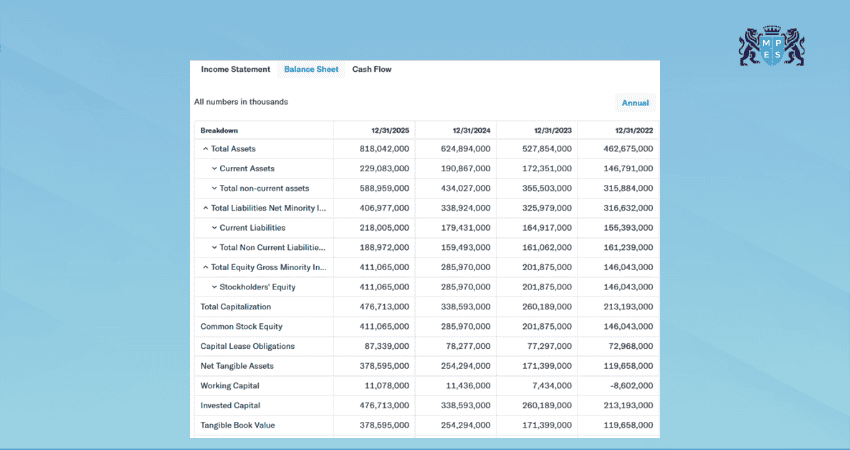
Source: Yahoo Finance
In this example, Amazon's total assets are segregated toward the top of the report. This asset section is divided into current and non-current assets, and each category is further broken down into more specific accounts.
Bring order to every level of financial chaos with our
Managing Costs and Finance (MA2) Course
- Sign up now!
How to Read or Analyse a Balance Sheet?
There may be differences in how Balance Sheets are presented across countries, but the core structure is consistent. Assets are typically arranged by liquidity, with cash and cash equivalents at the top and intangible or other long‑term assets listed last. Most formats follow the accounting equation by presenting assets first, then liabilities and finally equity. Some organisations, however, choose to rearrange this format to emphasise that assets minus liabilities equals equity.
Here's how you can analyse a Balance Sheet:
1) Understand the Balance Sheet Structure: Start by identifying the three main sections: Assets, liabilities and equity.
2) Check the Accounting Equation: Ensure the statement follows the fundamental formula:
Assets = Liabilities + Shareholders’ Equity
This equation ensures the Balance Sheet is accurate because everything the company owns must be funded either through borrowing or investor contributions.
3) Evaluate Liquidity: Liquidity measures the company’s ability to meet short-term obligations. Analysts often calculate ratios such as the current ratio or quick ratio to determine whether current assets can cover current liabilities.
4) Assess Solvency and Debt Levels: Solvency analysis focuses on long-term financial stability. By comparing debt to equity or total assets, stakeholders can determine how much of the business is financed through borrowing and whether it can manage long-term obligations.
5) Analyse Trends Over Time: A single Balance Sheet only shows financial position at one moment. Comparing Balance Sheets from different periods helps identify trends such as growth in assets, increasing debt, or changes in equity.
6) Use Financial Ratios for Deeper Insights: Financial ratios provide a clearer understanding of performance and financial health. Common categories include:
a) Liquidity ratios: ability to pay short-term obligations
b) Solvency ratios: ability to manage long-term debt
c) Profitability ratios: efficiency in generating profit
d) Efficiency ratios:
how well assets are used to generate revenue.
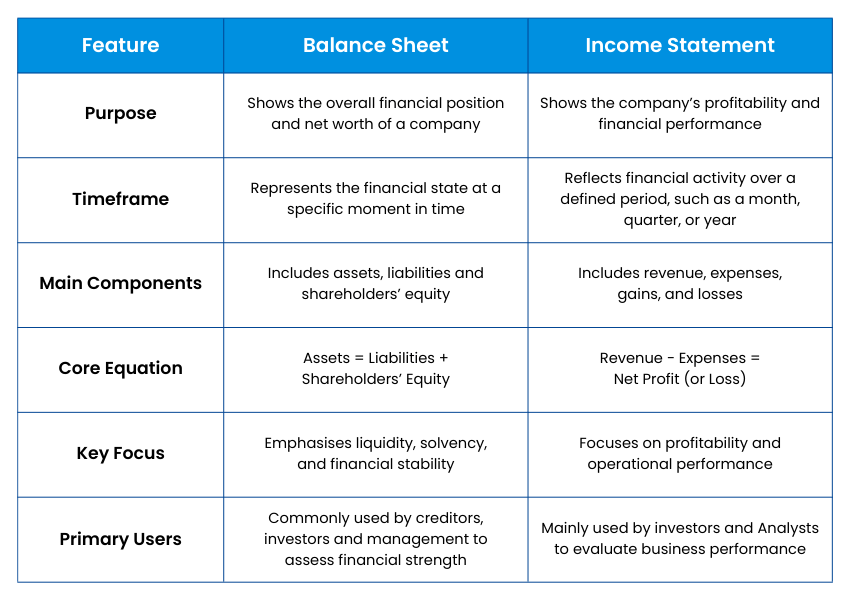
Balance Sheet vs Income Statement
Here are the main differences between a Balance Sheet and an income statement:
Advantages of a Balance Sheet
Here are the key benefits that Balance Sheets bring to businesses:
1) Provides a Clear Overview of Assets and Liabilities: A Balance Sheet offers an organised view of what a business owns and owes, helping ensure it can meet short-term financial obligations.
2) Supports Investor and Lender Confidence: It can be shared with lenders and investors to demonstrate the financial health of a business, including its debt levels and ability to manage liabilities.
3) Enables Financial Analysis and Forecasting: Many financial ratios and performance indicators are derived from Balance Sheet figures, helping assess liquidity, solvency, and operational efficiency.
4) Guides Informed Business Decisions:
By regularly reviewing the Balance Sheet, businesses can identify financial issues early, monitor equity growth, and make data-driven decisions to maintain healthy cash flow.
Disadvantages of a Balance Sheet
Here are the main drawbacks of Balance Sheets:
1) Does not Provide Complete Financial Picture: A Balance Sheet alone cannot fully explain a company’s financial performance. Analysts often combine it with the income statement and cash flow statement to gain deeper insights.
2) Represents Only a Single Point in Time: The Balance Sheet reflects the financial stature of a business on a specific date, making it difficult to assess long-term performance or trends without comparing previous statements.
3) Limited Context for Financial Figures: Numbers such as cash balances may appear strong, but without historical data, industry comparisons, or operational context, they may not accurately indicate financial health.
4) Influenced by Accounting Methods: Different accounting practices, particularly those related to depreciation and inventory valuation, can affect how figures appear on the Balance Sheet.
5) Subject to Managerial Judgement:
Certain items, such as accounts receivable, rely on estimates regarding collectability. These judgements may influence the reported values and impact the accuracy of the statement.
Tips for Creating Balance Sheets
Here are the two main tips for creating an accurate and reliable Balance Sheet:
1) Ensure Correct Statement Balances
A Balance Sheet must always follow the fundamental equation. If the figures do not match, the issue may arise from incorrect transaction entries, calculation mistakes or currency conversion errors. Always review totals carefully and ensure that all financial data has been recorded accurately.
2) Use Automation to Simplify the Process
Financial reporting tools can help accounting teams minimise manual data entry while improving accuracy. By integrating information from multiple financial systems and ledgers into a single platform, you can streamline data collection and improve reporting efficiency. Access controls can also be implemented to make sure that only authorised individuals can view or modify financial data.
Conclusion
A Balance Sheet is a powerful snapshot of a company’s financial strength. By understanding its components and how they connect, businesses and investors can make significantly smarter financial decisions. Mastering Balance Sheet analysis helps reveal stability, manage risks and build confidence in long-term business growth.
Amplify your record-keeping skills and excel in the field of Accounting with our comprehensive Maintaining Financial Records (FA2) Course – Sign up now!
Frequently Asked Questions
Q. What are Common Balance Sheet Mistakes?
Common Balance Sheet mistakes include:
a) Incorrect transaction entries
b) Missing financial data
c) Calculation errors that cause the statement to become unbalanced
d) Misclassified assets and liabilities
e) Failure to update figures regularly
f) Inaccurate valuation of inventory, depreciation or receivables
Q. What is the Golden Rule of Balance Sheet?
The golden rule of Balance Sheets is that the total assets must always equal the sum of liabilities and shareholders’ equity. This principle makes sure that every asset owned by a company is financed either through borrowing or through the owners’ investment in the business.
Q. What are the 4 Things to Look for in a Balance Sheet?
When reviewing a Balance Sheet, focus on assets, liabilities, shareholders’ equity and liquidity position. These elements help determine what the company owns, what it owes, the value available to owners, and whether the business can meet its short-term financial obligations.