Have Any Question?
 +44 7452 122728




 Back
Back




What Is Liquidity? A Guide to Financial Assets in Accounting
Liquidity in Accounting is the ability of a business to convert its assets into cash quickly without significantly affecting its value or financial position. It helps businesses meet short-term obligations such as paying bills, salaries, and suppliers on time. Strong Liquidity indicates good financial health and stability.Table Of Contents


 44 7452 122728
 10-Apr-2026
Author-James Smith
What plays a bigger role in business success, profit or cash? The answer might surprise you. Many companies show strong profits on paper but still struggle to pay their day-to-day expenses. This happens because profit does not always mean cash is available whenever needed. That is where Liquidity comes in.
It helps businesses understand how seamlessly they can access cash to manage operations. It plays a key role in avoiding cash shortages and improving financial stability. In this blog, we’ll explore What is Liquidity, why it is important, its different types, and how to calculate it effectively. Let’s get started!
What is Liquidity?
Liquidity refers to how quickly and easily an asset can be converted into cash without significantly affecting its market price. An asset can be called liquid when it can be turned into ready cash with minimal loss in market value.
In simple terms, Liquidity shows how easily a business can access cash when needed. Highly liquid assets like cash and bank balances can be used immediately, while less liquid assets such as property or machinery may take time to sell and convert into cash.
What is Business Liquidity?
Business Liquidity focuses specifically on a company’s ability to handle its short-term financial obligations using its available assets. It shows whether a business has enough cash or assets that can quickly become cash.
It is important for daily operations, as a business needs money to pay employees, purchase raw materials, and keep everything running smoothly. Without enough Liquidity, even a profitable company can struggle.

Why is Liquidity Important?
Liquidity is important because it keeps a business running without interruptions. Even successful companies can face problems if they do not have enough cash at the right time. So, here are some of the reasons why Liquidity of company is important:
1) Improves Financial Stability: Strong Liquidity acts as a safety net during uncertain times. It allows businesses to stay stable even when there are unexpected expenses or revenue drops.
2) Helps Manage Emergencies: Liquidity ensures that businesses can handle sudden financial challenges, such as repairs, economic downturns, or urgent payments, without major issues.
3) Ensures Smooth Day-to-day Operations: Liquidity helps businesses handle regular expenses like salaries, rent, and supplier payments without delays. This keeps operations running smoothly and avoids disruptions.
4) Helps Meet Short-term Obligations: A company with good Liquidity can easily pay its short-term debts on time. This minimises the risk of financial stress.
5) Builds Trust with Stakeholders: Investors, lenders, and suppliers are more confident in businesses that maintain healthy Liquidity. It shows that the company is financially responsible and reliable.
6) Supports Better Decision-making: When a business has enough cash available, it can make quicker and smarter decisions, such as investing in new opportunities or expanding operations.
Learn how to manage costs and business performance with Management Accounting (MA) Training – Register today!
Types of Liquidity
Liquidity exists in different forms depending on the context in which it is applied. Understanding these types helps businesses manage finances more effectively. Let's check the common types of Liquidity of a business:
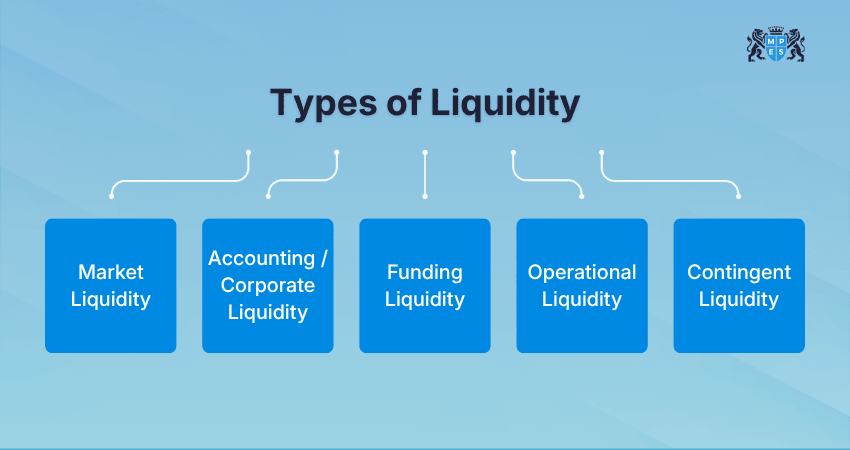
1) Market Liquidity
Market Liquidity means how easily an asset can be bought or sold in the market without impacting its price. Highly liquid markets, such as stock exchanges, allow assets to be traded quickly with minimal price changes.
For example, shares of large companies are more liquid because there are many buyers and sellers. In contrast, specialised assets like rare artwork or niche equipment may have low market Liquidity because fewer buyers exist.
2) Accounting Liquidity / Corporate Liquidity
Accounting or Corporate Liquidity focuses on a company’s financial statements and its ability to meet short-term liabilities using current assets. It uses numbers from the balance sheet to measure financial health.
For example, if a company has enough cash and receivables to pay its bills, salaries, and suppliers on time, it has good accounting Liquidity. This helps managers and investors understand how stable a business is. It also helps in planning and decision-making.
3) Funding Liquidity
Funding Liquidity is the ability of an organisation to obtain cash or financing when needed. This could come from sources like internal reserves, bank loans, or external investors. This improves a company’s financial flexibility.
For example, if a company needs funds to cover an urgent expense and can quickly get a bank loan or use a credit line, it has good funding Liquidity. This helps to invest in growth opportunities and handle emergencies without depending on existing cash reserves.
4) Operational Liquidity
Operational Liquidity relates to the cash flow generated from day-to-day business activities. It focuses on how efficiently a company converts its operations into cash. It also shows how well a business manages its working capital, such as receivables, payables, and inventory.
For example, if customers pay quickly and inventory is sold efficiently, the business will have good operational Liquidity. Poor Liquidity, on the other hand, may indicate inefficiencies in processes or delayed receivables.
5) Contingent Liquidity
Contingent Liquidity refers to a company’s ability to handle unexpected financial situations, such as economic downturns, emergencies, or sudden expenses. This often involves backup plans, such as emergency funds, credit lines, or insurance coverage.
For example, if a company faces an unexpected expense, such as equipment failure or a sudden drop in sales, it can use its emergency fund or credit line to manage the situation. This ensures that businesses can remain stable even during uncertain times.
Develop key skills in business operations and governance with the Business and Technology (BT) Course – Sign up soon!
How to Calculate Liquidity?
Liquidity is measured using formulas called ratios. These ratios compare assets with Liabilities to show how well a business can pay its short-term debts. Let's check how Liquidity is calculated:
1) Current Ratio
The current ratio measures a company’s ability to pay its short-term liabilities using its current assets. This ratio gives a general view of a company’s financial health. If the ratio is above one, it means the business has enough assets to cover its liabilities.

2) Quick Ratio
The quick ratio is also called an acid-test ratio, and it excludes inventory from current assets to give a more conservative measure of Liquidity. It doesn’t include inventory because it may take time to sell.

3) Cash Ratio
It is the most conservative Liquidity measure. It takes only cash and cash equivalents as liquid assets. This ratio shows whether a company can immediately pay off its short-term debts without relying on other assets.

Example of Liquidity
To understand Liquidity better, let’s look at a simple example. A company has the following:
1) Cash: £10,000
2) Accounts Receivable: £5,000
3) Inventory: £8,000
4) Current Liabilities: £10,000
Now we calculate:
1) Current ratio = (10,000 + 5,000 + 8,000) / 10,000 = 2.3
2) Quick ratio = (10,000 + 5,000) / 10,000 = 1.5
3) Cash ratio = 10,000 / 10,000 = 1
In this case, the company has enough liquid assets to cover its short-term obligations. It can use its cash immediately, collect receivables soon, and sell inventory if needed. These results show that the business has good Liquidity.
What is the Correct Order of Liquidity in Accounting?
In accounting, assets are listed in order of how quickly they can be turned into cash. This is called the order of Liquidity. Here is the usual order followed:
1) Cash and cash equivalents
2) Marketable securities
3) Accounts receivable
4) Inventory
5) Prepaid expenses
6) Fixed assets (machinery, buildings, equipment)
7) Intangible assets or goodwill
Conclusion
Liquidity is a fundamental concept in Accounting and Financial Management. It helps businesses stay stable, meet their obligations, and plan for the future. By understanding What is Liquidity, businesses can make better decisions, avoid financial problems, and grow with confidence. It is not just about having money, but about having the required amount of money at the right time.
Build your confidence in Accounting fundamentals with ACCA Applied Knowledge Training – Join now!
Frequently Asked Questions
Q. How do I Create a Liquidity Plan?
Creating a Liquidity plan involves analysing your cash inflows and outflows, predicting future financial needs and maintaining sufficient reserves. Start by tracking expenses, setting cash flow targets, and identifying potential risks. You also need to have some backups like credit lines or emergency funds to handle unexpected situations.
Q. What is a Good Liquidity Amount?
A good Liquidity level depends on the nature of the business and industry. In general, a current ratio between 1.5 and 2 or a quick ratio of 1.0 or higher is considered healthy. However, businesses with stable cash flows may operate effectively with lower ratios, while others may require higher Liquidity for safety.
Q. Is too Much Liquidity a Bad Thing?
Having too much Liquidity can sometimes be inefficient. It may mean that money is not being used effectively for growth or investment. Businesses should aim for a balance, keeping enough cash for safety while using extra funds to grow.