Have Any Question?
 +44 7452 122728




 Back
Back




What is the Pareto Principle? A Complete Guide to 80/20 Rule
The Pareto Principle, or 80/20 Rule, shows that 80% of results often come from 20% of efforts, helping improve efficiency, productivity, and decision-making. It encourages individuals and businesses to focus on high-impact tasks for better outcomes and efficiency. This also supports sustainable growth and smarter resource management.Table Of Contents


 44 7452 122728
 16-May-2026
Author-Gary Moore
Why do a few customers generate most profits, or a handful of tasks drive most success? The answer often lies in the Pareto Principle, commonly known as the 80/20 Rule. This powerful concept shows how a small number of causes can contribute to the majority of outcomes, making it one of the most practical principles in business and everyday life.
Whether you want to improve productivity, manage time effectively, or make smarter decisions, the Pareto Principle helps you focus on what creates the greatest impact. This blog explores how the 80/20 Rule works, its benefits, applications, limitations, and real-life examples. Let's dive into it!
What is the Pareto Principle?
The Pareto Principle, also known as the 80/20 Rule, states that roughly 80% of results come from 20% of causes or efforts. Introduced by Vilfredo Pareto, the concept highlights the imbalance between efforts and results, where a small number of activities often create the biggest impact. It is widely used in business, productivity, and quality management to identify high-value tasks or resources.
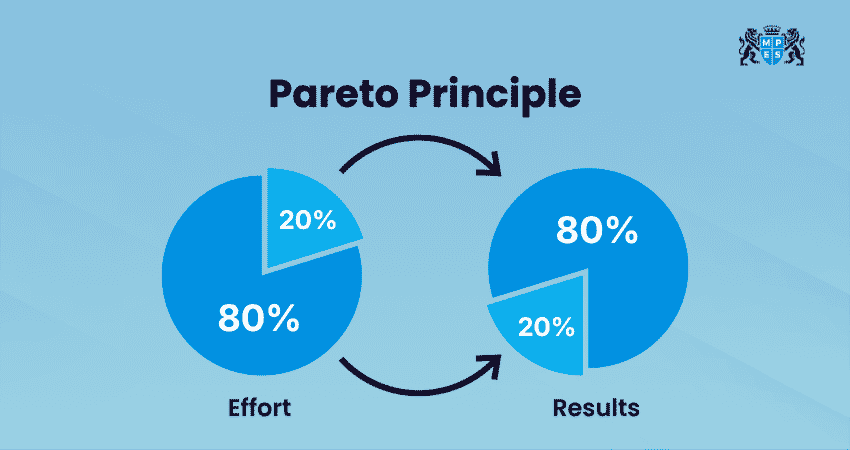
The Pareto Principle helps individuals and organisations focus on the most effective activities to improve efficiency and achieve better results. For example, a company may generate most profits from a small group of customers, while students may achieve better results by focusing on key topics.

Does the Pareto Principle Always Work?
No, the Pareto Principle, or 80/20 Rule, does not always apply exactly in every situation. It is a general guideline for prioritisation rather than strict scientific rules. While the principle suggests that a small number of causes create most results, the ratio may vary, such as 70/30 or 90/10.
The principle mainly helps individuals and organisations focus on the activities or resources that create the greatest impact and overall business value. Although it supports better productivity and decision-making, it should be used flexibly, as the 80/20 pattern may not apply in every case.
Practical Ways to Apply the Pareto Principle
The Pareto Principle can be applied across a wide range of practical situations to improve productivity and decision-making. By focusing on the small number of activities that deliver the greatest results, individuals and organisations can achieve more with less effort. Below are some key areas where it can be applied effectively:
1) Improving Productivity
The Pareto Principle can improve productivity by helping individuals focus on the tasks that create the greatest impact. In many cases, around 20% of daily tasks contribute to 80% of overall results. Instead of giving equal attention to every activity, people can prioritise high-value tasks that support important goals and project progress.
To apply the principle, individuals can create a list of tasks and identify which activities have the highest impact. For example, tasks involving team dependencies, project blockers, or activities that unlock progress for others should often receive priority. This approach helps improve time management, reduce distractions, and increase overall efficiency.
2) Better Decision-making
The Pareto Principle also supports better decision-making by helping organisations identify the main causes of problems. When businesses face multiple challenges, the principle allows teams to focus on the issues that have the greatest impact on operations, productivity, or customer satisfaction.
Organisations can apply the principle by identifying problems, analysing their root causes, and grouping similar issues together. Teams may also assign values to problems based on their business impact to determine which issues require immediate attention. By focusing on the top contributing factors, businesses can create solutions that resolve a large percentage of problems more effectively.
3) Managing Quality Standards
The Pareto Principle is broadly used in quality management and process improvement. Businesses often use Pareto Analysis and Pareto Charts to identify the most common causes of defects, delays, or operational issues. This helps organisations prioritise corrective actions and improve product or service quality.
In methodologies such as Six Sigma, Pareto Charts are commonly used to visualise problems and identify the factors causing the greatest variation in processes. By addressing the most significant issues first, organisations can reduce defects, enhance customer satisfaction, and increase operational efficiency.
Learn essential accounting and transaction recording skills for finance professionals with our Management Information (MA1) Training – Register now!
Advantages of the Pareto Principle
The Pareto Principle helps individuals and organisations focus on the activities that create the greatest impact. By identifying key priorities, it improves productivity, decision-making, and resource efficiency. Key advantages of the Pareto Principle include:
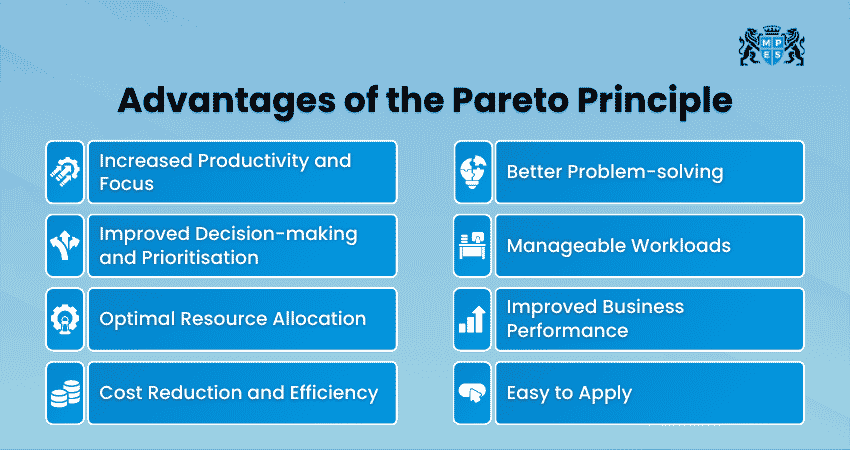
1) Increased Productivity and Focus: Helps individuals concentrate on the tasks that generate the highest results while reducing time spent on low-value activities
2) Improved Decision-making and Prioritisation: Supports better planning by identifying the most critical tasks, problems, or opportunities
3) Optimal Resource Allocation: Helps organisations assign resources, budgets, and talent to the most profitable or impactful areas
4) Cost Reduction and Efficiency: Identifies unnecessary processes, expenses, or recurring issues to improve operational efficiency
5) Better Problem-solving: Supports root cause analysis by focusing on the major causes of defects, delays, or business challenges
6) Manageable Workloads: Breaks large projects or responsibilities into smaller, prioritised tasks for easier management
7) Improved Business Performance: Helps businesses focus on profitable customers, products, or services that contribute most to revenue
8) Easy to Apply: The principle is simple to understand and can be used across industries, including business, education, healthcare, and Project Management
Disadvantages of the Pareto Principle
While the Pareto Principle is useful for prioritisation and productivity, it also has certain limitations. Focusing too heavily on the most impactful tasks or causes may result in overlooking other important areas. Some key disadvantages of the Pareto Principle include:
1) Depends on Historical Data: The analysis is often based on past information, which may not accurately reflect future changes or trends.
2) Highlights Issues but Not Solutions: It helps identify major problems or causes but does not explain how to solve them.
3) May Ignore Smaller Priorities: Focusing mainly on high-impact tasks can result in neglecting smaller activities that still matter over time.
4) Can Be Misunderstood: The principle does not suggest that only minimal effort is required to achieve major results.
5) Not Always Exact: The 80/20 ratio is a guideline and may differ depending on the situation or industry.
6) Limited for Detailed Analysis: It supports broad prioritisation but cannot replace deeper quantitative or performance analysis.
7) Risk of Incorrect Application: Using the principle in unsuitable situations may lead to poor judgement and ineffective prioritisation.
Develop confidence in recording and managing financial transactions accurately with the Recording Financial Transactions (FA1) Training – Join today!
Real-life Examples of the Pareto Principle
The Pareto Principle appears in many areas of business and daily life. It highlights how a small number of causes often produce the majority of results, helping people focus on high-impact areas. Some common real-life Pareto Principle examples include:
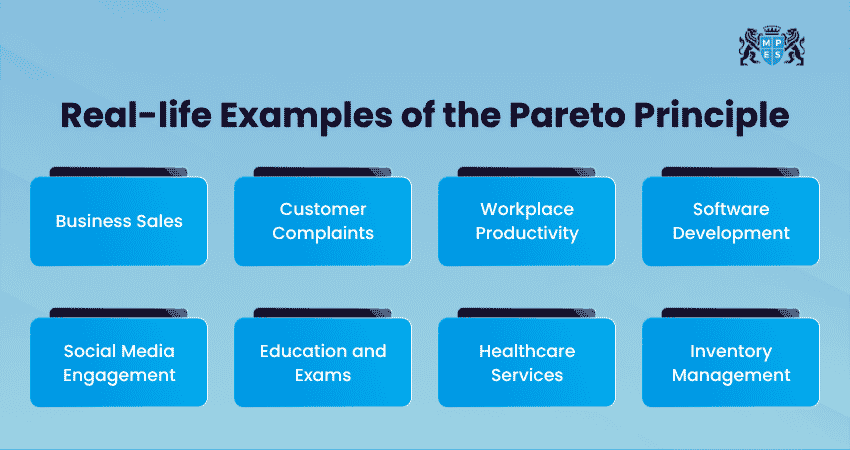
1) Business Sales: Around 80% of the company’s revenue may come from 20% of customers or products
2) Customer Complaints: A small number of recurring issues often cause the majority of customer complaints
3) Workplace Productivity: Employees may complete the most important work through a limited number of high-priority tasks
4) Software Development: A small percentage of software bugs may cause most system errors or failures
5) Social Media Engagement: A few posts or campaigns often generate the most likes, comments, and shares
6) Education and Exams: Students may achieve most exam results by focusing on the most important topics
7) Healthcare Services: A limited number of medical conditions may account for the majority of hospital visits
8) Inventory Management: A small percentage of products may generate most business profits or sales
Conclusion
The Pareto Principle remains one of the most effective ways to improve productivity, prioritise important tasks, and make smarter decisions. By focusing on the activities that create the greatest impact, individuals and organisations can achieve better results with less wasted effort, leading to greater efficiency, growth, and long-term success.
Build strong accounting and finance foundations for future career success with our ACCA Foundations Training – Join now!
Frequently Asked Questions
Q. What is the Difference Between the Pareto Principle and Pareto Efficiency?
The Pareto Principle, or 80/20 Rule, states that a small number of causes often create most results. Pareto Efficiency, however, is an economic concept where resources are allocated so efficiently that improving one person’s situation would make another person worse off.
Q. Does 20% of Employees Really Complete 80% of the Work?
Yes, the idea that 20% of employees complete 80% of the work is a common example of the Pareto Principle or 80/20 Rule. It suggests that a smaller group of employees often contributes to most of the results or productivity, though the exact ratio may vary across organisations and industries.
Q. Do the Numbers in the 80/20 Rule Need to Add up to 100?
No, the numbers in the 80/20 Rule do not always need to add up to 100. The Pareto Principle is a general guideline showing that a small number of causes often create most results. Depending on the situation, the ratio may vary, such as 70/30 or 90/10.