Have Any Question?
 +44 7452 122728




 Back
Back




Price Skimming: Definition, Strategy and How It Works
Price Skimming is a pricing strategy where businesses launch products at high prices and gradually reduce them over time to reach a broader market. It helps maximise early profits, recover costs, and target different customer groups. It is commonly used for new or innovative products to build a premium brand image in the early stages.Table Of Contents


 44 7452 122728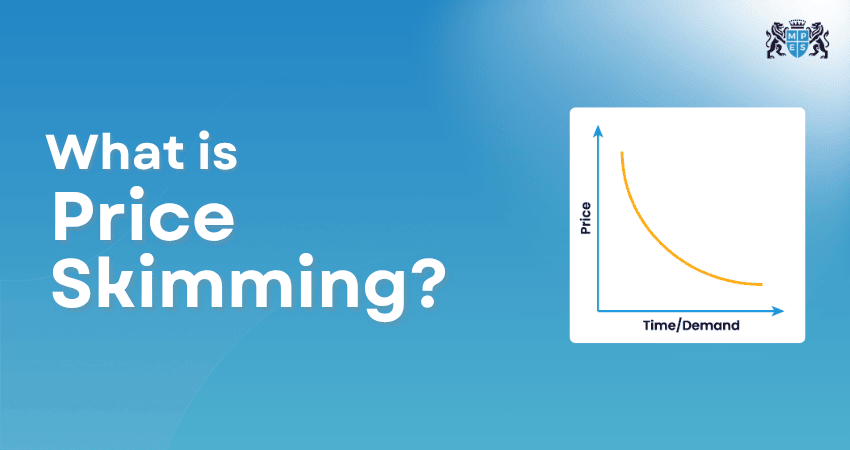
 18-Apr-2026
Author-Maria Thompson
You’ve probably seen it; new phones launch at high prices, then slowly become affordable. At first, only a few people will be willing to pay that huge amount, but over time, more customers jump in as prices drop. This pattern isn’t random. It is a well-planned strategy called Price Skimming.
Many businesses use it to maximise profits while building excitement and demand. But why do they start high when they know prices will fall later? Understanding this can completely change the way you look at pricing and product launches. In this blog, we’ll explore what is Price Skimming, how it works, and how businesses use it to target different customer groups. Let's dive in!
What is Price Skimming?
Price Skimming is the process of launching a product at a high price to attract customers who are willing to pay more, and then gradually reducing the price over time to reach a wider audience. This method relies on creating a sense of exclusivity in the early stages of a product launch.
This approach also allows companies to recover development and marketing costs quickly. Over time, lower prices help attract more price-sensitive customers and increase overall sales.
How Does Price Skimming Work?
Price Skimming works by aligning pricing with customer willingness to pay across different market segments. Instead of setting one fixed price for everyone, businesses adjust prices over time to capture value from various groups.
Initially, the product is priced high to attract early adopters. These customers are typically less price-sensitive and more focused on being the first to own or use a product. After this segment is served, the price is gradually reduced to reach a broader audience. Over time, the product reaches a price point that suits the mass market.
Stages of a Skimming Pricing Strategy
Price Skimming involves clearly planned stages, from setting a high initial price to gradually lowering it as market demand changes. Understanding these stages helps businesses apply the strategy more effectively and maximise overall results. So, here are the stages that you need to follow:
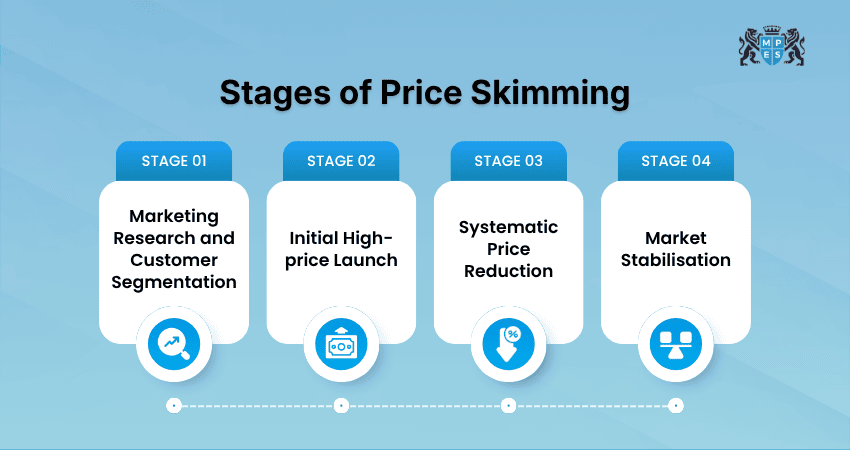
Phase 1: Marketing Research and Customer Segmentation
Before using Price Skimming, businesses need to understand their customers. They divide people into groups based on things like how much they can spend, how loyal they are to the brand, and how they usually shop. Early buyers are usually those who don’t mind paying more to get a new product first.
Companies also study the market by looking at competitors, demand and how customers react to different prices. This helps them decide the best starting price and plan future price changes.
Phase 2: Initial High-price Launch
In this stage, the product is launched at a high price. This helps businesses earn more from customers who are ready to pay extra for something new or exclusive. It also helps recover the money spent on creating and promoting the product.
Companies also try to make the product look premium through branding and marketing. Sometimes, they limit the number of products available to create a sense of urgency and make it feel more special.
Phase 3: Systematic Price Reduction
After the first group of customers has bought the product, the company slowly starts lowering the price. These changes are planned and done step by step, not all at once. This gradual approach helps maintain the product’s value while expanding its reach in the market.
Each price drop attracts a new group of customers who were waiting for a lower price. The goal is to keep sales going while still making a profit. Timing is important so that the company does not lose customers or reduce value too quickly.
Phase 4: Market Stabilisation
In the final stage, the price becomes stable and suitable for the general market. By this time, many different types of customers have already bought the product. Thus, at this point, businesses focus more on maintaining steady sales and staying competitive in the market.
Instead of frequent price changes, the goal is to build customer loyalty, improve product availability, and strengthen the brand’s position. This stage also helps ensure consistent revenue as the product reaches its full market potential.
Build a solid understanding of cost control and budgeting with the
Management Accounting (MA) Training
– Register today!
How to Implement Price Skimming?
Implementing Price Skimming requires careful planning and a clear understanding of your product and target customers. By following the right steps, companies can maximise profits while gradually expanding their customer base. Here is how you can effectively implement it:
Step 1: Analyse Price Sensitivity
Understanding how much customers are willing to pay is crucial. Businesses often use surveys, historical data, and competitor analysis to assess their product’s price sensitivity. This helps set the initial price at a level that maximises revenue without discouraging early buyers.
Step 2: Evaluate Fixed and Variable Costs
A successful Price Skimming strategy needs to account for costs. Fixed costs like research and development, along with variable costs like production and distribution, should be carefully analysed. This ensures that the pricing structure supports profitability at every stage.
Step 3: Plan Price Reductions
Price changes must be planned in advance rather than decided randomly after launch. Businesses need a clear roadmap outlining when and how prices will be reduced. This plan often aligns with product lifecycle stages, competitor activity, and market demand.
Step 4: Emphasise Premium Value
Even as prices decrease, the product has to maintain a perception of quality. Strong branding, storytelling, and customer experience play a vital role here. Companies that succeed in Price Skimming often invest heavily in marketing to reinforce their product’s value.
Advantages of Price Skimming
Price Skimming offers several benefits for businesses and understanding them helps explain why many companies choose this approach. The following are its advantages:
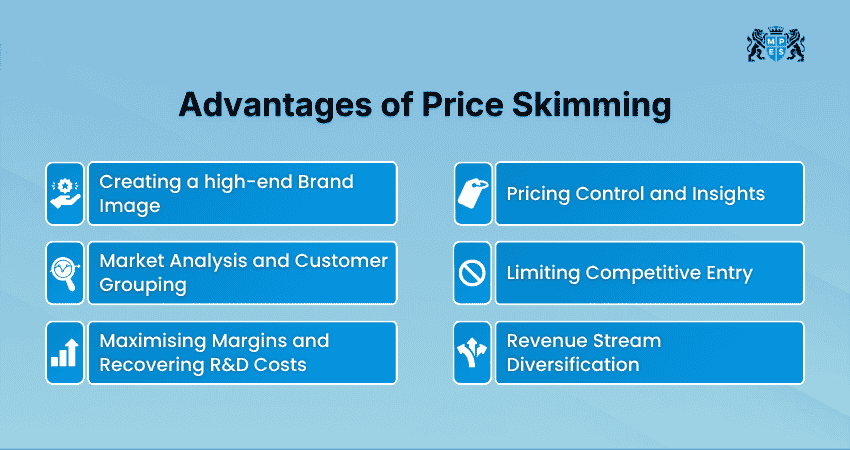
1) Creating a high-end Brand Image
One of the biggest benefits of Price Skimming is the ability to position a product as a premium. High initial pricing signals quality, exclusivity, and innovation. This perception can significantly enhance brand reputation and customer loyalty over time.
2) Market Analysis and Customer Grouping
Price Skimming naturally aligns with deep market understanding. Businesses gain insights into different customer segments and their behaviours. These insights can be used to refine future products and marketing strategies.
3) Maximising Margins and Recovering R&D Costs
By charging higher prices initially, companies can quickly recover their investment in Research and Development (R&D). This is particularly important in industries where innovation requires high upfront costs.
4) Pricing Control and Insights
Price Skimming gives businesses greater control over pricing decisions. They can adjust prices based on demand, competition, and customer response. This flexibility allows for continuous optimisation and improved profitability.
5) Limiting Competitive Entry
High initial prices can discourage competitors from entering the market immediately. It signals that the product offers unique value that may be difficult to replicate. It also allows the business to establish a strong market position before facing increased competition.
6) Revenue Stream Diversification
By targeting different customer segments over time, businesses create multiple revenue streams from a single product. This staged approach helps maximise overall earnings and reduces reliance on one customer group.
Develop essential business and organisational skills with the
Business and Technology (BT) Course
– Join soon!
Disadvantages of Price Skimming
While Price Skimming can be effective, it also comes with certain drawbacks that businesses need to consider. Here are the disadvantages that you should never miss out on before using it:
1) Managing Price Reductions
Frequent price changes of a product can be challenging to manage. If not handled carefully, they may confuse customers or damage brand trust. Companies need clear communication strategies to avoid negative reactions.
2) Limited Product Adoption
High initial prices can limit access to the product, especially for price-sensitive customers. This may slow down market penetration and reduce overall reach in the early stages. It can also delay the product’s acceptance in the wider market.
3) Less Effective in Highly Competitive Markets
In markets with intense competition, Price Skimming may not work well. Competitors can quickly introduce similar products at lower prices, attracting customers away. This makes it difficult to sustain high prices for long periods.
Examples of Price Skimming Success
Now, let’s check the real-world examples of companies that have successfully used Price Skimming:
1) Apple Inc.
Apple is one of the best-known examples. When a new iPhone is launched, it starts at a high price to target loyal customers and early adopters. Over time, prices drop or older models become cheaper, making them accessible to a wider audience.
2) Sony
Sony uses Price Skimming for products like PlayStation consoles. At launch, the price is high due to strong demand and limited supply. As competition increases and demand stabilises, the price is gradually reduced to attract more customers.
3) Nike
Nike applies this strategy with its premium and limited-edition trainers. New releases are priced high for enthusiasts and collectors. Later, discounts and sales make these products more affordable, helping Nike reach a broader market while maintaining its premium image.
4) Zara
Zara often launches new fashion collections at higher prices at the start of the season. As trends change or seasons end, prices are reduced through sales, making products accessible to more customers.
Best Practices for Implementing Price Skimming
To use Price Skimming successfully, businesses need more than just a high starting price. It requires a proper strategy. Therefore, the following are some of the best practices you can follow while implementing it:
1) Pre-implementation Assessment
Before adopting a Price Skimming strategy, businesses have to evaluate whether their product truly supports premium pricing. Factors like uniqueness, demand, and competition must be considered.
2) Strategic Planning and Timeline Development
Clear timelines for pricing changes are essential. Businesses should plan when to reduce prices based on market conditions and product lifecycle stages. This ensures consistency and avoids reactive decision-making.
3) Cross-functional Coordination
Price Skimming requires collaboration across departments, such as marketing, finance, sales, and product development. A proper alignment with these teams ensures that pricing decisions support overall business objectives.
4) Use of Analytics Tools
Modern businesses use Data Analytics to monitor customer behaviour, demand trends, and competitor actions. By using various tools, you can gather useful insights that help improve pricing decisions. This helps refine your pricing strategies and achieve better results over time.
Future Trends of Price Skimming
Price Skimming is changing as markets and technology continue to grow. Businesses are now using better tools and smarter methods to adjust prices more easily. Let's check the future trends that are being used:
1) Flexible Pricing Changes: Instead of fixed price drops, companies are using flexible pricing. Prices can change based on demand and market conditions.
2) Personalised Pricing: Some businesses offer different prices to different customers based on their preferences, purchase history or buying habits.
3) Data-driven Pricing Decisions: Businesses now use data to understand customer behaviour and demand. This helps them make better pricing decisions.
4) Integration With Digital Platforms: With more products being sold online, companies can easily update prices and reach more customers quickly.
5) Subscription and Tiered Pricing Options: Many businesses now offer different pricing levels, such as basic and premium plans, to attract different types of customers.
6) Faster Price Adjustments:
Due to high competition, companies now reduce prices more quickly to stay competitive and attract customers.
Price Skimming vs Penetration Pricing
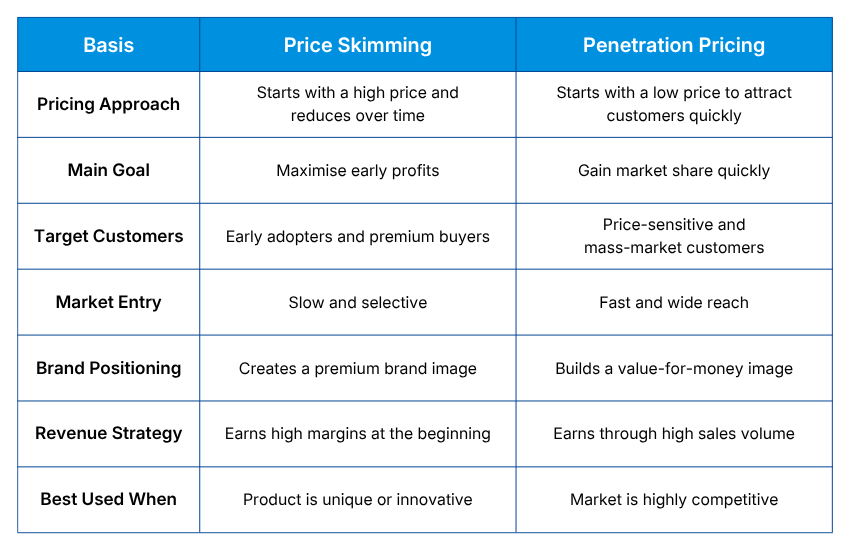
Price Skimming and penetration pricing are often compared because they take opposite approaches. Price Skimming starts high and gradually decreases, focusing on maximising early profits and targeting premium customers. In contrast, penetration pricing starts low to attract a large customer base quickly and gain market share.
The choice between these strategies depends on business goals. So, let’s have a deep insight into their differences with the table below:
Conclusion
Price Skimming is a strategic approach that combines market understanding, product positioning and timing. When executed correctly, it allows businesses to maximise revenue, recover costs quickly, and build a strong brand image. When used effectively, it can help businesses reach different customer groups while maintaining long-term profitability.
Gain essential business and finance skills with ACCA Applied Knowledge Training – Sign up now!
Frequently Asked Questions
Q. Who Benefits from Price Skimming?
Price Skimming primarily benefits innovative companies launching premium products, such as technology firms, luxury brands, and pharmaceutical companies. It also benefits businesses targeting early adopters willing to pay higher prices initially, allowing firms to recover development costs quickly and maximise profits before competitors enter the market.
Q. What is Price Skimming with an Example?
Price Skimming means launching a product at a high price and lowering it gradually over time. For example, Apple Inc. releases new iPhones at premium prices, then reduces older model prices to attract more customers and maximise revenue.
Q. How Does Tesco Use Price Skimming?
Tesco uses elements of Price Skimming in premium or limited-edition products. These products may launch at higher prices to target specific customer segments before being discounted over time. This approach helps Tesco maximise revenue while still appealing to a wider range of customers later.