Have Any Question?
 +44 7452 122728




 Back
Back




Cloud Accounting vs Traditional Accounting: A Complete Breakdown
Cloud Accounting stores financial data online for real-time access and automation, while Traditional Accounting uses local software with manual updates. Both systems help businesses manage financial records and reporting efficiently, but they differ in accessibility, scalability, security, and collaboration features.Table Of Contents


 44 7452 122728
 25-May-2026
Author-Veronica Davis
Managing business finances is not always easy, especially when invoices pile up, spreadsheets become difficult to track, and financial reports take hours to prepare manually. In today’s fast-moving business environment, the discussion around Cloud Accounting vs Traditional Accounting is becoming more relevant as organisations look for smarter and more efficient ways to manage their finances.
While some businesses still prefer Traditional Accounting for its familiarity and control, others choose Cloud Accounting for its flexibility, automation, and real-time access. This blog on Cloud Accounting vs Traditional Accounting explores their key differences, advantages, and disadvantages to help you choose the right system for your business. Let's read to know more!
What is Cloud Accounting?
Cloud Accounting is an online accounting system that stores financial data on secure cloud servers instead of local computers or paper records. It allows businesses to manage financial activities such as invoicing, expense tracking, payroll, and reporting through an internet connection.
Businesses can access Cloud Accounting systems anytime using devices such as laptops, tablets, or smartphones. Cloud Accounting also supports real-time updates, automatic backups, remote collaboration, and software automation, helping organisations improve efficiency and Financial Management.
What is Traditional Accounting?
Traditional Accounting is a conventional method of managing financial records using paper-based bookkeeping systems or accounting software installed on local computers. In this system, financial data is usually stored on office devices or internal servers instead of online cloud platforms.
Businesses use Traditional Accounting to record transactions, prepare financial reports, manage payroll, and maintain accounting records manually or through desktop software. Access to the data is generally limited to specific devices or office locations, and updates or backups often need to be handled manually.
Differences Between Cloud Accounting vs Traditional Accounting
Cloud Accounting and Traditional Accounting differ in cost, security, accessibility, collaboration, and maintenance. Traditional Accounting uses local software, while Cloud Accounting provides online access, automation, and real-time updates. The table below highlights the key differences between Cloud Based Accounting vs Traditional Accounting:
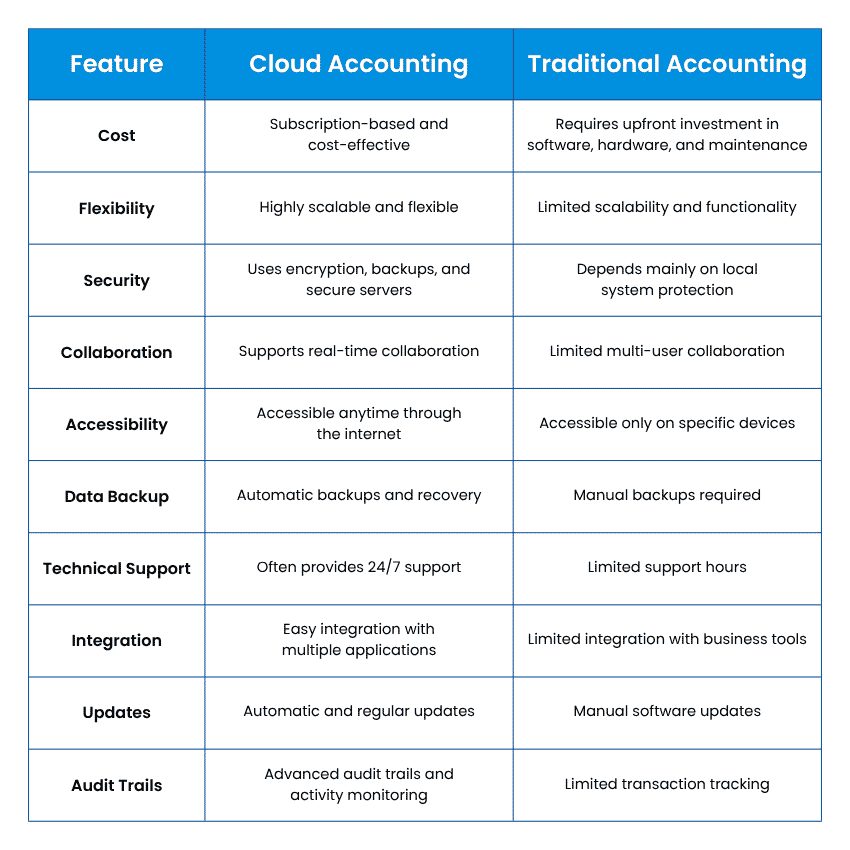
Cloud Accounting providers use encryption, secure servers, automatic backups, and regular security updates to protect financial data from cyber threats. These measures are centrally managed and continuously updated, ensuring stronger and more consistent protection over time.
Traditional Accounting systems store data on local computers or servers, which can increase the risk of data loss if devices are damaged or affected by viruses or ransomware. In this model, businesses are responsible for managing their own security, backups, and system updates, which can lead to inconsistencies in protection.
2) Scalability in Cloud Accounting and Traditional Accounting
Cloud Accounting systems are highly scalable, allowing businesses to easily upgrade features, add users, expand storage, and integrate additional applications as they grow. This flexibility makes cloud solutions ideal for organisations experiencing rapid or unpredictable growth.
Traditional Accounting systems are less adaptable because expanding capabilities often requires purchasing new software versions, additional storage, or upgraded hardware. This can make scaling slower, more complex, and more costly over time.
3) Accessibility in Cloud Accounting and Traditional Accounting
Cloud Accounting software can be accessed from any internet-connected device, allowing users in different locations to work on the system simultaneously. This supports remote working, flexible operations, and faster access to financial information in a Financial Accounting in a Remote Work Era.
Traditional Accounting software is usually limited to specific computers or office locations where the software is installed. This reduces flexibility and limits how many users can access the system simultaneously.
4) Cost Comparison in Cloud Accounting and Traditional Accounting
Cloud Accounting typically uses a monthly or yearly subscription model, allowing businesses to pay only for the services and features they need. Automatic updates and reduced infrastructure costs also make Cloud Accounting more cost-effective for many organisations.
Traditional Accounting systems often require upfront investments in software, hardware, storage devices, and ongoing maintenance. Businesses may also need to purchase updated software versions separately when upgrades are required.
Gain practical business and finance skills for professional accounting success with the Business, Technology & Finance (BTF) Training – Sign up now!
5) Collaboration in Cloud Accounting and Traditional Accounting
Cloud Accounting enhances collaboration by allowing multiple users to access and update financial data in real time from different locations. Many platforms also offer role-based access and dashboards, improving teamwork and transparency across departments.
Traditional Accounting systems make collaboration more difficult because access is often limited to specific devices or locations. This restricts simultaneous usage, slows communication, and can reduce overall workflow efficiency.
Advantages and Disadvantages of Cloud Accounting
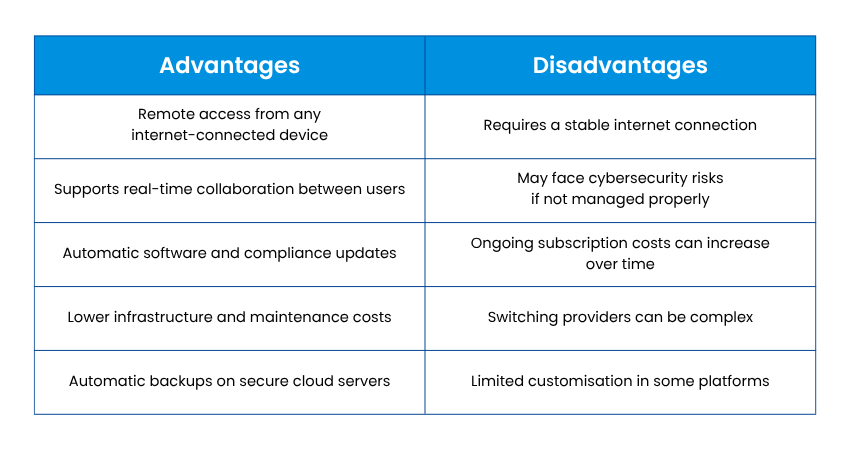
Cloud Accounting improves Financial Management through automation and online accessibility, but it also has certain limitations. The following points explain its key advantages and disadvantages:
Advantages of Cloud Accounting
1) Remote Accessibility: Users can access financial records, dashboards, and invoices from any internet-connected device.
2) Real-time Collaboration: Multiple users, including Accountants and finance teams, can work on the same system simultaneously.
3) Automatic Updates: Software updates and compliance changes are handled automatically by the provider.
4) Reduced Infrastructure Costs: Businesses can avoid large upfront investments in hardware and maintenance.
5) Automatic Data Backups: Financial data is regularly backed up on secure cloud servers for improved protection.
Disadvantages of Cloud Accounting
1) Internet Dependency: A steady internet connection is required to access and manage the system efficiently.
2) Cyber Security Risks: Online systems may face cyber threats if security practices are not managed properly.
3) Ongoing Subscription Costs: Monthly or yearly subscription fees can increase long-term expenses.
4) Vendor Lock-in: Moving data to another provider or system can sometimes be complex.
5) Limited Customisation: Some cloud platforms may not support highly customised business requirements.
Gain practical assurance knowledge for a successful accounting career path through the Assurance (AS) Training – Register today!
Advantages and Disadvantages of Traditional Accounting
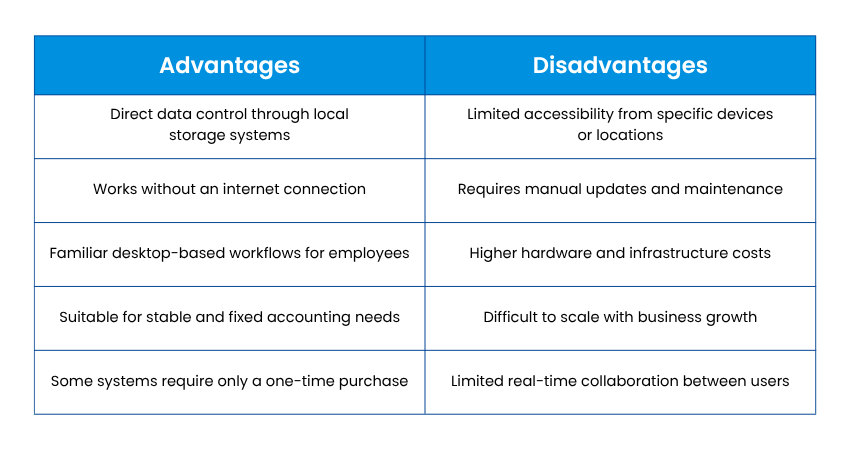
Traditional Accounting systems provide offline Financial Management and direct data control, but they also have limitations in accessibility, maintenance, and scalability. The following points explain their key advantages and disadvantages:
Advantages of Traditional Accounting
1) Direct Data Control: Businesses store and manage financial data on local systems without relying on third-party cloud providers.
2) Offline Accessibility: Traditional Accounting software can function without an internet connection, making it useful in areas with unstable connectivity.
3) Familiar Processes: Many organisations prefer Traditional Accounting because employees are already experienced with desktop-based systems and workflows.
4) Fixed System Structure: Traditional Accounting systems are suitable for businesses with stable operations and limited accounting requirements.
5) One-time Software Purchase: Some Traditional Accounting systems require only a one-time software purchase instead of recurring subscription fees.
Disadvantages of Traditional Accounting
1) Limited Accessibility: Users can usually access financial data only from specific computers or office locations.
2) Manual Maintenance: Businesses are responsible for software updates, backups, and system maintenance.
3) Higher Infrastructure Costs: Traditional Accounting may require investments in hardware, storage devices, and technical support.
4) Limited Scalability: Expanding system capabilities often requires additional software licences and hardware upgrades.
5) Reduced Collaboration: Traditional systems make real-time collaboration difficult because access is often limited to a few users or devices.
Conclusion
Choosing between Cloud Accounting vs Traditional Accounting can shape how efficiently a business manages its finances. While Traditional Accounting offers control and familiarity, Cloud Accounting provides flexibility, automation, and real-time access. Understanding their differences helps businesses choose a smarter and more scalable accounting solution for long-term growth.
Develop industry-ready accounting knowledge through the ACA Certificate Level Training – Register now!
Frequently Asked Questions
Q. Which is More Secure, Cloud Accounting or Traditional Accounting Systems?
Cloud Accounting often provides stronger security through encryption, automatic backups, and regular updates managed by providers. Traditional Accounting offers direct data control but may face higher risks from hardware failure, data loss, or outdated security measures if systems are not maintained properly.
Q. Does Cloud Accounting Help with Tax Compliance and Reporting?
Yes, Cloud Accounting helps businesses manage tax compliance and reporting more efficiently. It automates calculations, tracks financial records in real time, generates reports quickly, and helps reduce manual errors, making tax preparation and compliance easier for organisations.
Q. Which Accounting System is Better for Long-term Business Growth?
Cloud Accounting is often considered better for long-term business growth because it offers scalability, automation, remote accessibility, and real-time collaboration. However, the right choice depends on a business’s size, operational needs, budget, and preferred level of control over financial data.