Have Any Question?
 +44 7452 122728




 Back
Back




Accounting Rate of Return (ARR): Explained with Formula and Example
Accounting Rate of Return is a financial metric that measures investment profitability by comparing annual profit with the initial investment cost. It helps businesses compare projects and identify profitable income opportunities. Because it is simple to calculate, ARR is widely used in financial planning and investment decision-making.Table Of Contents


 44 7452 122728
 08-Jun-2026
Author-Veronica Davis
Every investment comes with one important question: Will it actually make a profit? Businesses invest in new projects, equipment, and technologies expecting higher income and profitable returns, but measuring profitability is not always easy. This is where the Accounting Rate of Return (ARR) becomes useful. It provides a quick and practical way to evaluate whether an investment is worth the cost.
From small businesses to large organisations, Accounting Rate of Return is widely used to compare projects and support smarter financial decisions. Whether you are learning finance or improving investment analysis skills, understanding ARR can make financial planning easier. In this blog, you will explore the ARR formula, calculation steps, examples, and depreciation impact. Let’s dive in!
What is Accounting Rate of Return (ARR)?
The Accounting Rate of Return (ARR) is a financial metric used to measure an investment’s profitability. It shows the percentage of return or income a business expects to earn based on average annual accounting profit compared to the initial investment cost. Businesses commonly use ARR to compare projects and identify investments with better return potential.
ARR is widely used in capital budgeting because it is simple to calculate and easy to understand. A higher ARR generally indicates a more profitable investment, while a lower ARR may suggest lower profitability. Unlike advanced financial methods, ARR focuses on accounting profit instead of cash flow and does not consider the time value of money.

Accounting Rate of Return Formula
The Accounting Rate of Return formula is used to measure the profitability of an investment by comparing the average net profit earned with the initial investment amount. It helps businesses understand the expected return an investment may generate over its useful life.
The formula for calculating the Accounting Rate of Return (ARR) is:

Where:
1) Average Net Profit = Average yearly profit earned from the investment (Total Profit over Investment Period / Number of Years)
2) Initial Investment = Total amount invested at the beginning of the project
A higher ARR generally indicates a more profitable investment opportunity, helping businesses compare projects and make better financial decisions.
How to Calculate Accounting Rate of Return?
The Accounting Rate of Return is calculated using simple accounting data to measure an investment’s expected profitability. The following steps explain how businesses calculate ARR and analyse the expected return percentage:
1) Calculate the Yearly Average Profit
The first step is to calculate the average annual profit generated by the investment during its useful life. To do this, divide the total accounting profit earned over the investment period by the number of years the investment is expected to operate. This provides the average yearly accounting profit used in the ARR calculation. This step ensures that profit is evenly distributed across the investment period, making comparisons more consistent and reliable.

2) Identify the Initial Investment Amount
Next, determine the total initial investment cost of the project. This includes the original purchase price of the asset, installation costs, setup charges, and any other expenses required to start the investment. Identifying the correct investment amount is important for accurate ARR calculation. Accurate identification of all initial costs helps prevent underestimating or overestimating the investment’s actual value.
3) Use the ARR Formula
After calculating the average annual profit and identifying the investment amount, apply the ARR formula. Divide the average annual profit by the initial investment amount and multiply the result by 100 to express it as a percentage for easier financial comparison and investment evaluation purposes.

4) Analyse the Results
Once the ARR percentage is calculated, businesses analyse the result to evaluate the investment’s profitability. A higher ARR usually indicates a more profitable investment opportunity, while a lower ARR may suggest lower returns. Companies often compare ARR values between projects to identify the most financially beneficial option.
Build practical audit and assurance skills for confident accounting careers with the Audit and Assurance (AA) Training – Sign up now!
Accounting Rate of Return Calculation Example
Understanding the Accounting Rate of Return (ARR) becomes easier with a practical example. Businesses use ARR to estimate how profitable an investment may be before making financial decisions. It helps compare projects and identify which investment is likely to generate better returns over time.
Suppose a company invests £100,000 in new machinery expected to operate for four years. During this period, the machine is expected to generate a total accounting profit and income of £40,000. The company wants to calculate the ARR to evaluate whether the investment is financially worthwhile.
Step 1: Calculate the Average Annual Profit
First, divide the total profit by the number of years the investment will operate:

Now divide the average annual profit by the initial investment amount and multiply by 100:

Final Result
The Accounting Rate of Return for this investment is 10%. This means the company is expected to earn a 10% annual return on its investment based on accounting profit. Businesses can compare this percentage with other investment opportunities or their target return requirements to make better financial decisions.
Build strong financial reporting skills for real-world accounting success through the Financial Reporting (FR) Training – Register today!
How Does Depreciation Affect the Accounting Rate of Return?
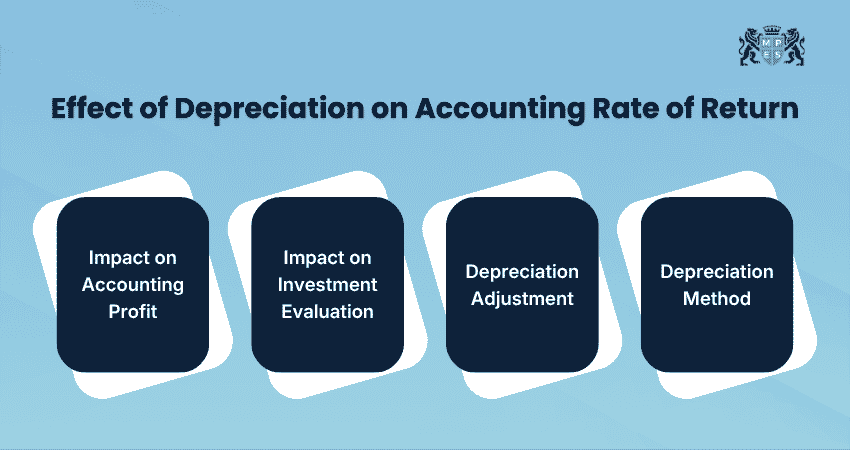
Depreciation is an important factor in Accounting Rate of Return (ARR) because it directly affects accounting profit and the final return percentage. The following points explain its impact on ARR. Understanding this relationship helps businesses make more informed investment decisions.
1) Impact on Accounting Profit:
Depreciation is a non-cash expense that reduces an asset’s value over its useful life. During ARR calculation, it is deducted from revenue to determine net profit, resulting in lower ARR values. This reduction in reported profit can significantly influence how profitable an investment appears in accounting terms.
2) Impact on Investment Evaluation:
Depreciation can reduce an investment’s perceived profitability. Projects with high depreciation costs may appear less attractive in ARR calculations, even if they generate strong cash flows. This means ARR may not always reflect the true cash-generating potential of an investment.
3) Depreciation Adjustment:
Some analysts adjust ARR calculations by adding back depreciation expenses to accounting profit. This helps provide a clearer view of the investment’s economic profitability after considering depreciation effects. Such adjustments can improve accuracy when comparing projects with different asset structures.
4) Depreciation Method:
The depreciation method also affects ARR results. Methods such as straight-line and accelerated depreciation produce different expense values, causing ARR percentages to vary. Therefore, choosing the right depreciation method is important for consistent and fair investment evaluation.
Conclusion
The Accounting Rate of Return (ARR) is a simple and useful method for measuring investment profitability using accounting profit. By understanding its formula, calculation process, and the impact of depreciation, businesses can compare investment opportunities more effectively and make informed financial decisions that support long-term growth and profitability.
Accelerate your accounting career through the ACCA Applied Skills Courses – Join today!
Frequently Asked Questions
Q. Is Accounting Rate of Return the Same as Internal Rate of Return?
No, the Accounting Rate of Return (ARR) and Internal Rate of Return (IRR) are different. ARR measures profitability using accounting profit, while IRR measures investment returns based on cash flows and the time value of money. IRR is generally considered more accurate for long-term investment analysis.
Q. Is the Accounting Rate of Return the Same as Return on Investment?
No, the Accounting Rate of Return (ARR) and Return on Investment (ROI) are different. ARR measures average annual accounting profit, while ROI measures the overall return earned from an investment.
Q. What are Returns Called in Accounting?
In accounting, returns usually refer to goods returned by customers or buyers. These are commonly called sales returns when customers return products and purchase returns when businesses return goods to suppliers.