Have Any Question?
 +44 7452 122728




 Back
Back




What Is Gross Income? Importance and How to Calculate It
Gross Income is the total money earned by an individual or business before taxes, deductions, or expenses are removed, helping measure overall earnings. It supports budgeting, tax planning, and loan approvals, while also showing overall earning potential and enabling better financial decisions and long-term planning.Table Of Contents


 44 7452 122728
 02-Apr-2026
Author-Maria Thompson
Have you ever looked at your salary and wondered why the amount you receive feels much lower than what was promised? Or noticed that banks and employers always focus on a higher figure than your take-home pay? This is where understanding Gross Income becomes important, as it represents the total earnings before any deductions are made.
Whether you are planning your monthly budget, applying for a loan, or comparing job offers, knowing this figure can help you make better financial decisions. In this blog, you will learn what Gross Income means, why it matters, and how to calculate it in a simple and practical way.
What is Gross Income?
Gross Income is the total amount of money an individual or business earns before any deductions, such as taxes, expenses, or other costs, are removed. It represents the full earnings generated over a specific period and provides a clear view of total earnings.
For individuals, it includes salary, wages, tips, bonuses, and investment income, while for businesses, it is calculated as total revenue minus the Cost of Goods Sold (COGS). Gross Income is widely used to determine tax liability, assess loan eligibility and evaluate an individual’s or organisation’s financial position.

Why Gross Income is Important?
Gross Income is important because it influences many financial decisions, from borrowing money to planning future earnings. It serves as a key measure used by organisations to assess their financial capacity in situations such as the following:
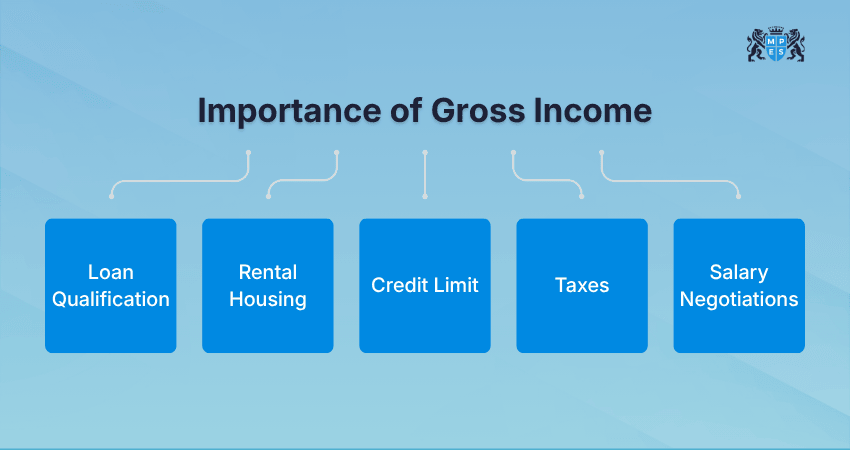
1) Loan Qualification: Lenders check your Gross Income to decide if you meet the minimum requirement for loan approval.
2) Rental Housing: Landlords use it to assess whether you can afford and consistently pay rent.
3) Credit Limit: Credit card issuers consider it when determining how much credit to offer you.
4) Taxes: It acts as the starting point for calculating how much tax you owe.
5) Salary Negotiations: Knowing your Gross Income helps you negotiate better pay and improve your earning potential.
How Gross Income Works?
Gross Income works differently for individuals and businesses, as each has different income sources and uses. It acts as the starting point for financial evaluation, helping measure total income before deductions. This can be understood more clearly as follows:
1) For Individuals: Gross Income includes all earnings such as salary, wages, and bonuses. It can be easily identified from a pay slip or calculated based on hours worked and pay rate.
2) Financial Assessment: Lenders and landlords use an individual’s Gross Income to evaluate their ability to repay loans or afford rent. It also helps determine affordability and financial stability.
3) For Businesses: Gross Income is calculated by subtracting the cost of goods sold from total revenue, focusing on income generated from core operations.
4) Performance Analysis: Businesses use Gross Income to analyse how specific products or services perform, excluding unrelated expenses like rent, to get clearer insights.
Develop skills in business structure, leadership, and technology-driven decision making with the Business and Technology (BT) Training – Join today!
How to Calculate Gross Income?
Calculating Gross Income involves adding all earnings before any deductions, such as taxes or expenses. While the concept is the same, the method differs slightly for individuals and businesses. To make this clearer, let’s look at how it is calculated for each:
Individual Gross Income
Individual Gross Income is calculated by adding all sources of income earned before any taxes or expenses are deducted. This includes not only salary or wages but also other earnings such as tips, bonuses, rental income, dividends, interest, pensions, and capital gains.
Formula:

For tax purposes, certain types of income may not be included, but they can still be considered when calculating Gross Income for loans or credit assessments. In general, for non-tax purposes, Gross Income is simply the total amount an individual earns before any deductions are applied.
Business Gross Income
Business Gross Income is calculated by subtracting the cost of goods sold (COGS) from total revenue. It shows how much a company earns from its core operations after accounting for direct costs of producing goods or services.
Formula:

This measure helps businesses understand how profitable their products or services are. It can be calculated for the entire business or for specific products, allowing companies to analyse performance and identify which areas generate the most profit.
Examples of Individual Gross Income
Understanding individual Gross Income becomes easier with practical examples, as it includes all earnings before any deductions such as taxes or expenses. It represents the total income a person receives from different sources within a specific period.
Example 1:
a) Salary: £2,500
b) Bonus: £500
c) Gross Income: £3,000
Example 2:
a) Salary: £2,000
b) Rental Income: £300
c) Gross Income: £2,300
These examples show how Gross Income is calculated by adding all income sources before any deductions are made.
Build management accounting skills to analyse data and support business performance. Join for the best Management Accounting (MA) Training now!
Examples of Business Gross Income
Understanding business Gross Income becomes easier with practical examples. It is calculated by subtracting the cost of goods sold (COGS) from total revenue, showing how much a company earns from its core operations.
Example 1:
a) Total Revenue: £100,000
b) Cost of Goods Sold (COGS): £40,000
c) Gross Income: £60,000
Example 2:
a) Total Revenue: £70,000
b) Cost of Goods Sold (COGS): £25,000
c) Gross Income: £45,000
These examples show how businesses calculate Gross Income by subtracting production costs from total sales to understand profitability.
What is the Difference Between Gross and Net Income?
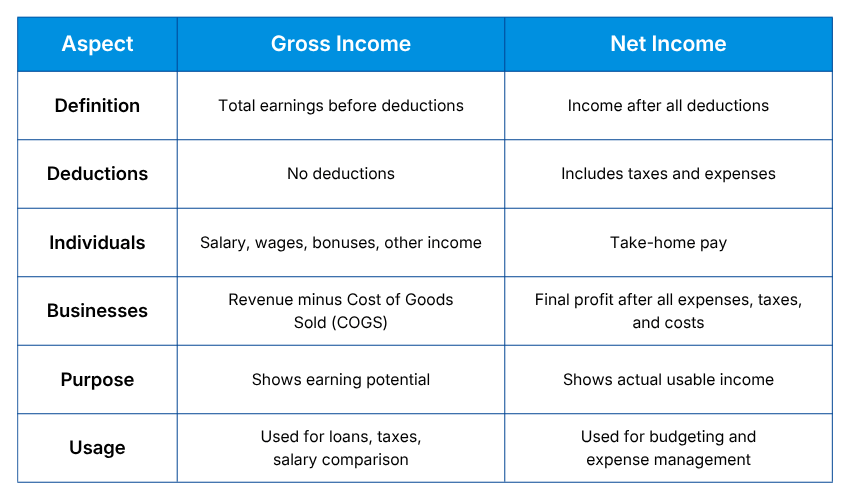
Gross Income is the total amount earned before any deductions, while net income is the amount remaining after expenses, taxes, and other costs are removed. In simple terms, Gross Income shows total earnings, whereas net income reflects the actual income available after deductions.
For individuals, net income represents the take-home pay after taxes and other deductions. For businesses, it refers to the final profit after all expenses, including production, administrative, and tax costs, have been subtracted from total revenue.
Conclusion
Understanding Gross Income helps individuals and businesses gain a clear view of total earnings before deductions. It supports better financial planning, budgeting, and decision-making. By knowing how it works and how to calculate it, you can manage money more effectively and make informed choices for long-term financial stability.
Start your ACCA journey with strong financial and business foundations with the ACCA Applied Knowledge Training – Join now!
Frequently Asked Questions
Q. Does Gross Income Include Money That Will be Paid in Taxes?
Gross Income is the total earnings of an individual or business before any deductions like taxes, costs, or interest. It includes all earnings such as salary, wages, bonuses, and other income before deductions.
Q. Is it Better to be Paid Gross or Net Income?
It is better to understand and negotiate your pay in Gross Income for clarity and transparency, as it shows your total earnings before deductions. However, budgeting should be based on net income, as it reflects your actual take-home pay and helps you manage expenses without overspending.
Q. Which is Better: Gross or Net Salary?
Neither is better on its own. Gross Income helps in understanding total compensation and benefits, while net salary shows your actual take-home pay. Both are important for managing finances effectively.