Have Any Question?
 +44 7452 122728




 Back
Back




What is CapEx(Capital Expenditure)? Meaning, Examples, and Importance
Capital Expenditure refers to the funds a company invests in acquiring, upgrading, or maintaining long-term assets, such as equipment, property, or technology. These assets are used over many years to help the business operate and grow. They support long-term business expansion, improve efficiency, and increase productivity.
Table Of Contents


 44 7452 122728
 27-Feb-2026
Author-Veronica Davis
Businesses don’t grow just by cutting costs. They grow by investing in the right assets. A company may save money on daily operations, but real progress often begins when it decides to purchase equipment, upgrade technology, or expand its facilities. That’s where Capital Expenditure (CapEx) enters your business.
It explains how organisations invest money today to strengthen their future operations and earning capacity. From a small shop buying better tools to a large firm getting a production plant, CapEx is involved. In this blog, we will explore what is CapEx, how to calculate it, and its importance in investing in assets effectively. Let's get started!
What is CapEx?
Capital Expenditure (CapEx) refers to money a business spends to buy, upgrade, improve, or extend the life of long-term assets. These assets are not consumed immediately. Instead, they help the business run its operations and generate income in the future, rather than supporting only daily activities.
Examples of CapEx include purchasing machinery, constructing buildings, buying vehicles, or implementing major software platforms. Instead of recording the full cost immediately as an expense, the company treats it as an
asset
and spreads the cost over its useful life through depreciation. Thus, CapEx is an investment in the business’s future growth.

Importance of CapEx (Capital Expenditure)
CapEx is important because it decides how a business will perform in the future. It checks whether a company can expand, improve efficiency, and stay relevant in a changing market. Below are the reasons why CapEx is important:
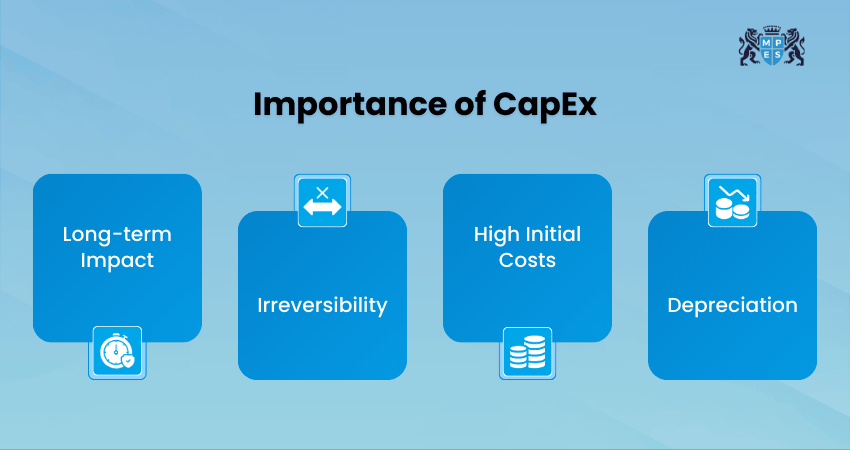
1) Long-term Impact
CapEx investments affect business performance for many years. When a business buys new machinery, upgrades technology, or builds a facility, the benefits are not limited to one financial year. Instead, they improve production capacity and service quality over a long period.
For example, if an organisation replaces manual work with automated machines, work becomes faster and profits can grow for many years. This shows that CapEx is not a short-term decision but a long-term investment for business growth.
2) Irreversibility
Most CapEx cannot be easily reversed. Once a company constructs a building or installs specialised equipment, it cannot quickly recover the invested money. Because of this, businesses perform detailed analysis before approving CapEx projects. They study demand, Return-on-Investment (ROI), expected returns, and risks.
For example, if an organisation builds a factory to produce a specific product and demand later drops, it cannot easily recover the investment. Selling the factory may take time and often lead to financial loss.
3) High Initial Costs
CapEx usually requires a large upfront investment. Unlike operating expenses that occur regularly in smaller amounts, capital spending happens in one major investment. This makes Cash Flow Management very important.
Therefore, businesses plan budgets, financing methods, and repayment schedules before committing to large capital purchases. Organisations may finance CapEx through loans, leasing arrangements, or investor funding to manage substantial upfront costs.
4) Depreciation
Depreciation is the process of spreading the cost of a long-term asset over its useful life. It records a small portion of the asset’s value as an expense each year instead of charging the full cost at once. Capital assets are used over several years, so their cost is not treated as a one-time expense.
Because capital assets provide value over several years, their cost is systematically allocated across their useful life rather than treated as a single-period expense. For example, a machine costing £100,000 with a 10-year useful life will show about £10,000 depreciation each year. This helps the financial statements reflect the business’s earnings accurately.
When do Businesses Use CapEx?
Businesses use Capital Expenditure (CapEx) when they need to invest in assets that will support operations for many years. These decisions are usually linked to growth, efficiency improvement, or replacing outdated resources. Here are the situations when CapEx is used:
1) Business Expansion: Opening a new branch, warehouse, or production unit
2) Asset Replacement: Replacing old machines, vehicles, or computers
3) Technology Upgrades: Installing new software, automation systems, or computer networks
4) Increasing Capacity: Adding equipment to produce more goods or serve more customers
5) Cost Reduction: Investing in energy-efficient machines to lower operating costs
Develop real-world skills in cost management and financial analysis with the Management Accounting (MA) Course – Register today!
Types of Capital Expenditure (CapEx)
CapEx includes different long-term assets that help a business run and grow over many years. Although the investments depend on the business, most businesses spend CapEx on similar kinds of assets. Here are some of its types:
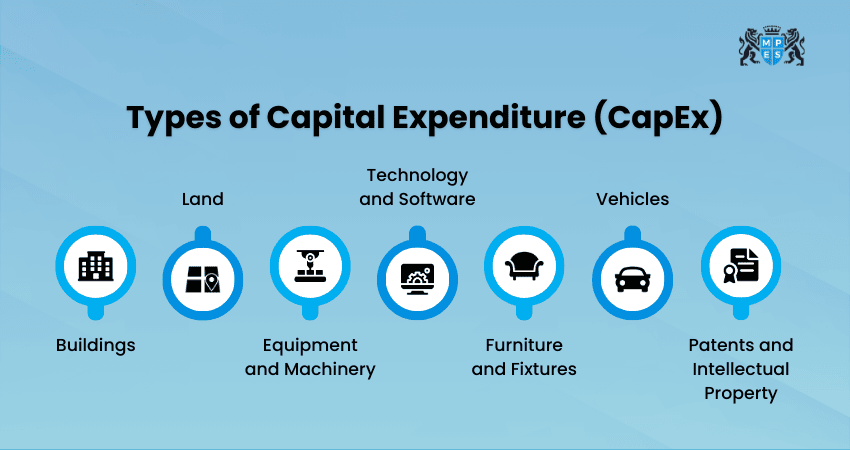
1) Buildings
Businesses may buy or construct buildings for offices, factories, warehouses, shops, or storage. These buildings are used for daily work and continue to benefit the company for a long time.
2) Land
Land purchased for business use or future expansion is also CapEx. Unlike machinery, land is usually not depreciated because it does not wear out. Some companies also keep land as a long-term investment.
3) Equipment and Machinery
Machines and equipment are major capital investments, especially in manufacturing. They help produce goods from raw materials. Replacing old machines or buying new ones can increase production speed and reduce costs.
4) Technology and Software
Companies also invest in computers, servers, business software, and automation systems. These tools help with communication, record keeping, reporting, and managing daily operations. Certain software systems are capitalised as CapEx when they provide long-term economic benefit and meet
Accounting Principles
in order to meet recognition criteria.
5) Furniture and Fixtures
Office furniture, fittings, and interior setup are considered CapEx because they make the workplace usable for employees and customers. Even though they cost less than machinery, they are used for many years.
6) Vehicles
Business vehicles such as delivery vans, trucks, and company cars are Capital Expenditures. They are used to transport goods, staff, or clients and help the business operate smoothly.
7) Patents and Intellectual Property
Acquired patents and certain capitalised development costs are treated as CapEx because they generate long-term economic value. If a company develops a product based on these rights, it can create long-term income and a competitive advantage.
How to Calculate Capital Expenditure (CapEx)?
Capital Expenditure is not always shown directly in financial statements , but it can be calculated using information from the balance sheet and income statement. The calculation can be derived as follows:

In this formula:
1) PP&E (Property, Plant, and Equipment) means fixed assets such as buildings, machinery, vehicles, and equipment.
2) PP&E (Current Period) is the value of these assets at the end of the year.
3) PP&E (Prior Period) is the value at the beginning of the year.
4) Depreciation is the amount of asset value reduced during the year due to usage.
Example
Let's check it with an example to know how it works in a real context:
Imagine a furniture manufacturing company. At the start of the year, the company had machines and equipment worth £300,000. During the year, some machines wore out due to regular use, and £25,000 is recorded as depreciation. Now, the company has bought new machines, and the total value of its machines has become £380,000. Now we calculate CapEx:
CapEx = £380,000 − £300,000 + £25,000
CapEx = £80,000 + £25,000
CapEx = £105,000
This shows the business actually spent £105,000 on new or upgraded equipment during the year.
Explore how business processes and technology work together with the
Business and Technology (BT) Course
– Sign up soon!
Capital Expenditures Best Practices for Businesses
Involving in capital investments without proper planning can create serious financial problems. Therefore, businesses follow structured approaches to manage CapEx effectively. Here are the best practices that you can follow:
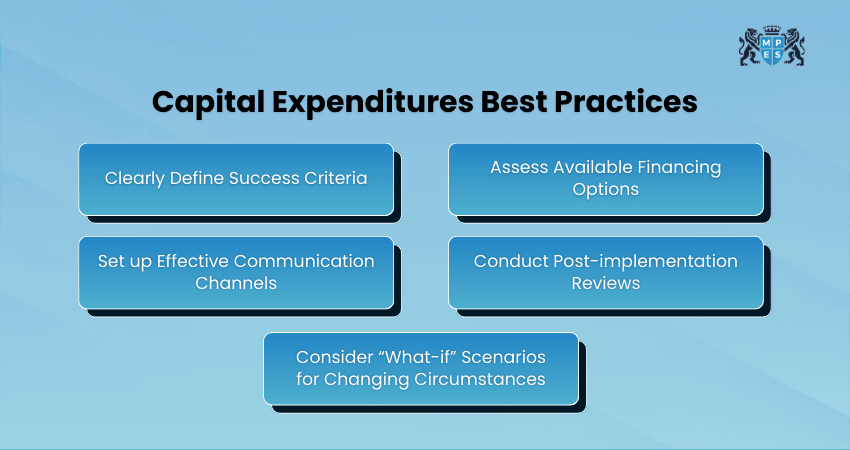
1) Clearly Define Success Criteria
Before approving a project, management should define measurable goals. These may include revenue increase, cost reduction, productivity improvement, or efficiency gains. Clear metrics help evaluate whether the investment actually delivers value.
2) Set up Effective Communication Channels
CapEx projects often involve finance teams, operations, procurement, Information Technology (IT), and senior management. Regular reporting meetings and transparent documentation prevent confusion, delays, and budget overruns, and improve coordination.
3) Assess Available Financing Options
Before getting into the action of purchasing capital investment, businesses need to decide how to fund them. Common options include profits, loans, leasing, or investors. The wrong funding choice can cause cash flow problems.
4) Conduct Post-implementation Reviews
After completing a capital project, businesses should review its performance. They need to assess if the expected results were achieved, such as improved productivity, reduced operating costs, or increased sales.
5) Consider “What-if” Scenarios for Changing Circumstances
Business conditions can change quickly, so businesses should think about possible risks before investing. They need to consider situations such as falling demand, new technology replacing existing equipment, or changes in laws and regulations. Planning these in advance helps you get prepared for alternative actions.
6) Leverage Accounting Tools to Streamline Capital Expenditure Management
Businesses can use modern accounting and Enterprise Resource Planning (ERP) software to manage CapEx. These tools help track asset life, depreciation, maintenance schedules, and project budgets in one place. Automation reduces manual errors, saves time, and gives a clear view of financial performance.
7) Use a Standardised Business Case Template for Proposed Capital Projects
Before approving a capital project, businesses should prepare a structured business proposal. It has to explain the project objective, estimated cost, expected return, possible risks, and the timeline for completion. Standard formats help managers compare different projects easily.
Common Challenges in Managing Capital Expenditure (CapEx)
Managing CapEx can be challenging because it involves large amounts of money and long-term planning. Let's check some of the common challenges of it so that you can make informed decisions:
1) Budget Overruns: Projects may cost more than expected due to an increase in price, changes in design, or delays. If spending is not controlled, the company can exceed its planned budget.
2) Wrong Demand Estimates: Companies invest based on expected future sales. If demand turns out to be lower, expensive machines or facilities may remain underused, reducing profits.
3) Cash Flow Problems: Large upfront payments can reduce the cash available for daily expenses like salaries, rent, and supplier payments. This can create operational difficulties.
4) Fast Technology Changes: Technology changes quickly. Equipment or systems bought today may become outdated sooner than expected, forcing the business to spend again.
5) Funding Difficulties: Getting loans or investor support is not always easy, especially for small businesses. Interest payments can also increase the total cost of the investment.
6) Ongoing Maintenance Costs: After buying an asset, businesses must spend money on maintenance and repairs. If these costs are ignored, the investment may not provide the expected benefits.
Examples of Capital Expenditure (CapEx)
Understanding real-life examples of CapEx helps distinguish it from regular expenses. So, below are the common examples of CapEx:
Manufacturing Business:
1) Buying production machines or assembly equipment
2) Installing automated production lines
3) Constructing a factory or workshop
Retail Business:
1) Opening a new store location
2) Renovating shop interiors and display areas
3) Installing billing systems and checkout counters
IT Company:
1) Purchasing computers, servers, and networking equipment
2) Developing or purchasing long-term business software
3) Setting up a data centre or backup system
Logistics and Transport Company:
1) Buying delivery vans, trucks, or company vehicles
2) Building warehouses and storage facilities
3) Installing vehicle tracking systems
Hospitality Industry:
1) Building hotels or restaurants
2) Purchasing kitchen equipment and appliances
3) Installing security and surveillance systems
Conclusion
Capital Expenditure is one of the most important financial concepts in business management. While operational expenses keep a company running day to day, CapEx determines its long-term future. It represents commitment, strategy, and confidence in growth. Whether you are a Business Owner, Investor, or management professional, understanding its benefits helps you evaluate the real health and growth potential of any organisation.
Learn how companies make effective financial decisions with
ACCA Applied Knowledge Training
– Begin now!
Frequently Asked Questions
Q. How Does CapEx Appear on a Balance Sheet?
Capital Expenditure (CapEx) results in an increase in long‑term assets, such as Property, Plant, and Equipment (PPE), on the balance sheet. They’re capitalised rather than expensed, then depreciated over time, reducing the asset’s carrying amount over time.
Q. What is a Good CapEx Ratio?
A good CapEx ratio varies by industry and by the formula used. For example, the CapEx-to-Cash Flow ratio measures whether operating cash flow can cover capital investments. A ratio above 1.0 in this context may indicate strong reinvestment capacity, but interpretation depends on the company’s growth strategy and sector norms.
Q. Is CapEx Eligible for Tax Deductions?
CapEx is not fully tax-deductible in the year of purchase. However, businesses can claim tax benefits gradually through depreciation or amortisation over the asset’s useful life. This spreads the tax advantage across multiple years rather than one accounting period.