Have Any Question?
 +44 7452 122728




 Back
Back




Capital Gains Tax: Definition, How It Works, and Current Rates
Capital Gains Tax is the tax you pay when you make a profit from selling things like property, shares, or valuable assets. It applies only to the gain you make, not the full sale amount. With careful planning, you can reduce your tax using exemptions, allowances, smart timing, and tax-friendly accounts. Read on to learn more.
Table Of Contents


 44 7452 122728
 07-Apr-2025
Author-Maria Thompson
Have you ever sold something valuable like property, shares, or artwork and wondered if you owe tax on the profit? That's where Capital Gains Tax (CGT) comes in. It's a key part of managing your money smartly, especially if you invest or deal with high-value items. Knowing how it works can help you keep more of your earnings and avoid surprises.
In this blog, we will walk you through everything you need to know about Capital Gains Tax - how it works, who pays it, current rates, and how to reduce what you owe. So let's get started and turn complex tax rules into smart money decisions!
What is Capital Gains Tax?
Capital Gains Tax is the tax you pay when you make a profit from selling something valuable. This can include things like property, shares, or other investments. You are only taxed on the profit you make, not the total amount you sold it for.
For example, if you bought a piece of land for £10,000 and later sold it for £15,000, your profit is £5,000. This £5,000 is called a capital gain, and you may have to pay tax on it. Some personal possessions, like your main home or car, are usually not taxed. However, it depends on the value and type of asset.

How to Calculate Capital Gains Tax?
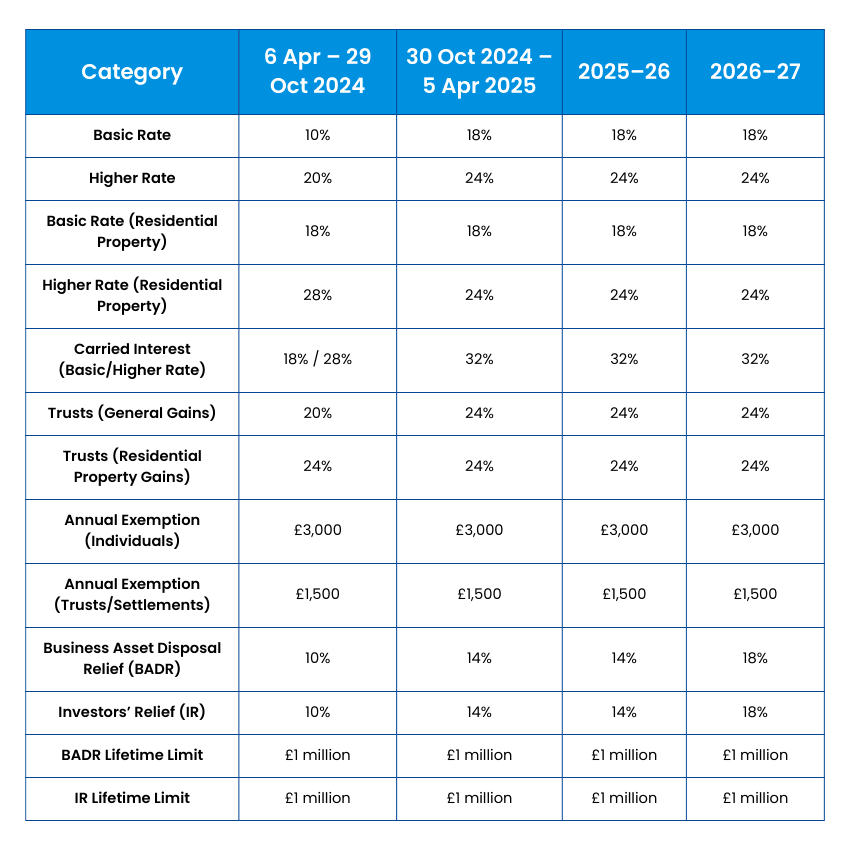
Each tax year, you're allowed to earn a certain amount of capital gains without paying tax, known as the annual exempt amount or CGT allowance. For the 2025/2026 tax year, this allowance is £3,000. You only pay Capital Gains Tax on the portion of your gains that exceeds this allowance.
For instance, if your total gain is £16,000, tax will apply only to £13,000. The rate of CGT depends on both the type of asset sold and your income tax bracket. Here are the Capital Gains Tax rates for 2025/2026:
1) Basic rate taxpayers: 18%
2) Higher and additional rate taxpayers: 24%
Scottish taxpayers should refer to the 'rest of UK' tax bands to determine their applicable CGT rate. It's important to note that any unused CGT allowance cannot be carried forward to future tax years.
When Capital Gains Tax is Applied?
Capital Gains Tax is applied when you sell or give away something valuable and make a profit. This includes things like property, shares, or personal items worth more than a certain amount. You only pay
tax
on the profit, not the full selling price.
How to Apply Capital Gains Tax?
To apply Capital Gains Tax, you need to report your gains to His
Majesty's Revenue and Customs (HMRC)
. This is usually done through a Self-assessment tax return or using the 'real-time Capital Gains Tax service' if you're not filing a full return.
You must provide details such as:
1) What the asset was
2) How much you paid for it (acquisition cost)
3) How much you sold it for (disposal value)
4) Any associated costs (like legal fees or estate agent fees)
5) Any losses you're claiming
After you submit this information, HMRC will calculate how much Capital Gains Tax you owe (if any), and they'll tell you how and when to pay it.
Who Pays Capital Gains Tax?
Here are the people who may need to pay Capital Gains Tax:
1) People who sell property that is not their main home
2) Anyone who makes a profit from selling shares or investments
3) Business owners who sell business assets for a gain
4) Individuals who give away valuable items and still make a gain
5) People who inherit something and later sell it for a profit
Capital Gains Tax Rates for 2025/2026
Capital Gains Tax rates in the UK have been updated for the 2025/2026 tax year. These changes affect how much tax individuals and trustees pay when selling assets like property or shares. Here are the new rates:
Capital Gains Tax Strategies
Here are a few strategies to help lower your taxes and keep more of your profits:
1) Avoid Wash Sales
This happens when you sell a losing investment and quickly buy it back to claim a tax loss. This is not allowed for tax purposes, and the loss won't count. To avoid this, wait at least 30 days before buying the same or similar asset again. So remember these points:
a) Wait 30 days before rebuying the same investment
b) Don't buy similar assets immediately after selling
c) Plan sales around tax rules to claim valid losses
2) Maximise Retirement Contributions
Putting money into retirement accounts like a pension or ISA can reduce your taxable income. This means you might fall into a lower tax band and pay less Capital Gains Tax. It also helps you save for the future at the same time. Keep these points in mind:

a) Contribute to pensions or tax-free savings accounts
b) Use yearly allowances to the full when possible
c) Reduce your total income to lower your tax rate
3) Time Your Retirement Wisely
Selling assets after retirement could mean paying less Capital Gains Tax. That's because your income may be lower, so you fall into a lower tax band. It's a good idea to plan big sales when your income is smaller. Consider these points:
a) Delay selling assets until you retire if possible
b) Plan sales for low-income years for tax savings
c) Spread gains over multiple years to stay below limits
4) Monitor Holding Periods
How long you keep an asset can affect the tax you pay. In some cases, holding it longer can bring tax benefits or allow for better planning. Keep track of purchase and sale dates to avoid surprises. Consider these points:
a) Keep records of when you bought and sold assets
b) Avoid short-term flipping of shares or property
c) Plan sales to use annual tax-free allowances
5) Choose the Right Cost Basis
The cost basis is the original price you paid for an asset. Picking the right method for calculating it can reduce your tax bill. Some methods, like "specific identification", give you more control over your gains.
a) Track what you paid for each investment
b) Use cost-basis methods that lower your gains
c) Ask an advisor if you are unsure which method is best
Master the math behind smart financial decisions in our
Financial Management (FM) Course
. Sign up now and open up new opportunities!
Capital Gains Tax Exceptions
Here are the common exceptions where you may pay less or no tax:
1) Collectibles
a) Some personal items like jewellery or antiques may be exempt
b) Gains under a certain amount on collectables are not taxed
c) If the item is worth less than £6,000, CGT might not apply
d) Selling collectible items as a hobby may not trigger tax
2) Owner-occupied Real Estate
a) No CGT if the property is your main residence
b) You must have lived in it as your only or main home
c) Private Residence Relief may cover the full gain
d) Letting part of it might still allow partial exemption
3) Investment Real Estate
a) You may get tax relief when selling business property
b) Rollover relief allows delay of CGT if reinvesting
c) Gift Hold-Over Relief applies when gifting to certain people
d) Special rules apply if the property was used for business
4) Investment Exceptions
a) ISAs and pensions are usually free from CGT
b) UK government bonds (gilts) are not subject to CGT
c) Personal chattels sold below £6,000 are often exempt
d) Shares transferred between spouses are tax-free
Build trust and verify truths with powerful auditing. Sign up for our
Audit and Assurance (AA) Course
now!
How to Reduce Capital Gains Tax Legally?
If you earn profits from investments, Capital Gains Tax may apply. However, there are several legitimate ways to reduce your tax liability:
1) Hold Investments Longer:
Keeping assets for more than a year can result in lower tax rates compared to short-term gains, which are taxed as regular income.
2) Offset Gains With Losses:
Investment losses can be used to reduce taxable gains. You can deduct up to £3,000 in losses annually, with any excess carried forward to future years.
3) Track Allowable Expenses:
Costs related to acquiring or maintaining investments can be added to the cost basis, reducing your overall taxable profit.
4) Use Tax-advantaged Accounts:
Investing in a 401(k) or Individual Retirement Account (IRA) can help defer or eliminate taxes on gains, though withdrawal rules may apply.
5) Take Advantage of Exclusions:
When selling a property, certain rules may allow you to exclude part of the gain. Planning the timing of your sale can help you qualify for these benefits.
Capital Gains Taxes vs Income Tax
Income tax
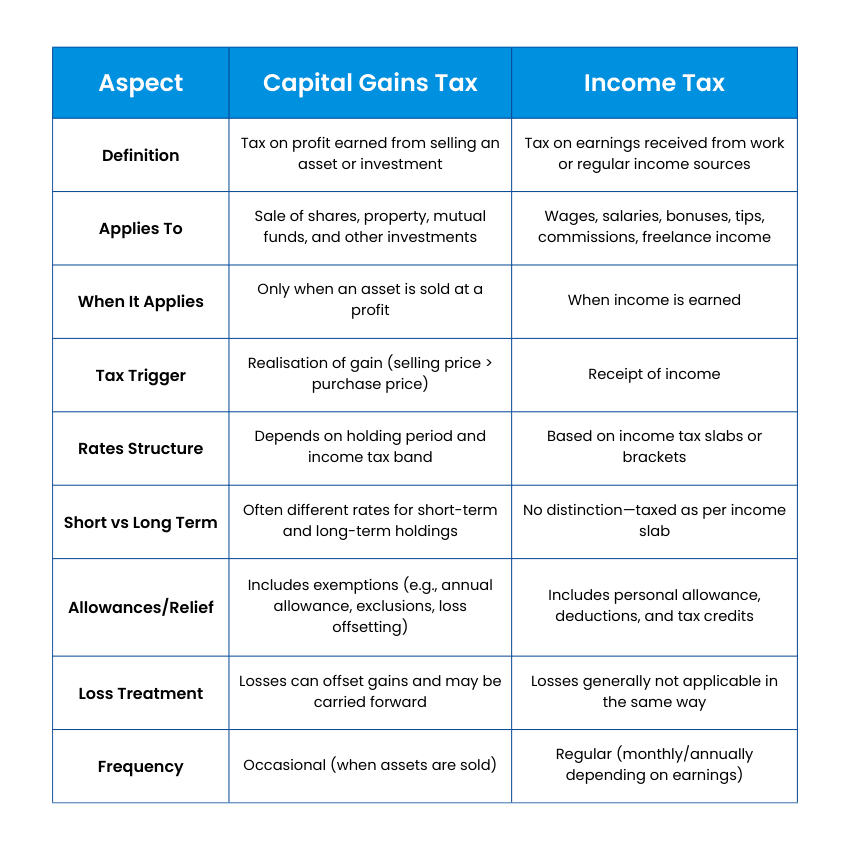
applies to most types of earned income, including wages, salaries, tips, commissions and earnings from freelance or contract work. Conversely, Capital Gains Tax is charged when you sell an asset or investment for a profit, which means you receive more than its original purchase price. Here are the key differences:
Capital Gains Taxes Examples
Here are simple examples of when Capital Gains Tax may apply:
a) Selling shares for £5,000 after buying for £2,000
b) Making a £10,000 profit from selling a second home
c) Gaining £6,000 by selling a valuable painting
d) Gifting jewellery that has increased in value
Conclusion
Capital gains tax doesn't have to feel like a financial puzzle. Once you understand what it is, the rates that apply and how to calculate your liability, you're better equipped to make smarter financial moves. With the right knowledge, every investment decision becomes clearer and every gain can feel a little more rewarding.
Step into strategic finance leadership with our ACA Professional Level Training - Register now!
Frequently Asked Questions
Q. What is the Current Capital Gains Tax in the UK?
In the UK, Capital Gains Tax depends on your income tax band and type of asset sold. For the 2025/2026 tax year, individuals have a tax-free allowance of £3,000. Gains above this are taxed at 18% for basic rate taxpayers and 24% for higher and additional rate taxpayers on most assets.
Q. What is the 7-year rule for Capital Gains Tax?
The 7-year rule does not directly apply to Capital Gains Tax; it relates to Inheritance Tax (IHT). If you gift an asset and survive for seven years after giving it, the gift is usually exempt from IHT. But CGT may still apply at the time of gifting if the asset has increased in value, as it is treated as a disposal for tax purposes.
Q. How to Avoid Capital Gains Taxes?
While CGT cannot always be avoided, it can be reduced legally. You can use your annual tax-free allowance, offset gains with capital losses and invest through tax-efficient accounts like ISAs. Holding assets longer or transferring assets to a spouse can also help minimise tax liability.