Have Any Question?
 +44 7452 122728




 Back
Back




Cash vs Accrual Accounting: Differences Explained with Examples
Cash Accounting records transactions when cash is received or paid, while Accrual Accounting records them when earned or incurred, regardless of cash flow. Both methods are used in accounting based on business needs and reporting requirements. Understanding the difference helps ensure accurate financial tracking and decision-making.
Table Of Contents


 44 7452 122728
 23-Jun-2025
Author-Maria Thompson
Are you tracking your business income the right way, or just the easiest way? The accounting method you choose can quietly influence your profits, taxes, and financial clarity. It shapes how you record each income and expense and when they are recorded. Two of the most common ways of accounting include Cash Accounting and Accrual Accounting.
Each follows a unique approach to recognising transactions. While one focuses on actual cash movement, the other reflects income and financial commitments as they arise. In this blog, we will focus on Cash vs Accrual Accounting, helping you choose the method that aligns best with your business goals. Let's dive in!
What is Cash Basis Accounting?
Cash Basis Accounting is a straightforward approach where transactions are recorded only when cash actually changes hands. This means revenue is recognised when you receive payment from a customer, and expenses are recorded when you pay a bill.
For instance, if you send a client an invoice in December and they pay you in January, you record that income in January the moment the cash enters your bank account. This method keeps your books closely aligned with your bank statement, making it ideal for businesses with a low volume of transactions.

What is Accrual Accounting?
Accrual Accounting offers a complete financial view by recording income when earned and expenses when incurred, irrespective of when cash is exchanged. For example, a December invoice is recorded as December income, even if the payment arrives in January.
Similarly, if you receive a supplier’s invoice in November but pay it in December, it still counts as a November expense. This matching principle ensures income and related expenses are recorded in the same period, giving a clearer picture of financial performance.
Differences Between Cash and Accrual Accounting
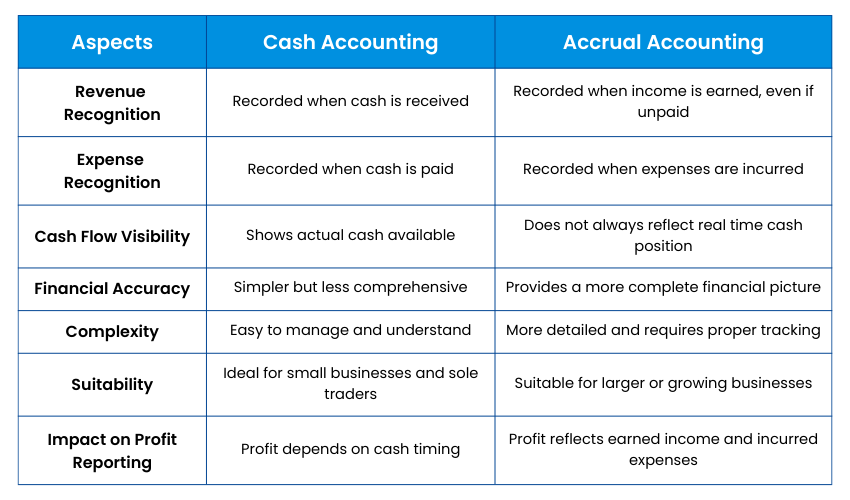
Let’s now look at where these Cash Accounting vs Accrual Accounting methods diverge in practical terms:
1) Cash vs Accrual Accounting: Revenue Timing
Cash Accounting: Revenue is entered when cash is actually received. This gives a clear view of cash flow and liquidity, but may not reflect when the work was completed or services were delivered. It is best suited for small businesses with simple, short-term transactions.
Accrual Accounting: Revenue is recognised when it is earned, even if payment is received later. This approach ensures income is recorded in the correct accounting period, offering a more accurate and complete picture of business performance.
2) Cash vs Accrual Accounting: Tax Effects
Cash Accounting: Taxes are paid only on income that has been received. This helps businesses control cash flow effectively and may allow flexibility in timing income and expenses to reduce tax burdens.
Accrual Accounting: Taxes are based on income that has been earned, regardless of when cash is received. This can result in tax obligations before actual cash inflow, which may impact short-term cash management.
3) Cash vs Accrual Accounting: Matching Adherence
Cash Accounting: This method does not follow the matching principle, so income and related expenses may appear in different periods. As a result, financial statements may not accurately reflect the true profitability of a business.
Accrual Accounting: It follows the matching principle by recording expenses in the same period as the related revenue. This ensures financial reports present a consistent and realistic view of profits and losses.
4) Cash vs Accrual Accounting: Receivables/Payables
Cash Accounting: It does not record accounts receivable or Accounts Payable, meaning future income and unpaid expenses are not tracked. This limits visibility into outstanding obligations and expected cash inflows.
Accrual Accounting: It records both receivables and payables, providing a complete picture of what a business owes and what it is owed. This improves financial planning, credit management, and decision-making.
Advance your reporting skills with the CIMA’s CGMA® Advanced Financial Reporting (F2) Course today!
5) Cash vs Accrual Accounting: Contract Implications
Cash Accounting: Revenue from contracts is recorded only when payments are received. This may delay income recognition and understate performance during ongoing or long-term projects.
Accrual Accounting: Revenue is recognised as work is completed, even if payment is pending. This aligns income with project progress and offers a more accurate financial position.
6) Cash vs Accrual Accounting: Regulatory Compliance
Cash Accounting: Commonly used by small businesses due to its simplicity. However, it may not meet the reporting standards required by regulators, investors, or financial institutions for larger organisations.
Accrual Accounting: Required under recognised accounting standards such as GAAP and IFRS. It is widely accepted for financial reporting and ensures transparency and consistency in financial statements.
7) Cash vs Accrual Accounting: Accruals/Deferrals
Cash Accounting: It does not consider accruals or deferrals, so future income and expenses are not recorded. This limits the ability to reflect upcoming obligations or revenues accurately.
Accrual Accounting: It includes accruals and deferrals, ensuring that all expected income and expenses are recorded in the correct periods. This supports better forecasting and financial control.
8) Cash vs Accrual Accounting: Unearned Revenue
Cash Accounting: Revenue is recorded immediately when cash is received, even if the service has not yet been delivered. This can lead to overstated income in the short term.
Accrual Accounting: Unearned revenue is treated as a liability until the service or product is provided. This ensures revenue is only recognised when it is truly earned.
9) Cash vs Accrual Accounting: Recognition Complexity
Cash Accounting: Simple and easy to use, as transactions are recorded only when cash moves. It requires less accounting knowledge but provides limited insight into overall financial health.
Accrual Accounting: More complex, as it involves tracking earned income, incurred expenses, and adjusting entries. However, it provides a more detailed and accurate view of financial performance.
10) Cash vs Accrual Accounting: Depreciation/Amortisation
Cash Accounting: Typically, it expenses assets at the time of purchase and does not allocate costs over time. This can distort long-term profitability and asset value.
Accrual Accounting: Spreads the cost of assets over their useful life using depreciation or amortisation. This ensures expenses are matched with usage, giving a realistic view of financial performance.
Align people, processes, and strategy for business success with CIMA’s CGMA® Managing Performance (E2) Training – Register today!
Cash vs Accrual Accounting: Advantages and Disadvantages
These are the advantages and disadvantages of Cash Accounting vs Accrual Accounting:
Advantages of Cash Accounting
1) Simple to Maintain: No need to track complex entries like accruals or deferrals. Everything is recorded as the trasaction occurs.
2) Real-time Cash Insights: Since you only record actual cash movement, your financial reports always reflect your current cash position.
3) Lower Administrative Burden: Accounts can easily be managed in-house using basic tools like Excel or simple accounting apps.
4) Favourable Tax Timing: You're taxed only on income you’ve received, which can provide some flexibility in timing cash flows, depending on applicable tax regulations.
5) Easy to Understand: The method is straightforward, making it ideal for small business owners without strong accounting knowledge.
6) Better Cash Control: Helps businesses focus on available cash, reducing the risk of overspending or cash shortages.
Advantages of Accrual Accounting
1) More Accurate Financial Reports: Reflects true business performance by including income and expenses in the correct periods.
2) Better Forecasting: With receivables and payables accounted for, you can plan cash flow, budgets, and future financial commitments more effectively.
3) Stronger Stakeholder Confidence: Banks and investors generally prefer accrual-based reports for assessing financial stability and growth.
4) Regulatory Compliance: Aligns with Generally Accepted Accounting Principles (GAAP) and International Financial Reporting Standards (IFRS).
5) Improved Decision-making: Provides a complete financial picture, helping businesses make informed strategic decisions.
6) Supports Business Growth: Suitable for larger or growing businesses that need detailed financial tracking and reporting.
Disadvantages of Cash Basis Accounting
1) Incomplete Financial Picture: Cash basis accounting does not include unpaid receivables or payables. This can result in an incomplete view of a business’s financial position.
2) Challenges with Scalability: As a business grows, this method becomes less effective. Many organisations eventually need to shift to Accrual Accounting for better accuracy and reporting.
3) Potentially Misleading Financials: Since pending payments are not recorded, profits and losses may appear inaccurate. This can lead to poor financial decisions.
4) Limited Insight for Planning: Without tracking future income or expenses, it becomes harder to plan budgets and forecasts. This limits long-term financial planning.
5) Investor and Lender Limitations: Investors and lenders often prefer detailed financial data. Using cash basis accounting may reduce access to funding or credit opportunities.
Disadvantages of Accrual Basis Accounting
1) More Complex to Manage: Accrual Accounting requires detailed tracking of income and expenses as they occur, often needing more time, expertise, or professional support.
2) Cash Flow Visibility Issues: It may show profits even when cash has not been received. This can make it harder to understand the actual cash available for daily operations.
3) Tax on Unreceived Income: Businesses may need to pay taxes on revenue that has been earned but not yet collected. This can put pressure on cash reserves, especially for small businesses.
4) Higher Risk of Errors or Fraud: The complexity of Accrual Accounting can increase the chances of errors or internal fraud. Strong controls and regular monitoring are required to manage this risk.
5) Higher Costs: Maintaining accurate accrual records often involves additional costs. Businesses may need accounting software or professional bookkeeping services.
6) Time-consuming Process: Recording transactions as they occur takes more time than Cash Accounting. As business activity grows, the workload also increases.
Strengthen business and Financial Analysis skills through the CIMA’s CGMA® Management Level Case Study Training – Join now!
Cash vs Accrual Accounting: Examples
Understanding how Cash Accounting differs from Accrual Accounting becomes easier when we look at practical situations. Below are two common scenarios that show how Accrual Accounting and Cash Accounting treat the same transaction differently:
Example 1: You Send an Invoice
Imagine you provide a service in March and send a £2,000 invoice to your client, but the payment is received in April.
1) Under Cash Accounting: The £2,000 is recorded in April, when the money is actually received.
2) Under Accrual Accounting: The £2,000 is recorded in March, when the income is earned, and the invoice is issued.
This example shows that your March revenue will differ depending on the method used, highlighting the key difference between Cash and Accrual Accounting.
Example 2: You Receive a Bill
Now, let’s look at another example. Imagine you receive a £500 supplier bill in June for materials or services already delivered, but you decide to settle the payment in July according to the agreed credit terms.
1) Under Cash Accounting: The £500 expense is recorded in July, when payment is made.
2) Under Accrual Accounting: The £500 expense is recorded in June, when the cost is incurred.
Thus, even though the transaction is the same, the month in which you record it can change your reported profit for that period.
Cash vs Accrual Accounting: Which One Should You Use?
Choosing between Cash vs Accrual Accounting is based on your business size and financial needs. Cash Accounting is simple and ideal for small businesses and freelancers who need real-time tracking of cash flow. Accrual Accounting suits growing businesses with complex transactions, offering a clearer long-term financial picture by recording income and expenses when they are incurred.
Selecting the right method can improve financial reporting , tax management, and decision-making based on your business’s structure and growth plans.
What is the Hybrid Method in Cash and Accrual Accounting?
The hybrid method combines elements of both Cash Accounting and Accrual Accounting. Instead of strictly following one approach, businesses use a combination of cash and accrual principles, applying each where appropriate in line with accounting policies and regulations. This allows limited flexibility while maintaining financial accuracy and compliance with accounting standards.
For example, a business may record daily expenses using the cash method for simplicity, while recognising revenue and major costs using the accrual method to reflect true performance. This hybrid method can offer a balanced view of cash flow and overall profitability.
Conclusion
Choosing between Cash vs Accrual Accounting depends on your business size, complexity, and financial goals. Cash Accounting offers simplicity and real-time tracking, while Accrual Accounting provides accuracy and long-term insights. Understanding both methods helps you make informed decisions that support growth, improve reporting, and align with your financial strategy.
Elevate your management accounting capabilities with CIMA’s CGMA® Management Level Training – Join now!
Frequently Asked Questions
Q. How Cash vs Accrual Accounting Affects Your Taxes?
Cash Accounting taxes income only when received and expenses when paid, helping manage timing and cash flow. Accrual Accounting taxes income when earned and expenses when incurred, which may create tax liability before cash is received.
Q. Should an LLC Use Cash or Accrual Accounting?
Cash Accounting suits eligible small LLCs seeking simplicity and tax timing control under IRS gross receipts rules. Accrual Accounting is better for larger or growing LLCs that require accurate income matching, inventory accounting, or GAAP compliant financial reporting.
Q. What are the Three Golden Rules of Accounting?
These are the three golden rules of accounting:
1) Personal Accounts: Debit the receiver and credit the giver
2) Real Accounts: Debit what comes in and credit what goes out
3) Nominal Accounts: Debit all expenses and losses, and credit all incomes and gains