Have Any Question?
 +44 7452 122728




 Back
Back




What is Stagflation? Causes, Risks and Cure Explained
Stagflation is an economic condition marked by slow growth, high inflation, and rising unemployment, creating challenges for policymakers and investors. It reduces purchasing power and weakens economic activity across industries. Understanding its causes and effects helps individuals and businesses better prepare for economic uncertainty.
Table Of Contents


 44 7452 122728
 10-Jan-2026
Author-Veronica Davis
Have you ever felt like prices keep rising while the economy doesn’t seem to improve? Groceries, fuel, and everyday expenses become more expensive, yet job opportunities and income growth remain limited. This difficult situation is known as Stagflation, where high inflation occurs alongside slow economic growth and rising unemployment.
Understanding Stagflation helps explain why such difficult economic periods occur. In this blog, we explore what it means, how it works, its causes, warning signs, examples, and how it differs from recession and inflation. Read on to learn more!
What is Stagflation?
Stagflation is an economic condition where high inflation, slow economic growth, and rising unemployment occur at the same time. Normally, inflation increases when the economy grows and demand rises. However, Stagflation breaks this pattern because prices continue to rise even when economic activity slows.
In such situations, businesses face higher production costs while consumer demand weakens. Companies raise prices to manage these costs, which increases inflation, while slow growth leads to fewer jobs and lower investment. Stagflation is often caused by supply shocks, such as energy crises or supply chain disruptions, along with weak economic policies.

History of Stagflation
Stagflation became widely recognised during the 1970s oil crisis, when inflation rose while economic growth slowed. The key developments below explain how it emerged:
1) Origin (1960s):
Before the 1970s, economists believed in the Phillips Curve, which suggested inflation and unemployment moved in opposite directions. The word “Stagflation” was coined in 1965 by British politician Iain Macleod to describe stagnation with rising inflation.
2) 1970s Oil Crisis:
The most notable period of Stagflation occurred during the 1970s, especially after the 1973 Arab Oil Embargo. Oil supply cuts caused energy prices to surge, increasing production and transportation costs across industries.
3) Economic Impact:
Rising costs forced businesses to increase prices while cutting production and employment opportunities. This resulted in high inflation, weak economic growth, and rising unemployment, which are the key features of stagflation.
4) Policy Response (1980s):
In the early 1980s, strict monetary policies were introduced to control inflation. The U.S. Federal Reserve, under Chairman Paul Volcker, raised interest rates sharply. This strategy helped reduce inflation but also led to a short-term economic recession.
How Does Stagflation Work?
Stagflation occurs when slow economic growth, high unemployment, and rising inflation happen at the same time. In this situation, prices of goods and services continue to increase, which reduces people’s purchasing power. At the same time, economic activity slows, meaning businesses grow less and job opportunities become limited.
Supply shocks such as oil price increases, trade disruptions, or supply chain issues raise production costs for businesses. Companies respond by increasing prices while reducing production or hiring. As a result, inflation rises while economic growth slows, leading to Stagflation.
What Causes Stagflation?
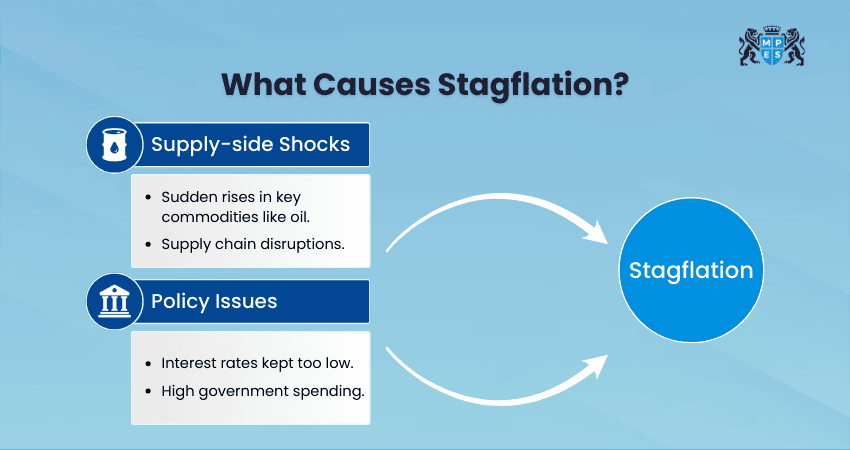
Economists generally identify two main causes of Stagflation: supply-side shocks and poor economic policies. These factors raise production costs while slowing economic activity, leading businesses to increase prices and reduce output or hiring. The main causes are explained below:
Supply-side Shock
A supply-side shock occurs when the price or supply of key resources suddenly changes. A sharp rise in oil prices is a common example, as it increases production and transportation costs across industries. Businesses raise prices or cut jobs to manage costs, causing inflation to rise while economic growth slows.
Poor Economic Policies
Stagflation can also result from ineffective fiscal or monetary policies. Excessive government spending or very low interest rates can increase demand and push prices higher. Workers then demand higher wages, while businesses raise prices to cover labour costs. This wage-price spiral increases inflation while economic growth remains weak.
Start your accounting career by mastering core financial reporting concepts through the
Financial Accounting (FA) Training
– Join today!
What are the Warning Signs of Stagflation?
Stagflation usually develops gradually rather than appearing suddenly. Several economic indicators can signal the early stages of this condition. The key warning signs of Stagflation are explained below:
1) Supply Disruptions:
Major interruptions in supply chains caused by geopolitical conflicts, trade restrictions, or natural disasters can increase production costs and reduce the availability of goods, creating Stagflationary pressures.
2) Rising Input Costs:
When businesses face continuous increases in the cost of essential inputs such as energy, raw materials, or labour, they often raise prices. If these costs grow faster than productivity, inflation rises while growth slows.
3) Declining Productivity:
Falling output per worker can signal deeper economic problems. When productivity declines while wages rise, businesses face higher costs and may reduce hiring or investment.
4) Policy Uncertainty:
Unpredictable or inconsistent economic policies can make it difficult for businesses to plan investments, hiring, and expansion, which may slow economic activity.
5) Rising Inflation Expectations:
When businesses and consumers expect prices to continue rising, they may increase wages and prices in advance. This behaviour can reinforce inflation.
6) Slowing Growth with Persistent Inflation:
A clear warning sign is when economic growth weakens for several quarters while inflation remains high, indicating that the economy may be entering a Stagflationary period.
Why is Stagflation Bad?
Stagflation is considered harmful because it combines slow economic growth, high unemployment, and rising inflation at the same time. This creates a difficult situation for households and businesses. As prices increase, people’s purchasing power falls, making everyday goods and services more expensive while income growth remains limited.
At the same time, weak economic activity reduces job opportunities and business expansion. Companies may reduce hiring or cut jobs to manage rising costs. Stagflation also creates challenges for policymakers, as measures used to control inflation, such as raising interest rates, can further slow economic growth and increase unemployment.
Why is Stagflation Hard to Fix?
Stagflation is difficult to resolve because it combines inflation, unemployment, and slow economic growth at the same time. Policies used to solve one problem often worsen the others. The key challenges are explained below:
1) Controlling Inflation:
Central banks may increase interest rates to reduce inflation, but higher rates can slow economic growth and increase unemployment.
2) Stimulating Economic Growth:
Lower interest rates or higher government spending can encourage investment and spending, but they may also push inflation even higher.
3) Reducing Unemployment:
Policies designed to create jobs and increase economic demand can stimulate the economy, but they may also increase inflationary pressure and reduce purchasing power.
Learn how businesses operate and the role of technology in success through the
Management Accounting (MA) Training
– Register today!
Stagflation vs Recession
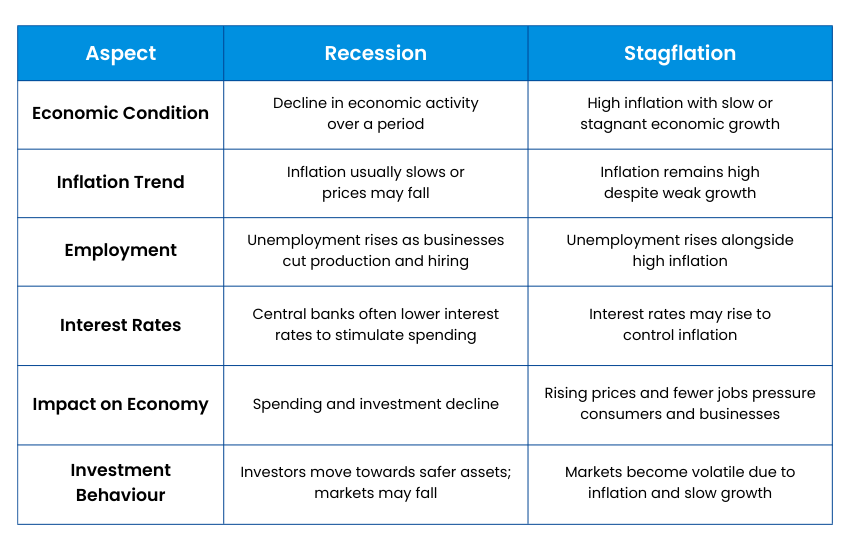
A recession is a temporary decrease in economic activity marked by falling GDP, reduced spending, and rising unemployment. During this period, inflation usually slows down or prices may fall because demand for goods and services decreases.
Stagflation, in contrast, occurs when high inflation exists alongside slow economic growth and rising unemployment. Prices continue to rise even during an economic slowdown, increasing the cost of living while job opportunities decline.
Stagflation vs Inflation
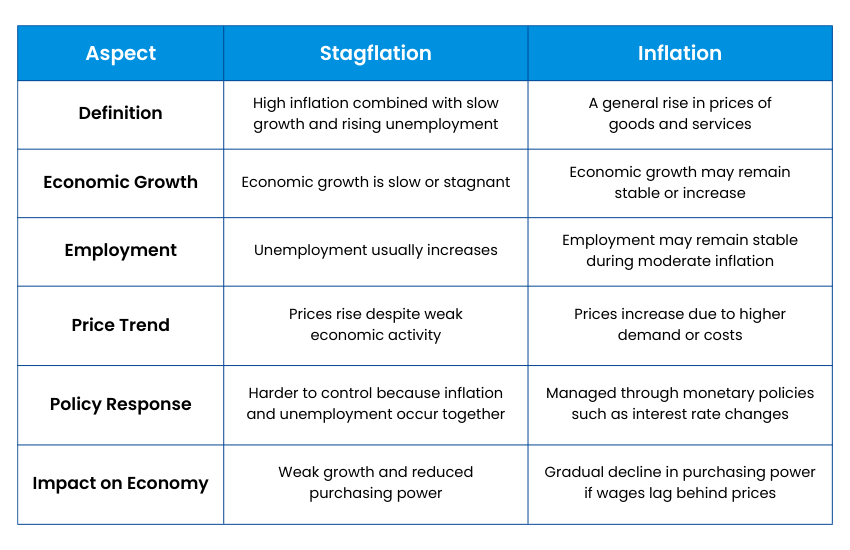
Stagflation occurs when prices rise while economic growth slows and unemployment increases. Higher living costs reduce consumer spending, and businesses may cut production or hiring due to weak economic activity.
Inflation, in contrast, refers to a general increase in prices during periods of economic growth. Strong demand often leads businesses to expand production, and unemployment may decrease as economic activity rises.
Examples of Stagflation
An early example of Stagflation appeared in the 1960s in the United Kingdom, where slow economic growth occurred alongside rising inflation. Economists linked this to low productivity, high government spending, and a persistent trade deficit, meaning the country imported more than it exported.
The most well-known example occurred during the 1970s in the United States and the United Kingdom. High government spending, low interest rates, and currency devaluation initially boosted growth, but a major oil price shock increased costs and inflation, causing growth to slow while unemployment and prices rose.
How to Invest During Stagflation?
Stagflation can be challenging for investors because it combines rising prices with slow economic growth. During this period, both stocks and bonds may perform poorly, making traditional investment strategies less effective.
Investors often focus on inflation-resistant assets such as commodities, gold, real estate, and Treasury Inflation-Protected Securities (TIPS). Defensive sectors such as consumer goods, utilities, and healthcare, along with high-quality dividend-paying stocks, may also offer more stability during Stagflation.
Conclusion
Stagflation highlights a difficult economic phase where rising prices occur alongside slow growth and unemployment. Understanding its causes, warning signs, and effects helps businesses, policymakers, and investors respond more effectively. With informed strategies and careful financial planning, economies and individuals can better manage risks during such challenging periods.
Start your accounting career by mastering essential business and financial concepts with the ACCA Applied Knowledge Training – Join now!
Frequently Asked Questions
Q. What Happens During a Stagflation?
During Stagflation, the economy faces rising prices, slow growth, and increasing unemployment at the same time. Businesses deal with higher costs and weaker demand, leading to reduced hiring and investment. As inflation rises and job opportunities decline, consumers experience lower purchasing power and higher living costs.
Q. Is Stagflation Worse Than Recession?
Stagflation is often considered worse than a recession because it combines high inflation, slow economic growth, and rising unemployment. While recessions mainly reduce demand and prices, stagflation creates policy challenges by causing economic stagnation alongside persistent price increases.
Q. Who Benefits During Stagflation?
During Stagflation, most people face economic challenges, but some may benefit. Investors in inflation-resistant assets like commodities, gold, or real estate may see gains. Companies in defensive sectors such as energy, utilities, and consumer essentials may also perform relatively better.