Have Any Question?
 +44 7452 122728




 Back
Back




Understanding the Income Statement: A Compreshesive Guide
An Income Statement is a financial report showing a company’s revenue, expenses, and profit over a period, helping assess its financial performance. It is useful for organisations to identify trends in income and spending, enabling better budgeting, improved financial control, and effective strategic decision-making over time.
Table Of Contents


 44 7452 122728
 20-Mar-2026
Author-Veronica Davis
Businesses need a clear way to understand whether they are making a profit or facing losses. This is where the Income Statement becomes essential. It provides a detailed summary of an organisations’ revenues, expenses and the profits over a specific period, thus helping businesses see how money flows through their operations.
It is important for anyone involved in business, finance or decision-making. Reviewing this financial report helps Managers and stakeholders quickly evaluate performance and identify areas for improvement. In this blog, you will learn about the Income Statement, its importance, parts, how to prepare one, and more. So read on and embed greater clarity to your business!
What is an Income Statement?
An Income Statement is an integral financial report that summarises a company’s revenue, expenses, gains, and losses over a specific accounting period. It starts with revenue and ends with net income, showing whether the business made a profit or incurred a loss.
The Income Statement is one of the most important financial statements used by businesses. It provides insights into a company’s operations, efficiency, and performance and can be presented in single-step or multi-step formats.

Why is the Income Statement Important?
The Income Statement plays an integral role in financial reporting and helps businesses understand their financial performance. Let’s look at the core reasons below that demonstrate its importance:
1) Business Planning
The Income Statement helps organisations understand where their revenue and costs come from. This information supports financial planning and strategy development since reports, analysis, and business decisions are reliant on the Income Statement data.
2) Compliance
Accurate Income Statements are crucial for regulatory compliance and financial transparency. Auditors review this report along with other financial documents to ensure that the company’s financial records present a reliable and accurate picture of its finances.
3) Risk Management
The Income Statement helps stakeholders identify financial patterns, errors, or inconsistencies. Reviewing this report regularly helps businesses spot potential financial mismanagement or other risks proactively and take timely corrective action.
Parts of an Income Statement
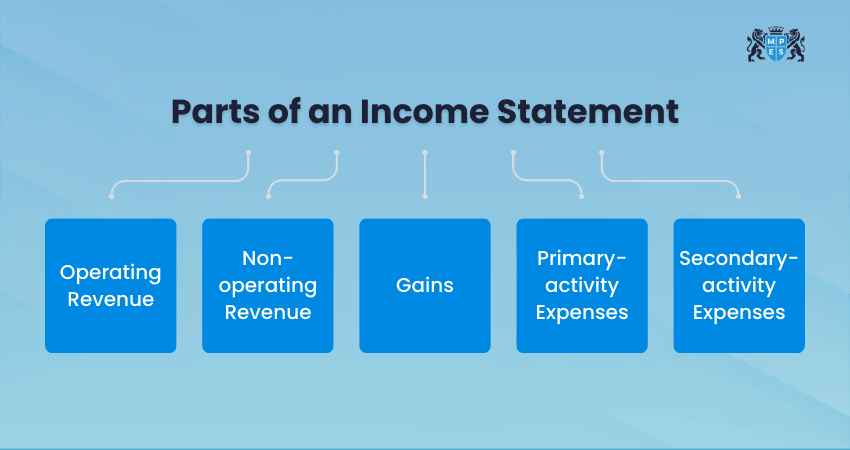
An Income Statement is made up of parts that show how a company earns revenue and spends money during a specific period. Understanding these parts helps businesses analyse financial performance, identify costs and determine their profitability. Let’s explore these parts:
1) Operating Revenue
Operating revenue refers to the generated income that mainly comes from a company’s primary business activities. For example, a manufacturing company earns operating revenue from selling its products, while a service-based organisation generates revenue through the services it provides to customers.
2) Non-operating Revenue
Non-operating revenue comes from secondary activities that are not part of the core business operations. Examples include interest earned on funds kept in the bank, income from renting company property, or royalty payments from partnerships.
3) Gains
Gains refer to money earned from one-time or non-business activities, such as selling long-term assets. For instance, a company may record gains when it sells unused land, an old vehicle, or a subsidiary business.
4) Primary-activity Expenses
Primary-activity expenses are the costs directly related to running the business and generating operating revenue. These include Cost of Goods Sold (COGS), employee wages, sales commissions, utilities, transportation, administrative costs, depreciation, and research and development expenses.
5) Secondary-activity Expenses
Secondary-activity expenses are costs related to activities outside the company’s core operations. These include expenses such as interest paid on loans or other financial obligations that support the business but are not directly related to its primary activities.
Develop skills to support budgeting, costing, and strategic decision-making with Management Accounting (MA) Training now!
Preparing an Income Statement in Eight Simple Steps
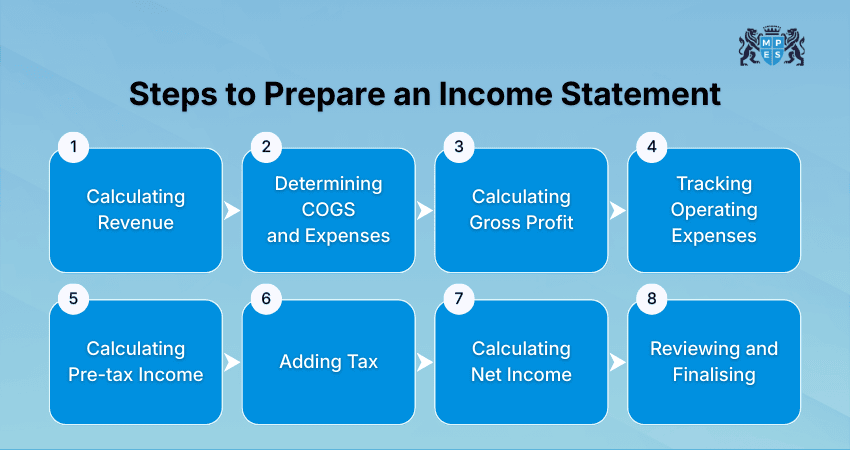
Preparing an Income Statement may seem complex, but it becomes easier when the process is broken into clear steps. Following a structured approach helps businesses organise financial data accurately. Let's look at the steps below:
1) Calculating Revenue
The first step is to determine the total revenue generated during a specific accounting period. This includes income that is earned from selling products or providing services. Accurate revenue reporting is essential because it builds the starting point for calculating overall profitability.
2) Determining COGS and Expenses
Then, businesses identify the direct and indirect costs involved in producing goods or delivering services. These can include supply chain costs, payroll expenses, and other operational charges related to business activities.
3) Calculating Gross Profit
To calculate gross profit, subtract COGS from the total revenue. This calculation helps organisations understand how efficiently they produce and sell their products or services before considering operating expenses.
4) Tracking Operating Expenses
Now, operating expenses, such as administrative costs, insurance, depreciation, utilities, and other recurring costs, are recorded. Tracking these expenses is useful for businesses to understand the cost of running daily business operations.
5) Calculating Pre-tax Income
Pre-tax income is calculated by subtracting operating expenses from gross profit. This figure shows the company’s earnings before tax and provides insight into operational profitability. It helps businesses understand their true operating performance before tax obligations are applied.
6) Adding Tax
In this step, apply the relevant tax obligations based on applicable regulations. Taxes are calculated using the pre-tax income figure and deducted accordingly. This ensures the financial report reflects the company’s actual tax liability for the reporting period.
7) Calculating Net Income
Net income is the final profit after subtracting taxes and expenses from the total revenue. This value shows whether the company generated a profit or experienced a loss during the reporting period. It is one of the most important figures used by stakeholders to assess a business's financial performance.
8) Reviewing and Finalising
Finally, in the last step, the Income Statement must be diligently reviewed to ensure accuracy and completeness. This step helps to identify any errors, confirm calculation accuracy, and prepare the report for internal analysis or external financial reporting.
Explore how business operations and technology work together to support organisational success with Business and Technology (BT) Training – Join now!
Income Statement Analysis
Income Statement analysis helps businesses and investors evaluate financial performance by examining revenues, expenses, and profitability. It identifies trends, assesses efficiency, and supports better financial decision-making. Let’s look at the methods used below:
1) Vertical Analysis
Vertical analysis is a financial analysis method in which each line item in the Income Statement is expressed in the form of a percentage of a base figure. Instead of focusing on monetary values, this approach emphasises the relative proportion of each expense or revenue item.
This method allows analysts to compare financial statements across different periods, industries, or companies. Also, it helps to identify how individual costs contribute to overall business profitability and whether certain expenses are increasing or decreasing over time.
2) Horizontal Analysis
Horizontal analysis’s primary focus is on comparing financial data across multiple reporting periods. It examines changes in revenue, expenses, and profits over time, usually in absolute amounts or percentage growth.
This approach helps organisations identify financial trends, measure growth, and evaluate consistency in performance. Comparing results from different periods, such as quarterly or yearly data, can help analysts effectively understand the factors that are driving the company’s financial performance.
3) Using Both Methods
Vertical and horizontal analysis are most effective when used together because they provide different perspectives on financial performance. Vertical analysis shows how each line item relates to revenue within a single period, thus helping organisations understand cost structures and profitability.
On the other hand, Horizontal analysis highlights changing financial data across multiple periods. Using both methods together helps businesses identify trends, compare performance over time, and develop a complete view of their financial health.
Learn how to record financial transactions accurately with Recording Financial Transactions (FA1) Training today!
Example of an Income Statement
An Income Statement example helps readers understand how financial information is organised to show a company’s revenues, expenses, and profits during a specific period. Let’s look at the table below that presents a simplified Income Statement for a company over two financial years:
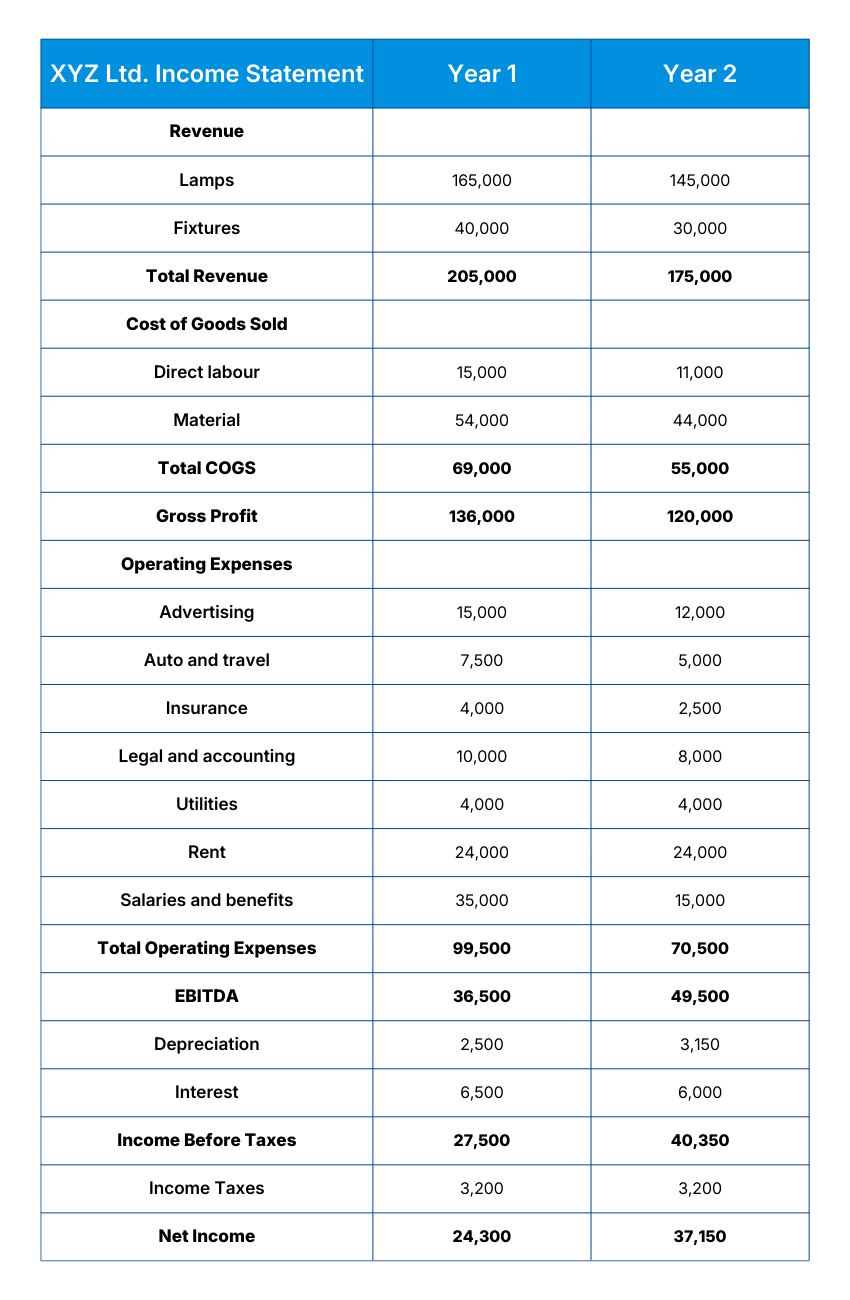
The table shows a simplified Income Statement for BrightLight Ltd. It compares financial performance across two years. It begins with revenue generated from product sales, followed by the COGS, which includes expenses, such as labour and materials used to produce the products. Subtracting COGS from revenue results in gross profit, indicating how much the company earns after covering production costs.
Then, the Income Statement lists operating expenses, including advertising, utilities, rent, and employee salaries. Afterwards, these costs are subtracted from gross profit to calculate Earnings Before Interest, Depreciation, Taxes and Amortisation (EBITDA), reflecting the company’s operational performance. After subtracting depreciation and interest, income before taxes is calculated. Deducting taxes gives the net income, which is the company’s final profit.
Uses of Income Statements
An Income Statement is an indispensable financial document used by different stakeholders to evaluate a company’s financial performance. It helps both internal and external users understand how effectively a business operates. Let's look at it insightfully below:
1) Investors
Investors utilise the Income Statement to assess a company’s financial performance and profitability. Analysing income and expense details helps them understand how the business generates profit and compare its performance with other companies in the same industry. This helps investors make better decisions regarding where to invest their money.
2) Management
Management teams use the Income Statement to assess how the company’s core business activities are performing. It helps them understand whether revenue mainly comes from primary operations or from secondary sources. Based on these insights, management can make strategic decisions like expanding into new markets, increasing production capacity, or reallocating resources.
3) Creditors
Creditors analyse the Income Statement to evaluate a company’s financial stability and repayment ability. Reviewing trends in revenue, costs, and profits over different periods helps them to assess whether the business is improving its financial performance. This information helps lenders decide if the company can meet its future financial obligations.
Income Statement vs Balance Sheet
The balance sheet and Income Statement are vital financial statements, but they are different from each other. Let’s look at the table below to understand their differences:
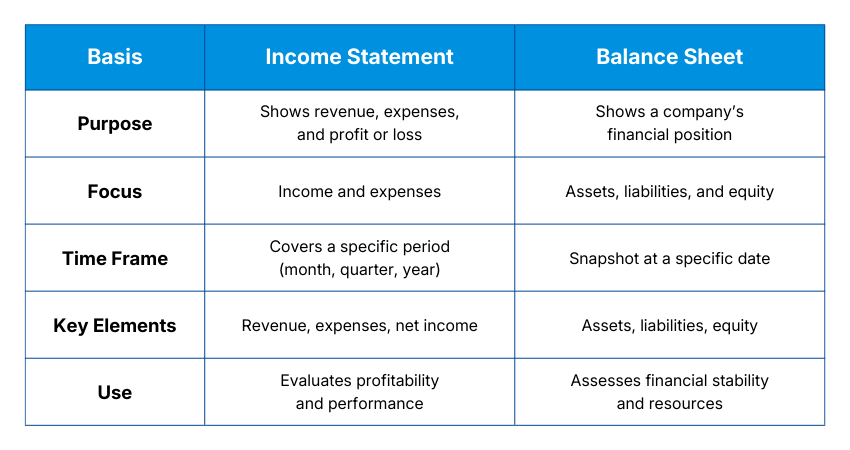
The Income Statement focuses on a company’s financial performance over a period by showing revenues, expenses, and net profit or loss. It helps businesses and stakeholders understand how effectively the organisation generates income and manages costs.
On the other hand, the balance sheet gives a snapshot of the company’s financial position at a particular moment. It lists assets, liabilities, and equity, helping stakeholders assess the company’s financial stability and the resources it owns or owes.
Conclusion
An Income Statement is a critical document required for evaluating a company’s financial performance and making informed decisions. It helps businesses and stakeholders gain valuable insights into operational efficiency and profitability. When used alongside other financial statements, it provides a clearer picture of financial health, helping organisations plan effectively, manage resources wisely, and support long-term business growth.
Build a strong accounting foundation with ACCA Applied Knowledge Training and start your finance career journey today!
Frequently Asked Questions
Q. What are the Four Components of the Income Statement?
The four components of the Income Statement include:
1) Revenue: Total income generated from sales or services.
2) Expenses: Costs to run the business.
3) Gains and Losses: Non-operating income or losses from other activities.
4) Net Income: Final profit or loss following all deducted expenses.
Q. Do Banks Have Income Statements?
Yes, banks have Income Statements that report their profitability to investors and regulators. A bank’s Income Statement mainly highlights net interest income, calculated from interest earned on loans minus interest paid on deposits, along with non-interest income, such as service fees.
Q. Where Can I Get an Income Statement?
You can find an Income Statement by generating it through accounting software such as QuickBooks or Xero. Also, it can be calculated manually by subtracting all expenses, including COGS and operating costs, from total revenue for a specific period to determine net income.