Have Any Question?
 +44 7452 122728




 Back
Back




Opportunity Cost: Definition, Importance, Formula and Examples
Opportunity Cost is the value of the next best alternative you give up when a choice is made, showing the benefits forgone in choosing one option over another. It encourages better use of limited resources such as time, money, and effort. It helps individuals and businesses understand the trade-offs involved in decision-making.
Table Of Contents


 44 7452 122728
 06-Mar-2026
Author-Hailey Davis
Have you ever wondered what you might be missing when you choose one option over another? Every decision we make involves selecting one option while leaving another behind. Whether it is a business or even a simple everyday choice, there is always an alternative that we give up. This trade-off is known as Opportunity Cost.
It helps everyone understand the value of the opportunities they do not choose. In this blog, we will explore what is Opportunity Cost, its importance, how it is calculated, and examples that show how it affects both business and everyday decisions. Let's get started!
What is Opportunity Cost?
Opportunity Cost refers to the value of the next best alternative that is sacrificed when a decision is made. In simple terms, it represents what you give up when choosing one option instead of another. It may involve lost profits, time, money, or other valuable resources.
The concept exists because resources are limited. Individuals and businesses cannot pursue every available option at the same time. As a result, they need to decide how to use their resources in the most effective way. When one option is selected, the benefits of the next best alternative become the Opportunity Cost.

Why is Opportunity Cost Important?
Opportunity Cost plays a significant role in decision-making because it highlights the true cost of choices beyond just financial expenses. Here are the importance of Opportunity Cost:
1) Better Decision-making: Opportunity Cost helps people compare alternatives and make informed decisions by understanding what they might lose when choosing one option.
2) Efficient Use of Resources: It encourages individuals and businesses to use limited resources like time, money, and labour efficiently.
3) Improved Financial Planning: Businesses use Opportunity Cost to compare investments and choose options that provide the highest possible return.
4) Strategic Business Decisions: Businesses analyse Opportunity Costs to decide between strategies such as expanding operations, launching products, or increasing marketing efforts.
5) Better Personal Choices: Individuals can make smarter decisions about spending, saving, and managing time by considering Opportunity Costs.
6) Clearer Understanding of Trade-offs: Every decision involves a trade-off. Opportunity Cost helps people recognise these trade-offs and understand the true value of the options they do not choose.
How to Calculate Opportunity Cost?
Opportunity Cost can be calculated by comparing the potential returns of two alternatives. The general formula used is:
Opportunity Cost = Return on the Best Alternative Not Chosen – Return on the Option Chosen
This formula helps quantify the value lost by not selecting the next best alternative. It allows decision-makers to evaluate which option provides greater value. For example, consider a company with two investment choices:
1) Investment A Expected Return: £20,000
2) Investment B Expected Return: £15,000
If the company chooses Investment B, the Opportunity Cost becomes:
Opportunity Cost = £20,000 – £15,000 = £5,000
This means the company sacrifices £5,000 in potential profit by choosing Investment B instead of Investment A. However, Opportunity Cost is not always measured in financial terms. It can also involve intangible factors such as time, satisfaction, or personal development.
Enhance your financial decision-making with the Financial Management (FM) Course – Register today!
Types of Opportunity Cost
Opportunity Cost can be categorised into two different types depending on the nature of the resources being sacrificed. Here are those two types:
Explicit Opportunity Cost
Explicit Opportunity Cost involves direct financial costs that can be measured in monetary terms. These costs usually appear in financial records such as budgets, invoices, or accounting statements. Businesses often consider explicit Opportunity Costs when deciding how to spend money because these costs directly affect profits and financial performance.
Example: If a company spends £10,000 on equipment instead of investing the same amount in stocks, the lost investment return represents an explicit Opportunity Cost.
Implicit Opportunity Cost
Implicit Opportunity Cost refers to non-monetary costs that arise when existing resources are used for a particular purpose instead of another. These costs are not directly recorded in financial statements, but they still represent valuable opportunities that are given up.
Example: If a business owner uses their own building for operations instead of renting it out, then the lost rental income becomes the Opportunity Cost.
Explicit vs Implicit Costs
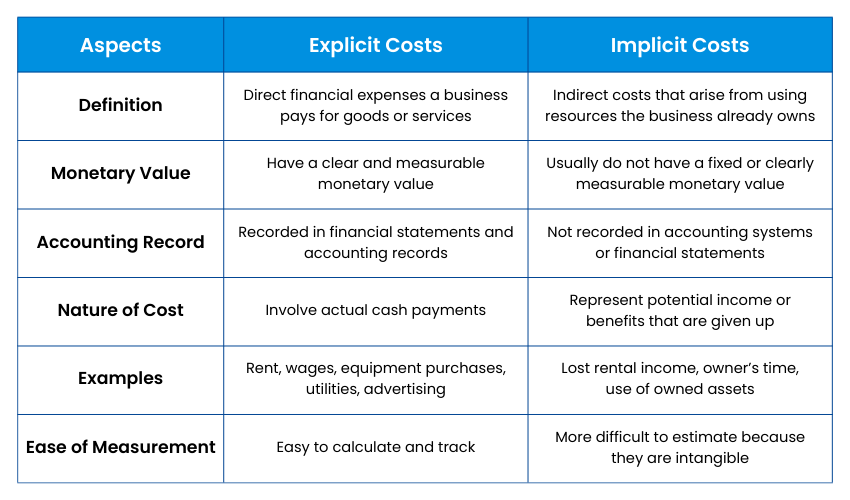
In Opportunity Cost, both explicit and implicit costs play important roles. Explicit costs are easy to measure because they involve direct financial transactions. Implicit costs, however, require estimation because they involve forgone opportunities rather than direct monetary payments. Businesses have to consider both types when analysing investment decisions.
Here is a detailed difference between explicit and implicit costs:
Examples of Opportunity Costs
Opportunity Cost appears in many real-world situations, from business strategy to personal decision-making. Examining practical examples can help illustrate how the concept works in practice. Here are the examples for both individual and business requirements:
For a Business
Let’s imagine a manufacturing company that has a budget of £100,000 and needs to choose between two investment options: expanding production capacity or investing in Research and Development (R&D) for a new product.
1) Revenue from Expanding Production Capacity: £140,000
2) Revenue from New Product Development: £160,000
If the company decides to expand production capacity, it will earn £140,000 in revenue. However, by not investing in the development of a new product, the company gives up the opportunity to earn £160,000. The opportunity cost in this case is the £160,000 return from the next best alternative, while the difference of £20,000 represents the additional profit the company could have earned by choosing the other option.
For an Individual
Opportunity Cost also plays a major role in everyday personal decisions. Let’s imagine a freelance Graphic Designer who has eight hours available in a day and needs to choose between two client projects. One project pays £300, while another, smaller project pays £200 for the same amount of time.
If the Designer chooses the project that pays £200, the Opportunity Cost becomes the £300 income from the better-paying project, while the additional £100 represents the extra earnings that were forgone. This example shows how individuals also face Opportunity Costs when deciding how to use their time, skills, or resources.
Enhance your ability to support strategic decisions with the Performance Management (PM) Course – Sign up soon!
Opportunity Cost vs Opportunity Benefit
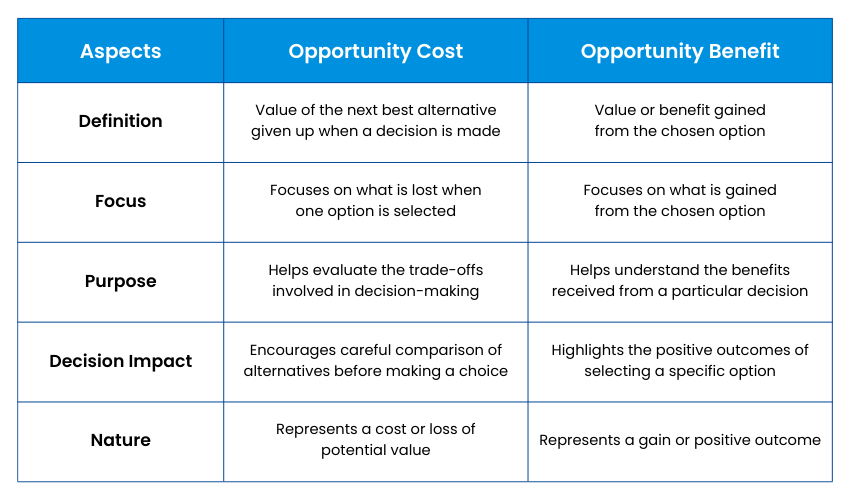
Opportunity Cost is closely related to the concept of opportunity benefit, but the two ideas focus on different aspects of decision-making. Opportunity Cost represents the value of what is given up when choosing a particular option. It emphasises the sacrifices or forgone alternatives associated with a decision.
Opportunity benefit, on the other hand, refers to the advantages gained from the chosen option. It represents the value or return obtained from the option that is selected. It highlights the positive outcomes that justify selecting one alternative over others. While Opportunity Cost focuses on what is sacrificed, opportunity benefit focuses on what is gained from the decision.
Conclusion
Opportunity Cost is a fundamental concept that helps individuals and businesses understand the true value of their decisions. Every choice involves a trade-off, and recognising what is given up when selecting another allows you to evaluate alternatives effectively. When used in the right way, it helps balance potential gains with the opportunities that are left behind.
Strengthen your financial and analytical skills with ACCA Applied Skills Training – Join now!
Frequently Asked Questions
Q. What is the Opportunity Cost in GCSE Business?
In the General Certificate of Secondary Education (GCSE), Opportunity Cost refers to the value of the next best alternative that is given up when a decision is made. It helps understand how businesses and individuals must choose between different options due to limited resources.
Q. Who Pays the Opportunity Cost?
The person or organisation making the decision incurs the Opportunity Cost. Whoever chooses one option over another bears the loss of the forgone alternative. It can be an individual, an Entrepreneur, a Manager, or an entire business.
Q. What do Opportunity Costs Include?
Opportunity Costs include both financial and non-financial sacrifices. These may involve lost profits, time, resources, convenience, personal satisfaction, or alternative uses of assets that could have been pursued if a different decision had been made.