Have Any Question?
 +44 7452 122728




 Back
Back




What is Value-Added Tax (VAT): Purpose and How to Calculate it
Value Added Tax (VAT) is a consumption tax added to goods and services at each stage of production and distribution, ultimately paid by the final consumer. It is calculated as a percentage of the product’s selling price. It is charged at different rates depending on the type of goods or services, as defined by government tax regulations.
Table Of Contents


 44 7452 122728
 08-Jan-2025
Author-Maria Thompson
Do you know how our everyday purchases help governments fund the public services that are so integral to our daily lives? This is all because of the Value Added Tax (VAT), a tax pouring its financial magic at every stage of the supply chain, from production to the checkout counter.
But What is VAT, and how does it work? In this blog, we will explore What is VAT Tax, how to calculate it, how it is applied at different stages, and why it plays such an important role in a country's economy. Let's dive in!
What is a Value Added Tax (VAT)?
Value-Added Tax (VAT) is a consumption tax, that's applied to the majority of goods and services across the United Kingdom (UK). It's levied at each supply chain stage, from production to the final consumer. Here are some important aspects of VAT:
1) Registered businesses must charge VAT on their supplies
2) They must pay it to His Majesty's Revenue & Customs (HMRC)
3) They can reclaim VAT on business expenses
As an indirect tax, VAT is paid by consumers in the product price, collected by businesses, and reported to HMRC. This ensures compliance with government regulations.
How Does VAT Work?
VAT is collected at every stage of a product's journey, that is, each time value is added, and a sale occurs. This process defines VAT as a Value-Added Tax, ultimately paid by the consumer. Here's how it works:
1) A supplier sells a cricket bat to a retailer for £150, including £25 VAT owed to HMRC
2) The retailer reclaims the £25 VAT, meaning they effectively don't pay VAT
3) The retailer sells the bat to a customer for £300, charging £50 VAT, which the customer pays in full
4) The retailer, after reclaiming the £25 VAT, pays £25 to HMRC
What is the Current VAT Rate in the UK
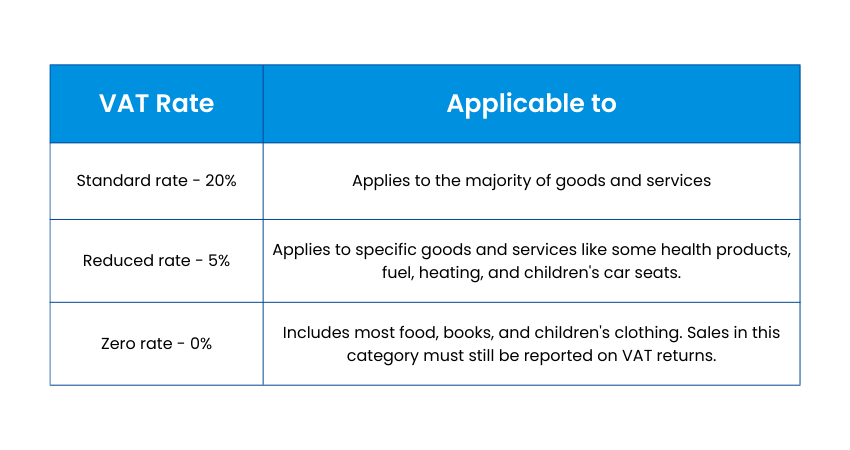
The following table summarises the VAT rates and applications in the UK:
How Much Money Does VAT Raise?
Taxes on consumer spending are the government's second-largest revenue source, with VAT contributing the most. In 2024-25, VAT is projected to generate £175.6 Billion (excluding refunds to certain public sector organisations). This accounts for 15.4% of total revenue, equivalent to £6,100 per household and 6.3% of the national income.
How to Calculate Value Added Tax?
Now that you know what is VAT Tax, let's check the ways to calculate VAT:
Total Price Including VAT - Standard Rate:
As mentioned above, the standard rate applies to most goods and services.
a) To calculate the total price at the standard VAT rate (20%), multiply the original price by 1.2.
b) To determine the reduced VAT rate (5%), multiply the original price by 1.05
Total Price Excluding VAT - Reduced Rate:
a) You can determine the total price, excluding the standard VAT rate (20%), by dividing the original price by 1.2.
b) To calculate the reduced VAT rate (5%), divide the original price by 1.05
Enhance your expertise in financial accounting and reporting with Financial Accounting and Reporting (FARI) Training – Register today!
Items Subject to VAT and Exempt From VAT
Not all goods and services are treated the same under Value Added Tax (VAT). While many everyday items are subject to VAT at standard or reduced rates, certain goods and services are either exempt or zero-rated depending on government policy. Let's check the items that are subject to VAT and exempt from it:
Items Subject to VAT
VAT is charged on the following taxable supplies:
1) Hiring or loaning goods to someone
2) Goods and services (service refers to anything other than supplying goods)
3) Commission
4) Selling business assets
5) Items sold to staff (for instance, canteen meals)
6) Business goods that are used for personal reasons
7) 'Non-sales' like part-exchange, bartering and gifts
Items Exempt From VAT
Some big examples of VAT-exempt goods and services are:
1) Investments, financial services and insurance
2) Parking spaces, garages and houseboat moorings
3) Education and training (excluding private schools)
4) Healthcare and medical treatment
5) Buildings, property and land
6) Burial or cremation services and funeral plans
7) Antiques and charity events
8) Gambling or lottery tickets
9) Sports activities
Value Added Tax on Imports
You must generally pay VAT on goods you import into the UK. The VAT may be added to the price when you pay customs. You can usually claim it back when submitting your VAT return. Here are some important points regarding import VAT:
1) VAT-registered businesses can use postponed VAT accounting to declare and reclaim import VAT on the same VAT Return.
2) Postponed VAT accounting allows businesses to reclaim import VAT as input tax, following normal rules.
3) Businesses can also opt to pay import VAT at the time of importation and reclaim it as input tax, subject to the same rules.
4) To claim input tax, the import VAT statement is required as evidence.
5) Shipping or forwarding agents typically cannot reclaim input tax since the goods are not part of their business use.
Value Added Tax on Exports
VAT is not charged if goods are exported from:
1) Northern Ireland to a place outside the UK and EU
2) Great Britain to a destination outside the UK
Here are some key points to remember including:
1) The sale can be zero-rated if you obtain and retain evidence of the export and meet all conditions.
2) You must ensure the goods are exported within the required timeframe
3) You should obtain evidence of export within three months of the time of sale
4) The timeframe can be extended for goods requiring processing before export (or for thoroughbred racehorses).
Gain a deep understanding of audit processes by joining our Audit and Assurance (AA) Course.
Who is Responsible for Collecting VAT?
Businesses play a crucial role in the VAT system, as they are responsible for collecting and remitting the tax to the relevant tax authorities. As an indirect tax, VAT is added to the prices of goods and services being sold to customers, who ultimately bear the cost, while businesses facilitate its payment.
How do You File and Pay VAT?
Filing and paying VAT involves several steps, which can vary depending on the country. Here's a general overview:
1) Register for VAT: First, ensure your business is registered for VAT. This typically involves providing information about your business, such as its name, location, and annual sales.
2) Maintain Accurate Records: Maintain detailed records of every sale and purchase, including the VAT charged and paid. This is crucial for accurate filing.
3) Calculate VAT: Determine the amount of VAT you owe by subtracting the VAT you paid on business-related purchases (input VAT) from the VAT you collected on sales (output VAT).
4) File VAT Returns: Submit your VAT return to the tax authorities, usually quarterly or monthly. This can often be done online through the tax authority's website.
5) Pay VAT: Pay the amount due to the tax authorities by the deadline. This can be done via direct debit, bank transfer, or other electronic payment methods.
Advantages of Value-Added Tax
Value-Added Tax (VAT) is widely adopted across the world because of the economic stability and administrative efficiency it offers. Let's check its advantages:
1) A VAT Closes Tax Loopholes
One of the key advantages of VAT is that it reduces opportunities for tax avoidance. Because tax is collected at every stage of production and distribution, businesses must account for the VAT they charge and the VAT they pay. This creates a built-in paper trail that makes underreporting more difficult and improves overall tax compliance.
2) VATs Provide Stronger Incentive to Earn
VAT is a consumption-based tax rather than a direct tax on income. This means individuals are not taxed more simply because they earn more. As a result, it may encourage productivity, saving, and investment, since tax is only paid when money is spent on goods and services.
3) May Provide a Stable Source of Revenue
Since VAT is for a broad range of goods and services, it generates a steady flow of revenue for governments. Consumer spending tends to remain relatively consistent even during economic slowdowns, which helps make VAT a dependable funding source for public services and national development.
4) Encourages Better Record Keeping
VAT requires businesses to maintain proper invoices and financial records to claim input tax credits. This encourages more organised accounting practices and greater transparency in business operations. Over time, it can help formalise the economy and improve overall financial discipline.
Disadvantages of Value-Added Tax
Although Value-Added Tax (VAT) offers several economic advantages, it has its own disadvantages. They are discussed below:
1) Cost of Doing Business May Rise
Businesses have to keep detailed records, calculate VAT correctly, and submit regular tax returns. This can take time and money, especially for small businesses. They may need Accountants or special software to manage VAT properly.
2) May Encourage Tax Evasion
Some businesses may try to avoid paying VAT by hiding sales or giving false information. In places where tax rules are not strictly checked, this can become a problem. This reduces the amount of money the government collects.
3) Conflicts Between State and Local Governments
In countries with different levels of government, there can be disagreements about how VAT should be charged or how the money should be shared. Different rules in different regions can also make things confusing for businesses.
4) May Lead to Higher Prices
Since VAT is applied to the price of goods and services, customers usually pay more. This can make everyday items more expensive, especially for people with lower incomes.
How to Get a VAT Refund?
You can get a VAT refund by following these steps:
1) Complete the Application Form: First, you must get a Tax Refund Application Form (called VAT 407) from the retailer. Additionally, you might be asked to show your passport for the purpose of checking your eligibility.
2) Customs Check: At customs, you must present the following:
a) VAT form(s)
b) Your passport
c) VAT invoice(s)
d) Tax-free goods
3) Approval and Refund: Once all the criteria are fulfilled, customs will approve your form and issue a signed document allowing you to receive the refund.
Conclusion
VAT is a crucial element of global economies that ensures governments can fund essential services. From production to purchase, it impacts businesses and consumers alike. Understanding What is VAT Tax keeps businesses on their toes, encourages them to stay compliant, and helps consumers appreciate its role in shaping the world of commerce.
Develop advanced expertise in Financial Management by joining our ACA Professional Level Course.
Frequently Asked Questions
Q. Is VAT the Same as GST?
The primary difference between GST and VAT is that VAT applies to the sale of goods, and GST applies to the supply of goods and services.
Q. Which Companies are Required to pay VAT?
VAT applies to companies involved in the production, distribution, and sale of goods and services. This includes manufacturers, wholesalers, retailers, and service providers.
Q. What is an Example of a VAT Code?
20.0 % S and 5.0 % R are examples of VAT codes for standard and reduced rates, respectively.
Q. How to Verify if a Company is VAT Registered?
To verify if a company is registered with VAT, you can do the following:
a) Use the European Commission’s VAT Information Exchange System (VIES)
b) Visit HMRC’s 'Check a VAT number' service
c) Call their VAT helpline