Have Any Question?
 +44 7452 122728




 Back
Back




Going Concern in Accounting: Importance, Pros, and Cons
Going Concern is the assumption that a company will continue its operations for the foreseeable future, without the intention or need to cease activities. It underpins financial reporting, ensuring that assets are not undervalued and liabilities are not overstated. Auditors assess this assumption during their reviews.
Table Of Contents


 44 7452 122728
 30-Jul-2025
Author-Maria Thompson
What if a business you relied on suddenly shut down without warning? That kind of uncertainty can be unsettling, especially in financial reporting. This is where the Going Concern concept plays a crucial role. It assumes that a company will continue operating into the foreseeable future, which supports accurate asset valuation and long-term planning.
In this blog, we'll explore the What is a Going Concern, its importance, key assumptions, advantages and drawbacks, and how auditors assess it. Understanding this Accounting Concept is key to making sense of a company's financial health. Let's get started!
What is the Going Concern Concept?
The Going Concern concept is a fundamental accounting principle that assumes a business will continue its operations for the foreseeable future. It indicates that the company does not intend or need to liquidate or significantly downsize its operations. As a result, financial statements assume assets will be used in operations, not sold off, providing a clearer view of the organisation's financial health.
This principle supports consistent reporting, long-term planning, and cost allocation. It also builds stakeholder trust. If there's significant doubt about the company's ability to continue, this must be clearly disclosed in the financial statements.

Importance of Going Concern
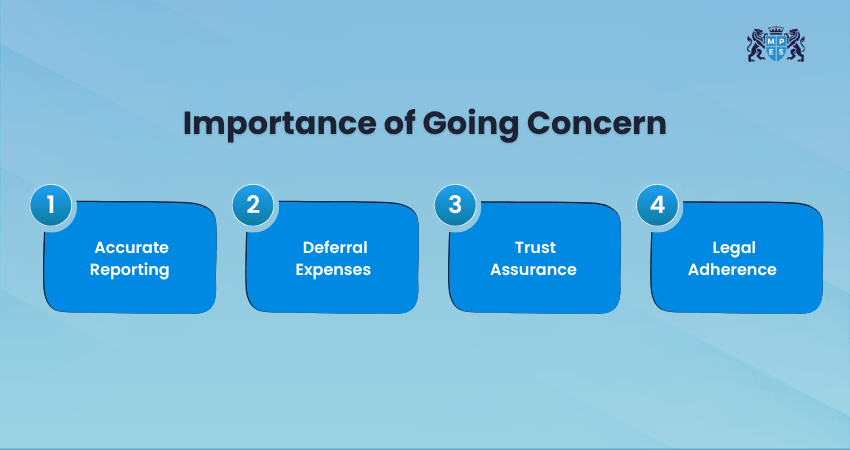
The Going Concern concept is essential to financial reporting, influencing how companies record assets, plan expenses, build stakeholder confidence, and meet regulatory standards. The following points highlight its key impacts:
1) Accurate Reporting
The Going Concern assumption allows companies to record assets based on continued use rather than immediate sale. It ensures consistent financial statements over reporting periods. This approach provides a stable basis for evaluating a company's operational performance and long-term financial position.
2) Deferral Expenses
Organisations can defer expenses such as depreciation and amortisation over several accounting periods. This approach aligns costs with the revenues they generate, improving accuracy in net income reporting and expense planning.
3) Trust Assurance
The use of the Going Concern principle signals operational stability. It supports stakeholder confidence by indicating that the company can meet its obligations. Lenders, investors, and partners rely on this status to assess financial risk and long-term viability.
4) Legal Adherence
Accounting frameworks like IFRS and GAAP require assessment and disclosure of Going Concern status. If material uncertainty exists, it must be transparently reported in the financial statements, ensuring legal compliance and accountability.
Assumptions of the Going Concern Concept
The Going Concern concept is based on the assumption that a company will continue operations for at least the next 12 months, unless evidence suggests otherwise. This assumption depends on several key conditions:
1) Ongoing Market Demand
There is an expectation that demand for the company's products or services will continue. This enables the business to maintain sales, attract new customers, and support steady growth.
2) Expected Profitability
Even if the business is currently unprofitable, it is assumed that future operations will generate profits. There is confidence that long-term profitability and growth are achievable.
3) Stable Legal Environment
The assumption also includes a stable legal and regulatory framework. It presumes no significant legislative changes will disrupt the company's ability to operate or affect its business model.
Master data-driven decisions with the
Management Information (MA1) Course
– Join now!
Advantages of Going Concern Concept
The Going Concern concept provides multiple advantages that ensure proper financial reporting, planning of operations, and stakeholder trust. The most notable benefits are:
1) Assets are recorded at their value in continued use, rather than liquidation value, resulting in more realistic and consistent balance sheets.
2) Expenses like depreciation and amortisation can be allocated over multiple periods, aligning costs with the revenues they help generate.
3) Consistent application enhances comparability across reporting periods, improving the reliability of financial analysis.
4) Management can make strategic decisions with the assumption of ongoing operations, enabling stable planning and resource allocation.
5) Stakeholders such as investors and lenders gain confidence in the organisation's financial stability, reducing perceived risk.
Disadvantages of Going Concern Concept
Despite its benefits, the Going Concern assumption also has limitations that may impact transparency and accuracy. The main disadvantages are:
1) It may delay recognition of financial distress, potentially leading to misleading financial statements during periods of instability.
2) Asset values may be overstated and liabilities understated, especially when the assumption is applied despite clear signs of financial trouble.
3) Future viability assessments rely on management judgment, which can be subjective or overly optimistic.
4) The assumption may obscure early warning signs of decline, reducing clarity for stakeholders.
5) Auditors face increased responsibility and complexity, with potential legal implications if the Going Concern status is misjudged.
Examples of Companies Considered as Going Concerns
Companies that are considered going concerns typically exhibit strong financial health, consistent revenue streams, and long-term strategic planning. These organisations show no signs of financial distress and are expected to continue operating into the foreseeable future. Here are some general characteristics and examples:
1) Large Multinational Corporations
Companies like global tech firms, consumer goods giants, and automotive manufacturers often qualify as going concerns due to their diversified operations, strong market presence, and stable cash flows.
2) Financially Stable Enterprises
Businesses with healthy balance sheets, low debt levels, and consistent profitability are typically assumed to be going concerns. Their ability to meet obligations and invest in future growth supports this assumption.
3) Publicly Traded Companies with Positive Outlooks
Firms listed on stock exchanges that regularly report profits, maintain investor confidence, and have clear growth strategies are generally treated as going concerns in financial reporting.
4) Government-backed or Regulated Entities
Utilities, public sector banks, and infrastructure companies often benefit from government support or regulation, which enhances their long-term viability.
What are Some Going Concern Red Flags?
While the Going Concern assumption is fundamental to financial reporting, there are certain warning signs that may indicate a company is at risk of not continuing its operations. These red flags help stakeholders assess whether the business can sustain itself in the foreseeable future.
1) Consistent Operating Losses
Repeated financial losses over several periods may indicate that the business model is unsustainable.
2) Negative Cash Flows
Inability to generate positive cash flow from core operations can signal liquidity problems.
3) Loan Defaults or Breach of Debt Covenants
Missing loan payments or violating terms of borrowing agreements raises concerns about financial health.
4) Overdue Liabilities
Delays in paying suppliers, employees, or taxes may reflect cash shortages.
5) Legal or Regulatory Challenges
Significant lawsuits, penalties, or compliance issues can threaten business continuity.
6) Loss of Major Customers or Contracts
Losing key revenue sources can severely impact future operations.
7) Inability to Raise Capital
Difficulty in obtaining funding or refinancing debt may limit the company's ability to sustain operations.
8) Plans to Liquidate or Restructure
Announcements of downsizing, asset sales, or restructuring may indicate uncertainty about future viability.
9) Auditor's Going Concern Warning
If an auditor expresses doubt about the company's ability to continue, it's a serious indicator of risk.
Unlock your financial expertise with the Maintaining Financial Records (FA2) Course – Register today!
How Auditors Identify the Going Concern Status of a Company?
Auditors follow a structured process to assess a company's ability to continue operating, focusing on financial statements and recent business trends.
1) Create Financial Statements
Auditors begin by reviewing the company's financial statements, including the balance sheet, income statement, and cash flow statement. These documents help determine whether the business has enough resources to cover liabilities and continue normal operations. If significant inconsistencies or signs of distress appear, further investigation is required.
2) Examine Recent Business Trends
Auditors also analyse recent trends in revenue, profitability, and cash flow. A consistent decline in any of these areas could suggest underlying issues. They look at industry performance, market position, and internal changes such as leadership turnover or restructuring to assess whether the business is on a stable path or facing growing risk.
Conclusion
By applying the Going Concern concept, organisations seize strategic planning opportunities and overcome short-term uncertainty. It helps achieve regulatory compliance, investor trust, and financial stability. To remain effective, companies must refine assumptions regularly, assess risks, and maintain transparency. Understanding this principle is vital for anyone involved in preparing or analysing financial statements.
Step into the world of accounting with our ACCA Foundations Training - Join now!
Frequently Asked Questions
Q. How Often Should a Business Assess its Going Concern Status?
A business should assess its Going Concern status whenever it prepares financial statements, usually every year and at interim reporting if needed. Each assessment should consider whether the business can continue operating for at least 12 months from the date the financial statements are authorised for issue.
Q. Who Assesses the Going Concern of a Business?
Management is primarily responsible for assessing whether a business can continue as a Going Concern for at least the next 12 months. Independent Auditors then review management's assessment and supporting evidence to determine whether it is reasonable and reflect their findings in the audit opinion.
Q. What is the Difference Between Going Concern and Liquidation?
A Going Concern assumes a business will continue operating for the foreseeable future and meet its financial obligations as they become due. In contrast, liquidation occurs when a business stops trading, sells its assets and uses the proceeds to repay creditors before closing its operations.