Have Any Question?
 +44 7452 122728




 Back
Back




Financial Accounting: Meaning, Principles, and How it Works
Financial Accounting is the systematic process of recording, summarising, and reporting a business’s financial transactions to show its financial position. It helps businesses to have a clear picture of their profit, cash flow, and finances. This is valuable in helping leaders, investors, and stakeholders make informed business decisions.
Table Of Contents


 44 7452 122728
 26-Dec-2024
Author-Maria Thompson
Imagine you're steering a thriving business, eager to decode the financial heartbeat of your operations. This is where Financial Accounting becomes your indispensable ally, transforming numbers into a compelling narrative of your company's financial health. But what makes this so vital? How do businesses ensure their financial statements are both accurate and insightful?
In this blog, we will explore what Financial Accounting is, its definition, principles, and operational mechanics. By the end of this blog, you'll learn its pivotal role in driving business success. So, let's dive in to navigate the financial landscape with confidence and clarity.
What is Financial Accounting?
Financial Accounting is a distinct branch of accounting. It involves recording, summarising, and reporting transactions arising from business operations over a period. These transactions are organised into financial statements, such as the balance sheet and income statement, which reflect a company's operational performance and financial position.
For example, a public company's income statement exemplifies Financial Accounting. The company must adhere to specific guidance on which transactions to record. Additionally, the format of the report is dictated by governing bodies. The result is a financial report that communicates the amount of revenue recognised in each period.

4 Basics of Financial Accounting
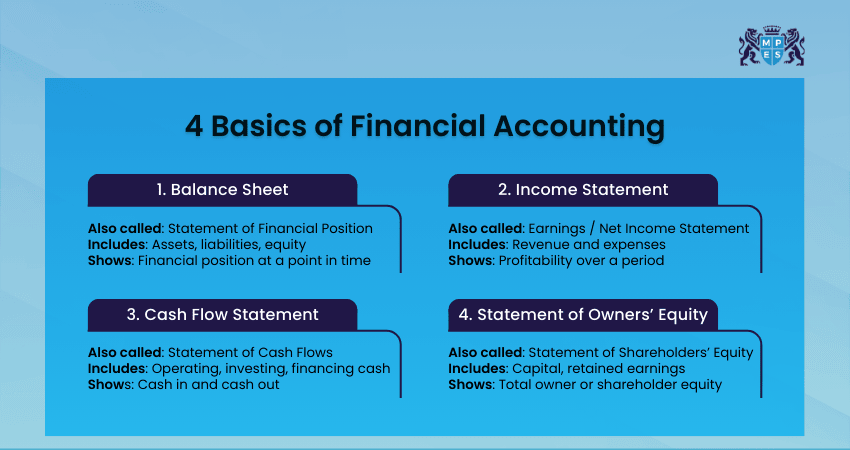
Let's discuss the four fundamentals of Financial Accounting:
1) Income Statement
An income statement shows the revenues, expenses, profits, and losses of a business over a period. These statements are prepared monthly, quarterly, or yearly. It helps management to review how much money the business earned, how much it spent, and the total net income.
2) Balance Sheet
A balance sheet outlines a company's assets,
Liabilities
, and equity. It gives a clear overview of the business's financial health at a single point in time. It is a crucial tool for assessing the liquidity (meeting short-term obligations) and solvency (meeting long-term obligations).
3) Cash Flow Statement
Cash flow statement refers to tracking the cash movement in and out of the business over a reporting period. It focuses only on real cash activity, excluding non-cash expenses, such as depreciation and amortisation. It helps to determine whether the business has enough capital to cover its short-term obligations.
4) Statement of Owner's Equity
The statement of owner's equity provides the value held by the shareholders or owners during a reporting period. It reflects profits earned, capital contributions, dividends paid, and withdrawals. It explains the reasons for increases or decreases in the owner's equity. It includes capital, retained earnings, and distributions paid to stakeholders.
How Financial Accounting Works?
Financial Accounting is a structured process that records business transactions and converts them into financial reports. It helps organisations track performance, understand financial position, and support decision-making. Below are the key steps that explain how Financial Accounting works.
1) Identifying Financial Transactions
The process begins by identifying business transactions such as sales, purchases, payments, salaries, and loan receipts. Only transactions that involve money or impact financial position are considered.
2) Recording Transactions
Each transaction is recorded using source documents like invoices, receipts, and bank statements. This ensures accuracy and creates a reliable financial record.
3) Classifying Financial Data
Transactions are then grouped into categories such as income, expenses, assets, and liabilities. This step helps organise data and improve clarity in financial reporting.
4) Summarising the Information
The classified data is totaled and reviewed to understand overall financial performance during a specific period.
5) Preparing Financial Statements
Finally, financial statements such as the income statement, balance sheet, and cash flow statement are prepared. These reports show business performance, financial position, and cash movement clearly. Make informed financial choices and drive business success - Register for the Foundations in Financial Management (FFM) Course now.
Types of Financial Accounting
Financial Accounting comprises two types. Each records business operations for different purposes. Let's look at them below:
1) Cash Accounting
Transactions are recorded when cash is received or paid. Here, revenue is recognised when money comes in, and expenses when money goes out. It is simple, but it does not show whether income was earned or costs were incurred earlier. It is suitable for small-sized businesses with fewer transactions.
2) Accrual Accounting
Transactions are recorded when they occur, even if cash is not received or paid yet. Here, revenue and expenses are matched to the period they belong to. This gives a clear view of the financial performance. It is suitable for large sized businesses with complex operations.
Principles of Financial Accounting
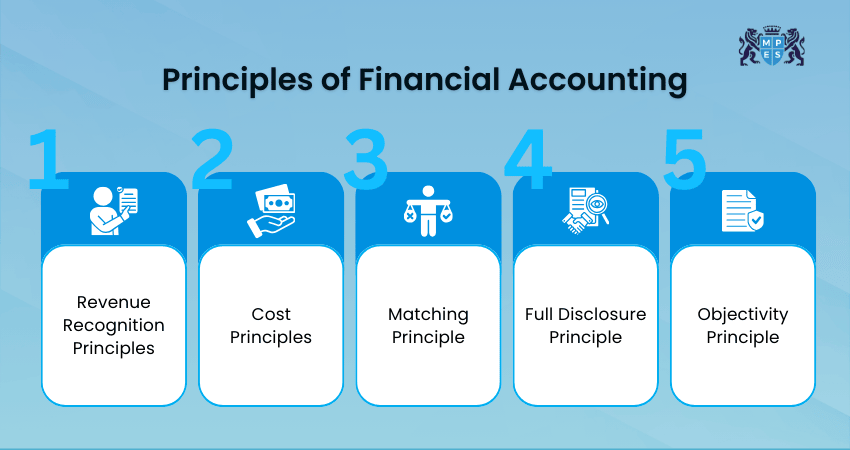
Financial Accounting is governed by five overarching principles that guide companies in preparing their financial statements. The type of accounting method should be established from the beginning, though it can be changed later with proper justification and adjustments.
These principles form the basis of all Financial Accounting technical guidance and relate to the accrual accounting process.
1) Revenue Recognition Principle
This principle asserts that revenue should be recognised once it is earned. It specifies the amount of revenue to be recorded, the timing of its reporting, and the conditions under which revenue should not be included in financial statements.
2) Cost Principle
This states the basis for recording costs. It dictates how much expenses must be recorded for (i.e., at transaction cost) and the proper recognition of expenses over time for appropriate situations (e.g., a depreciable asset is expensed over its useful life).
3) Matching Principle
This principle requires that revenue and the expenses related to earning that revenue be recorded in the same accounting period. It prevents companies from reporting income in one period and the associated costs in another. In essence, it governs when transactions should be recognised.
4) Full Disclosure Principle
Companies should provide complete, honest, and accurate information on their finances. All information relevant to their financial situation should be disclosed. To achieve this, financial statements should be prepared using Financial Accounting guidance that includes footnotes, schedules, or commentary that transparently report the financial position of a company.
5) Objectivity Principle
Accounting should be based solely on facts and objective evidence, free of bias and opinion. While Financial Accounting involves aspects of estimation and professional judgement, a set of financial statements must be factually and objectively prepared.
Examples of Financial Accounting
For a better understanding of how Financial Accounting works, let's look at the example through a fictional coffee shop, Beverly Beans Co.
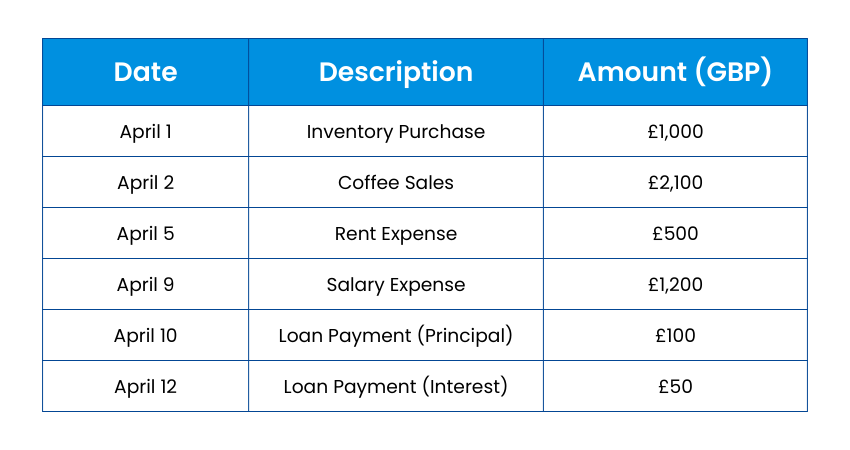
These entries record financial activity for the month. Here, you can find Financial Accounting principles at work, such as:
1) Cost Principle:
The inventory purchase of £1,000 on April 1 is recorded at its original cost. This represents the value of supplies used to generate revenue.
2) Revenue Recognition Principle:
The revenue of £2,100 from coffee sales is recognised in April, the month when the sale occurred.
3) Matching Principle:
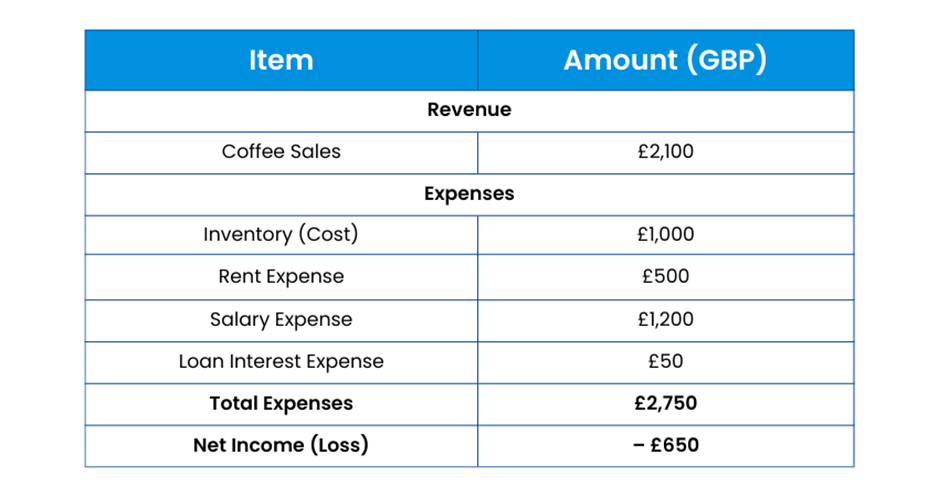
The expenses are matched to the month they relate to, even if payments will be made later. This includes rent (£500), salary (£1,200), and loan interest (£50). The loan principal repayment (£100) is not an expense and therefore does not appear in the income statement.
4) Income Statement:
Who Gains the Most from Financial Accounting?
Financial Accounting is a guiding compass for anyone who needs to transform raw data into meaningful insights to facilitate smart decisions. Below is the list of individuals and groups who gain the most out of it:
Investors
They commit their capital with the goal of earning returns. Financial Accounting helps them to evaluate a company's financial health by showing revenue, profits, debts, and cash flow. This enables investors to judge whether a business is stable, growing, or facing risks.
Creditors
Creditors, such as banks, lenders, and suppliers, need to know whether a business can repay what it owes. Financial Accounting provides them clarity over a company's liquidity, debt levels, and cash-generating ability.
Employees
Employees are dependent on their company's financial stability for receiving their wages, career growth, and security. Financial Accounting supports them by revealing whether the organisation is performing well to maintain its payroll, talent investment, and closing pay gaps.
Regulator
Regulators, such as tax authorities or government agencies, need Financial Accounting to enforce rules to maintain integrity in the market. Through accurate reports, it helps them to identify fraud, verify compliance, and protect public interests.
Management
Financial Accounting helps management to plan, budget, and make strategic business decisions. These reports help them to reveal which products are performing well, where costs are rising, and if the business is ready for growth. This helps to allocate resources effectively and maintain credibility with investors and partners.
Customers
Financial Accounting signals to customers whether a company is reliable and stable enough to deliver consistently. When entering long-term partnerships, customers look at financial statements to verify if the company can fulfil orders, maintain production, and manage business commitments.
Take the next step in your professional development with the Managing Costs and Finance (MA2) Course – Sign up now!
Financial Accounting vs Management Accounting
Both Financial Accounting and Management Accounting serve unique purposes within a business, each with its own set of principles and practices. Understanding the distinctions between these two types of accounting is crucial for effectively managing and reporting a company's financial health.
The key distinctions between Financial Accounting and Management Accounting are outlined below.
1) Purpose: Financial Accounting focuses on providing financial information to external stakeholders such as investors, creditors, and regulators. Management Accounting, on the other hand, supports internal decision-making by providing detailed financial and operational insights to management.
2) Reporting Standards: Financial Accounting must follow established standards such as Generally Accepted Accounting Principles (GAAP) or International Financial Reporting Standards (IFRS).Management Accounting is more flexible and does not need to follow external reporting standards, allowing organisations to design reports that suit their internal needs.
3) Time Frame: Financial Accounting reports on past financial performance over a specific period, such as quarterly or annually. Management Accounting is more future-oriented and focuses on budgets, forecasts, and projections to support strategic planning.
4) Detail and Scope: Financial Accounting provides a high-level overview of an organisation's overall financial performance through summarised financial statements. Management Accounting offers more detailed and customised information, often analysing data by department, product, or project to support better decision-making.
5) Legal Requirement: Financial Accounting is legally required for public companies and must often be audited for accuracy and transparency. Management Accounting is not legally required and is used internally to improve planning, control, and organisational performance.
Learn essential accounting and recording skills with Recording Financial Transactions (FA1) Course – Register today!
Conclusion
Financial Accounting is the backbone of an organisation's finances. It turns daily business activities into meaningful insights to guide smart business decisions, support long-term planning, and build trust. It ensures the business ecosystem runs seamlessly and responsibly. As companies navigate through the complex financial world, executing strong accounting practices remains significant.
Build a strong foundation in Accounting principles - Join our ACCA Foundations Course
Frequently Asked Questions
FaQ's not available