Have Any Question?
 +44 7452 122728




 Back
Back




Freelancing vs Full-Time Employment: Choosing the Right Career Path
Freelancing vs Full-Time is about choosing between freedom and stability. Freelancing offers flexibility and control, while Full-Time roles provide steady income and benefits. Choosing depends on work style, income needs, and goals. Consider your priorities carefully to choose the career path that best suits you.
Table Of Contents


 44 7452 122728
 25-Apr-2025
Author-Maria Thompson
Are you stuck between chasing freelance freedom or sticking with that steady 9-to-5? You're not alone. The choice between Freelancing vs Full-Time Employment is something almost every modern professional has wrestled with, especially when your coffee-fuelled brain starts wondering, "What if I worked on my own terms?" Or maybe on the flip side, you've thought, "What if I had a regular income without the constant hustle?" We get it.
Both paths sound tempting (and terrifying) in their own way. That's why we're breaking down the real talk behind Freelancing vs Full-Time Employment; no sugar-coating, just honest pros, cons, and everything in between to help you figure out what actually fits your life.
Freelancing vs Full-Time Employment: An Overview
The modern workforce is evolving, and so are career choices. Whether you're just starting out or thinking about a switch, understanding these two paths is key to making a confident decision.
What is Freelancing?
Freelancing involves working independently on a project or contract basis for one or more clients. Freelancers are essentially self-employed and often specialise in fields like writing, design, programming, consulting, and marketing. They have the freedom to choose their workload, clients, and work environment. Unlike traditional jobs, Freelancing offers no fixed salary or employer benefits, but it does provide greater control over how and when you work.
What is Full-Time Employment?
Full-Time Employment refers to a stable, long-term working relationship with an organisation. Employees typically work a set number of hours each week, receive a fixed monthly salary, and enjoy perks such as paid holidays, health insurance, and pension schemes. This traditional model offers job security, consistent income, and a clear career progression within a company structure.
Freelancing vs Full-Time Jobs
Let's compare Freelancing and Full-Time Employment based on factors that matter most to professionals.
1) Freelancing vs Full-Time: Flexibility and Job Security
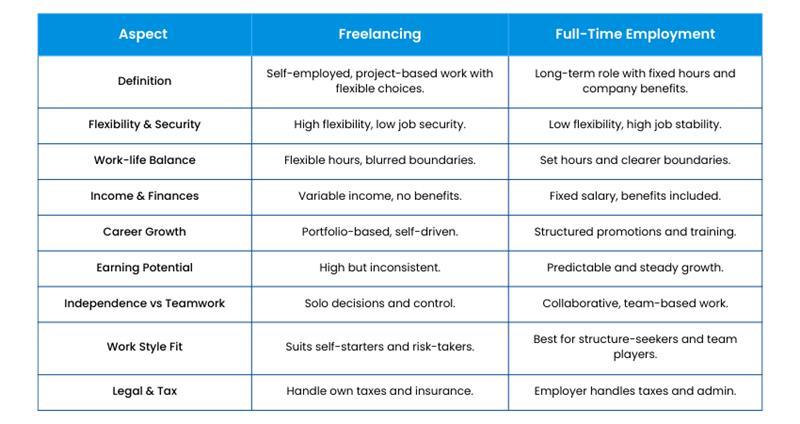
Freelancing scores high on flexibility. You decide your schedule, take breaks when needed, and work from anywhere. However, this freedom comes at a cost. There is no guaranteed job security. Projects can dry up, clients may delay payments, and you're constantly seeking your next gig.
Full-Time Employment, while less flexible, offers more stability. You know when and where you're working, and your paycheque arrives like clockwork. But the downside is that you have less control over your day and a limited say in the kind of work you do.
2) Freelancing vs Full-Time: Work-life Balance
Work-life balance can be easier to manage as a Freelancer if you're disciplined and guided by a strong Code of Ethics . You can avoid long commutes, work during your most productive hours, and even take a midweek day off. However, without boundaries, Freelancing can easily spill into personal time.
Full-Time roles often come with clearer lines between work and home life, though many face the challenge of burnout due to fixed schedules, long hours, or workplace stress. That said, some companies are adopting more flexible work policies, helping employees maintain balance.
3) Freelancing vs Full-Time: Income Stability and Financial Security
One of the biggest trade-offs is income stability. Freelancers may enjoy months of high earnings followed by periods of little to no work. Without employer-provided benefits like insurance or retirement contributions, financial planning becomes crucial.
Full-Time employees benefit from a predictable income, along with bonuses, sick leave, and other perks that help build long-term financial security.
4) Freelancing vs Full-Time: Opportunities for Career Growth
Freelancers grow by building a diverse portfolio, upskilling through real-world experience, and networking across industries. However, without a traditional promotion path or internal mentors, growth can feel like a solo journey.
In Full-Time roles, you often have access to structured training, mentorship programmes, and a clear hierarchy for advancement. This can be particularly appealing if you are someone who thrives on clear goals and external validation.
5) Freelancing vs Full-Time: Earning Potential
Earning potential in Freelancing is technically limitless. You can set your rates, work with multiple clients, and scale your income. However, this takes time and effort to Manage Business as a freelancer.
Full-Time Employment offers more modest and predictable income growth, usually tied to annual reviews or promotions. However, senior roles can still bring substantial salaries and bonuses.
Master the mindset of long-term success with our Attention Management Training - Register now!
6) Freelancing vs Full-Time: Independence vs Teamwork
Freelancing is ideal for those who enjoy working independently and making their own decisions. You're your own boss, managing clients, finances, and deadlines.
Full-Time Jobs foster teamwork and collaboration. You are part of a larger mission, working alongside colleagues, often with shared goals and support systems.
7) Freelancing vs Full-Time: Work Style and Personality
Your personality plays a big role in this decision. Are you self-motivated, adaptable, and comfortable with uncertainty? Freelancing might be your path. Prefer structure, stability, and social interaction? Full-Time work could be a better fit.
There's no one-size-fits-all answer; it's about what energises you and how you function best.
8) Freelancing vs Full-Time: Legal and Tax Considerations
Freelancers must manage their own taxes , register as self-employed or a business entity, and maintain accurate financial records. You may also need to invest in professional indemnity insurance.
Full-Time employees have taxes automatically deducted and are often supported by HR and payroll departments. Legal responsibilities are lower, but so is your autonomy over how your work is classified or used.
Transform ideas into outcomes with our
Motivation and Goal Setting Training
- Sign up now!
Advantages and Disadvantages of Freelancing
Freelancing suits those who value independence and variety. But it also demands resilience, resourcefulness, and a proactive mindset. Here are a few advantages and disadvantages of Freelancing:
Advantages:
1) Total control over your schedule and workload
2) Choose clients and projects that match your interests
3) Potential for higher earnings
4) Freedom to work remotely or while travelling
Disadvantages:
1) Unpredictable income and workload
2) No employer-provided benefits or paid leave
3) Requires constant marketing and self-promotion
4) You're responsible for everything, from invoicing to taxes
Advantages and Disadvantages of Full-Time Employment
Full-Time roles are ideal for those who seek stability, community, and long-term planning. They provide a safety net but may not satisfy entrepreneurial spirits. Here are a few advantages and disadvantages of Full-Time Employment:
Advantages:
1) Stable income and financial security
2) Access to employee benefits (insurance, pension, leave)
3) Clear career paths and mentorship
4) Predictable schedule and work environment
Disadvantages:
1) Limited flexibility and creative freedom
2) Risk of burnout from rigid routines or office politics
3) Income growth is often slow and structured
4) Less autonomy over tasks and work style
Conclusion
So, Freelancing vs Full-Time Employment: what's right for you? There's no universal answer. Your ideal career path depends on your values, lifestyle, financial goals, and personality. Some thrive in freedom, others in structure, and many find their sweet spot somewhere in between. Whichever path you take, make sure it aligns with your long-term goals and brings you a sense of fulfilment. The right career isn't just about earning a living; it's about crafting a life that feels meaningful and rewarding to you.
Where vision meets execution, enhance the art of planning with our Strategic Planning and Thinking Course - Join today!
Frequently Asked Questions
Q. How do Employers View Freelance Experience on a CV?
Many employers value Freelance experience because it demonstrates initiative, adaptability and practical skills. A well-presented freelance background can highlight industry expertise, project management, communication and problem-solving abilities, making professionals more competitive for a wide range of roles.
Q. Is it Better to Hire a Full-time Employee or a Freelancer?
The ideal choice depends on the specific needs of the business. Full-time employees are better suited to ongoing responsibilities, long-term projects, and team collaboration. Freelancers are often the better choice for short-term projects, specialised skills or when you need flexibility without the commitment of permanent employment.
Q. What Does the 3-month Rule Mean in Employment?
The 3-month rule generally refers to the initial period of employment, often linked to probation. During this time, employers assess an employee's performance, skills and suitability for the role, while employees evaluate whether the position and organisation meet their career expectations.